
Your taste in music shifts in predictable ways across your life, and knowing the pattern is the fastest way to find local underground shows you'll actually love. Research on over 250,000 listeners shows that preferences move through recognizable stages tied to psychological milestones, not random drift. The practical payoff: your nostalgia is a discovery tool, and the moments when your routine breaks are exactly when your ears open widest.
Three things to do this week:
- Pull up a playlist from when you were 16–22 and note which genres still hit hard.
- Block one 30-minute "discovery window" per week to browse local venue bills.
- Search your city on Hppn and preview three artists you've never heard of.
Table of Contents
- How does musical taste change across life stages?
- Why nostalgia and the reminiscence bump keep pulling you back
- What life events reliably push you toward new music?
- Why do recommendation algorithms fail older listeners, and how do you fix it?
- How to turn changing tastes into local show attendance
- How Hppn speeds up the discovery workflow
- Before you go: quick checklist for your first underground show
- Do music taste patterns look the same across cultures and demographics?
- Key Takeaways
- The thing nobody says about taste and live music
- Hppn puts your next local discovery one search away
- Useful sources and further reading
How does musical taste change across life stages?
Cambridge researchers mapped musical preferences across life stages using a five-dimension framework called the MUSIC model: Mellow, Unpretentious, Sophisticated, Intense, and Contemporary. The data came from a very large group of people over a decade, making it one of the largest studies of its kind. Each dimension rises or falls in a pattern that tracks closely with what psychologists call "life challenges."
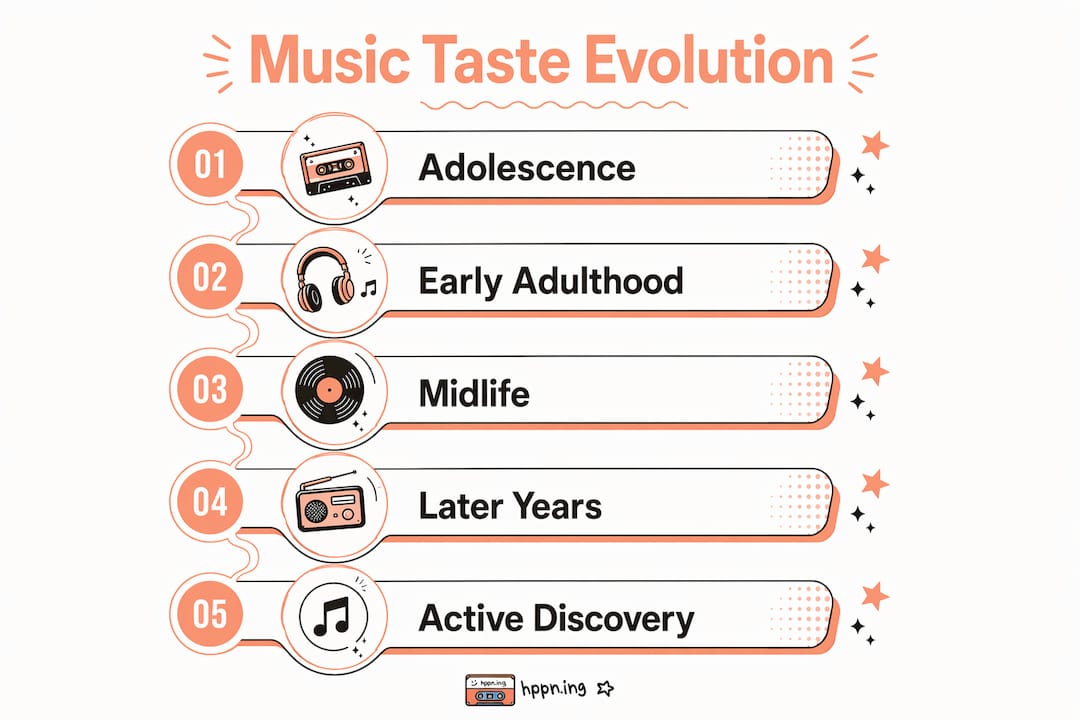
| Life stage | Dominant MUSIC dimensions | Psychological driver |
|---|---|---|
| Adolescence | Intense | Identity, rebellion, peer bonding |
| Early adulthood | Contemporary, Mellow | Social bonding, romance |
| Mid-adulthood | Sophisticated, Mellow | Career, status, emotional depth |
| Later adulthood (45+) | Unpretentious, Sophisticated | Relaxation, nostalgia, meaning |
Adolescents gravitate toward intense genres, heavy metal, punk, and aggressive hip-hop, because music is doing identity work. By early adulthood, the shift toward contemporary and mellow styles reflects a new priority: music as social glue at parties, on dates, in shared spaces. Middle age brings a tilt toward sophisticated and unpretentious styles, jazz, folk, classic rock, as listeners seek emotional depth and relaxation rather than stimulation.
Statistic callout: A longitudinal study of 40,000+ users and 542 million plays found that taste narrows and becomes more personally unique with age, while nostalgia drives repeated plays of tracks from the listener's formative years.
Why nostalgia and the reminiscence bump keep pulling you back
The reminiscence bump is the well-documented tendency for people to remember, and replay, music from their teens and early 20s more vividly than music from any other period. It's not just sentiment. Autobiographical memory is densest during those years because everything was new: first relationships, first independence, first real choices. Songs from that window get encoded alongside those memories and become retrieval cues for life itself.
Playcount data confirms that older listeners show both a narrowing of their active favorites and repeated spikes in plays for tracks from their formative era. The narrowing is real, but it doesn't mean curiosity dies. It means the bar for a new track to earn a permanent spot gets higher.
Here's the practical angle: nostalgia is a compass, not a cage. If you loved post-punk at 19, there are almost certainly local bands playing in that tradition right now in your city. A single nostalgic track can map directly to a living local scene. That's the move.
What life events reliably push you toward new music?
Routine disruption is the single most reliable trigger for musical exploration. A PNAS analysis of over 100 million streams found that when personal routines break, whether through travel, relocation, or lockdowns, listeners systematically seek out regional content they'd never encountered before. Crucially, those new exposures tend to stick.
Common triggers that reliably broaden musical taste:
- Travel or relocation: Exposure to regional scenes, local radio, and venue culture in a new city often permanently expands your listening graph.
- Relationship changes: Breakups and new relationships both introduce new sonic environments through shared playlists and partner tastes.
- Parenthood: Lullabies aside, many parents rediscover folk, acoustic, and world music through their kids' ears.
- Career shifts: A new commute, a new city, a new social circle, each one reshuffles the soundtrack.
- Cultural moments: Festivals, protests, and collective events expose listeners to scenes they'd never seek out alone.
Pro Tip: You don't need a cross-country move to trigger exploration. Change your listening hour, tune into a regional public radio stream from a city you've never visited, or follow a venue in a different neighborhood for 30 days. Small routine breaks produce real discovery.
Learning to discover niche genres locally is easier when you treat your own city as a destination worth exploring the same way you'd explore a new one.

Why do recommendation algorithms fail older listeners, and how do you fix it?
Most streaming recommendation systems are built around broad trend signals. They surface what's popular now, what's trending in your demographic, and what similar users clicked last week. That works reasonably well for younger listeners whose tastes are still wide and contemporary-leaning. For older or more niche-oriented listeners, it consistently misses.
Recommender-systems researcher Alan Said has documented that life-stage listening patterns shift in predictable ways and that recommendation engines often fail older users by over-emphasizing broad trends at the expense of the personalized, nostalgia-aware mixes those listeners actually want.
Practical fixes that actually move the needle:
- Build a seed playlist of 15–20 tracks from your 16–22 era and use it as a radio station base.
- "Like" or save tracks from local or regional artists specifically, not just mainstream acts.
- Follow venue pages and local promoter accounts rather than relying on algorithmic feeds.
- Use a platform built for finding emerging talent rather than one optimized for chart performance.
How to turn changing tastes into local show attendance
This is a six-step workflow you can run in under an hour and repeat monthly.
- Map your soundtrack era. Identify the 3–5 genres that defined ages 16–22 for you. Write them down.
- Build a seed playlist. Pull 15–20 tracks from that era. This is your discovery anchor.
- Find local artists in that tradition. Search by genre and city on Hppn or follow local venue social accounts. Preview before committing.
- Set a weekly discovery window. Thirty minutes on a Sunday evening. Browse bills, preview artists, add promising ones to a watchlist.
- Sign up for local newsletters. Most mid-size cities have at least one independent music blog or venue mailing list that surfaces underground bills weeks in advance.
- Preview before you buy. Watch a live video clip before purchasing any ticket. Live video previews cut the risk of a wasted evening dramatically.
Budget reality: Underground and local shows typically run $8–$20 at the door. Weekday gigs and community venue nights often come in at the lower end. A realistic monthly plan: one underground discovery night ($10–$15) plus one established local act at a mid-size venue ($20–$30). That's a full month of live music for under $50.
How Hppn speeds up the discovery workflow
Hppn is built specifically for the workflow above. Location-based search surfaces artists playing near you tonight or this weekend. Artist preview cards let you hear and watch a clip before deciding. Trending local lists show which underground acts are gaining traction in your city right now.
A sample user journey: you start with a nostalgic pull toward early-2000s indie rock. You search that era and genre on Hppn, find three local bands citing those influences, watch 90-second preview clips for each, add two to your watchlist, and buy a $12 ticket to the one playing Friday. That's the full loop from memory to live show in about 15 minutes.
Pro Tip: Use Hppn's location filter alongside a genre or era tag to narrow results fast. A watchlist of 5–8 artists gives you a ready queue so you're never starting from scratch on a Thursday night.
Platform features that map directly to the workflow:
- Artist previews via audio and video before any ticket commitment.
- Location-based discovery filtered by city, neighborhood, or radius.
- Trending local lists updated in real time to surface rising underground acts.
- Watchlists to track artists across multiple upcoming dates.
- Ticket access via referral links directly from the artist or event page.
Before you go: quick checklist for your first underground show
- Preview the artist online, at least one live clip, not just a studio recording.
- Check venue capacity. A 100-person room feels very different from a 500-person club.
- Confirm door price in advance; most underground shows are $8–$20 cash or card.
- Plan transit. Smaller venues often have limited or no parking.
- Check the venue's camera and recording policy before bringing gear.
- Expect a set of 30–45 minutes for an opener, 45–60 for a headliner at small venues.
- Arrive within 30 minutes of doors. Underground shows often start closer to on time than major gigs.
- Bring cash for merch. Most independent artists still prefer it.
For more on concert discovery best practices, including how to vet a venue before your first visit, Hppn's blog covers the full checklist.
Do music taste patterns look the same across cultures and demographics?
The broad life-stage arc, intense in adolescence, contemporary in early adulthood, sophisticated later, appears consistently across Western studies. But the specifics vary considerably by culture, geography, and demographic group.
In countries with strong regional music traditions, listeners often show a pronounced return to folk or traditional genres in middle age that has no direct equivalent in more homogenized markets. Gender differences are real but modest: research suggests women show slightly stronger preferences for mellow and contemporary styles across most life stages, while men show a longer persistence of intense preferences into adulthood. Neither pattern is universal.
One consistent exception to the narrowing-with-age finding: listeners who remain embedded in active local music scenes, attending shows regularly, volunteering at festivals, playing instruments, tend to maintain broader and more exploratory tastes well into their 40s and 50s. Scene participation appears to counteract the natural narrowing. How country music festivals evolved over decades illustrates this: festival communities sustain cross-generational discovery in ways that passive streaming rarely does.
Key Takeaways
Music taste shifts predictably by life stage, but active scene participation and deliberate routine disruption can keep your listening wide and your discovery sharp at any age.
| Point | Details |
|---|---|
| Life-stage arc is real | Preferences move from intense to sophisticated to unpretentious across adolescence, early adulthood, and middle age. |
| Nostalgia is a discovery tool | Tracks from ages 16–22 are your strongest compass for finding local artists in living traditions you already love. |
| Routine breaks open ears | Travel, relocation, and even small habit changes reliably trigger lasting exposure to new regional music. |
| Algorithms need manual correction | Seed playlists from your formative years and local venue follows produce better suggestions than passive streaming alone. |
| Hppn closes the loop | Use Hppn's location search, artist previews, and watchlists to move from a nostalgic track to a live ticket in one session. |
The thing nobody says about taste and live music
There's a version of this conversation that treats changing taste as something that happens to you, a slow drift you observe from the outside. That framing misses the most useful part. The research on routine disruption and regional exposure points to something more interesting: your taste is actively shaped by what you put yourself in front of. A single night at a small venue in a neighborhood you've never visited can permanently redirect your listening for years.
The platforms and algorithms built around chart performance will never surface that show. They're optimized for what you already know you like. The local underground scene operates on a completely different logic, one where the artist on stage is three years from being the act everyone claims they saw early. Getting there requires a little deliberate friction: a new neighborhood, a $12 ticket, a 45-minute set by someone whose name you can't yet pronounce.
That's the whole mission behind Hppn, and honestly, it's why taste evolution matters at all. Not as a curiosity about psychology, but as a reason to leave the house.
Hppn puts your next local discovery one search away
If you've spent time mapping your soundtrack era and building seed playlists, the next step is finding the show. Hppn lets you search by location, preview artists through live video and audio clips, and buy tickets without leaving the platform. No algorithm pushing this week's chart. Just local and underground acts, sorted by what's happening near you.
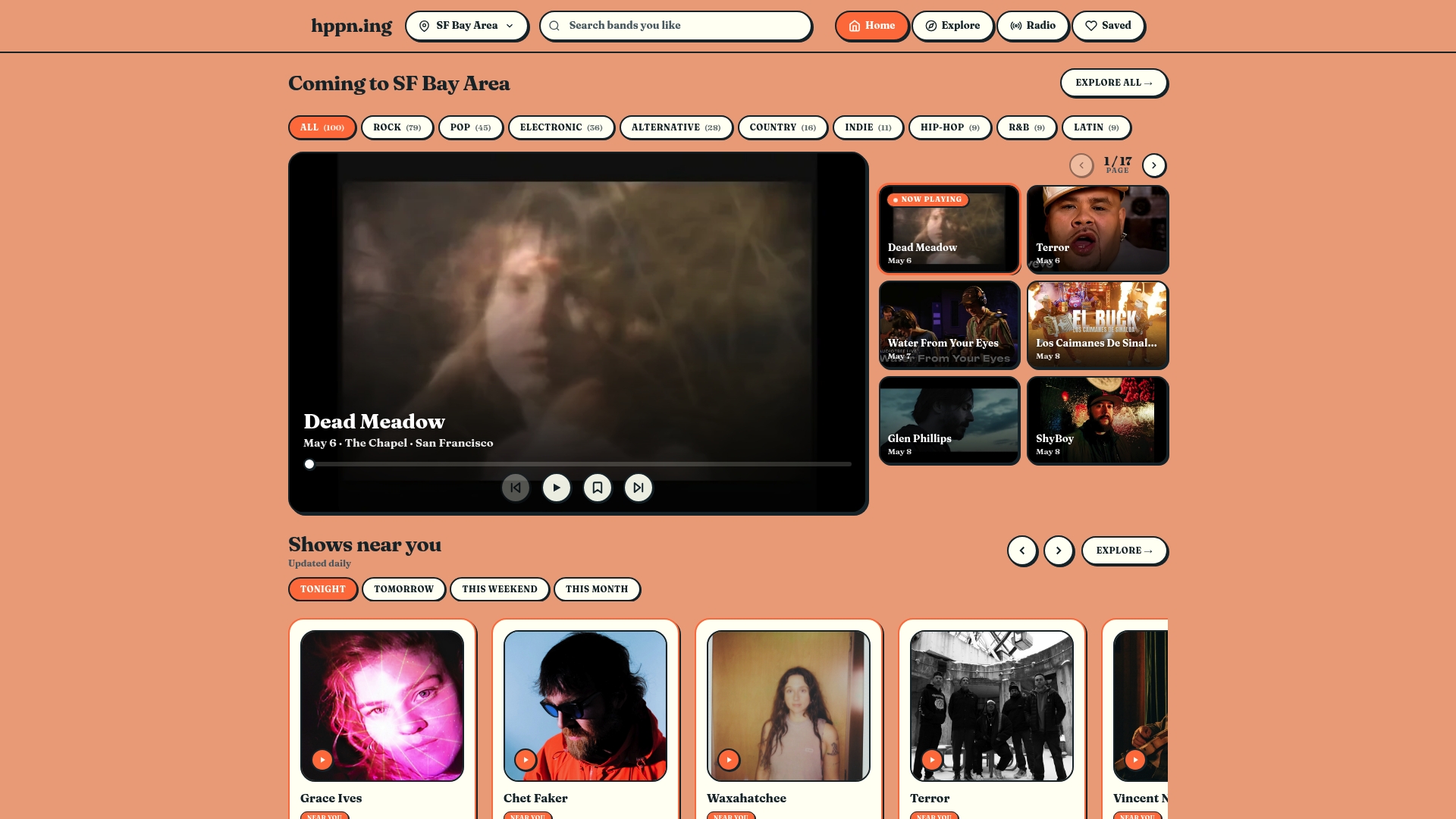
Browse artists, build your watchlist, and find a show worth attending this weekend at hppn.ing/listen. The preview feature alone is worth the visit: 90 seconds of a live clip tells you more than any playlist recommendation ever could.
Useful sources and further reading
- Cambridge University: Musical Ages of Modern Man — The original press summary of the MUSIC model study covering 250,000+ listeners across a decade. Start here for the life-stage framework.
- ScienceDaily: Musical Ages — Accessible summary of the Cambridge peer-reviewed findings on how taste shifts correspond to psychological life challenges.
- PNAS: Disrupted Routines and Musical Exploration — Peer-reviewed analysis of 100 million+ streams showing how routine disruptions drive lasting regional music discovery.
- University of Gothenburg: Fewer Favorite Songs With Age — 15-year Last.fm study (40,000+ users, 542 million plays) on taste narrowing and nostalgia effects in older listeners.
- Phys.org: Reminiscence Bump Study — Playcount research confirming the reminiscence bump and narrowing favorite-song sets as listeners age.
- Alan Said: Soundtracks Preprint — Recommender-systems research documenting life-stage listening shifts and the failure of trend-based algorithms for older users.
- Hppn: How Music Fans Find Emerging Talent — Platform guide covering algorithm gaps and practical tactics for discovering emerging local artists.
- Hppn: How to Discover Niche Music Genres Locally — Step-by-step guide to sourcing regional and niche scenes in your own city.
- Hppn: Why Local Music Scenes Matter — Background on the social value of local scenes and why platform discovery supports community music culture.