
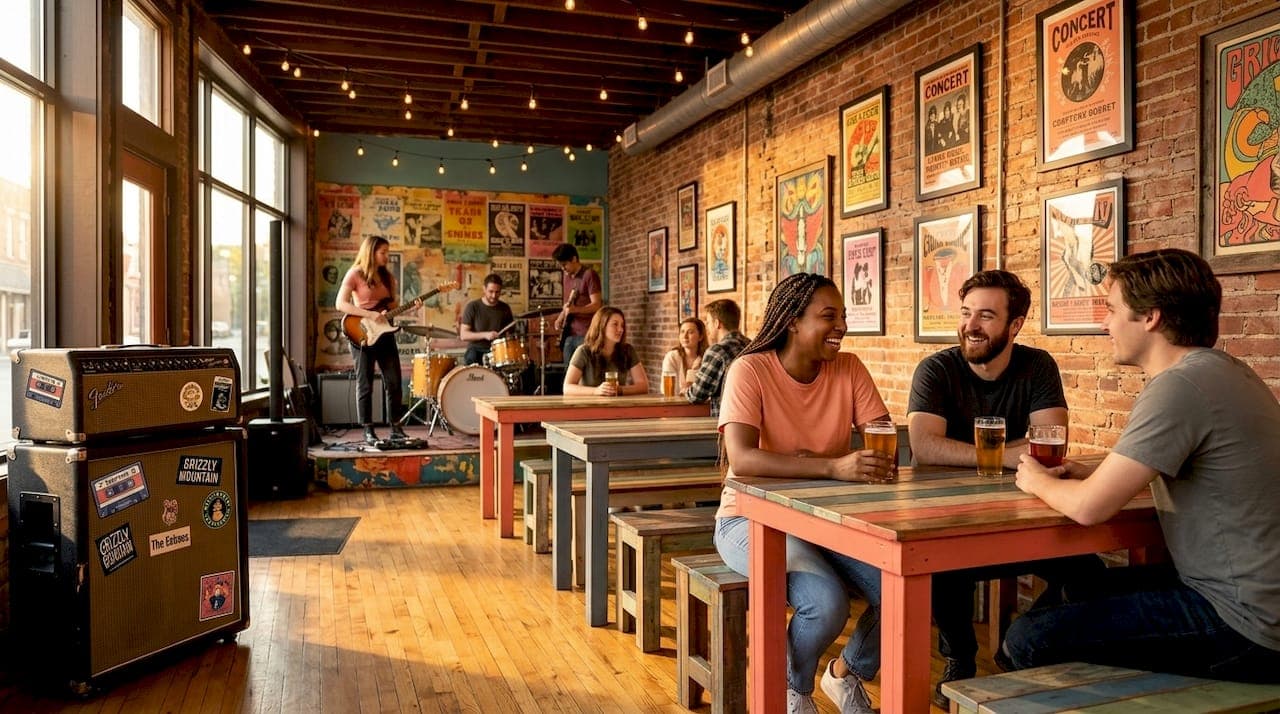
Most people think of local music as background noise at a bar on a Friday night. But consider this: independent live music venues in Chicago alone generate $2.8 billion in annual economic output and support nearly 17,000 jobs. That is not entertainment. That is infrastructure. Understanding why local music scenes matter changes how you see the corner venue, the weekend showcase, and the artists playing to 40 people who actually showed up.
Table of Contents
- Key takeaways
- Why local music scenes matter more than you think
- The real economic weight of local music
- How local scenes develop emerging artists
- Local scenes, social cohesion, and cultural identity
- Practical ways to support your local music scene
- My honest take: what we lose when these scenes disappear
- Discover your local scene with Hppn
- FAQ
Key takeaways
| Point | Details |
|---|---|
| Local scenes are economic engines | Independent venues create jobs, tax revenue, and tourism spending that ripple through entire neighborhoods. |
| Artist development happens locally | Emerging musicians rely on local stages, shared networks, and cooperative communities to build real careers. |
| Social cohesion grows from music | Local scenes act as third spaces where diverse groups connect, share identity, and build community resilience. |
| Authenticity drives audience loyalty | The "glocal" trend shows audiences are turning away from mass-produced music and toward locally rooted artists. |
| Everyone can actively support scenes | Attending shows, using discovery platforms, and advocating for venues are all concrete ways to keep local culture alive. |
Why local music scenes matter more than you think
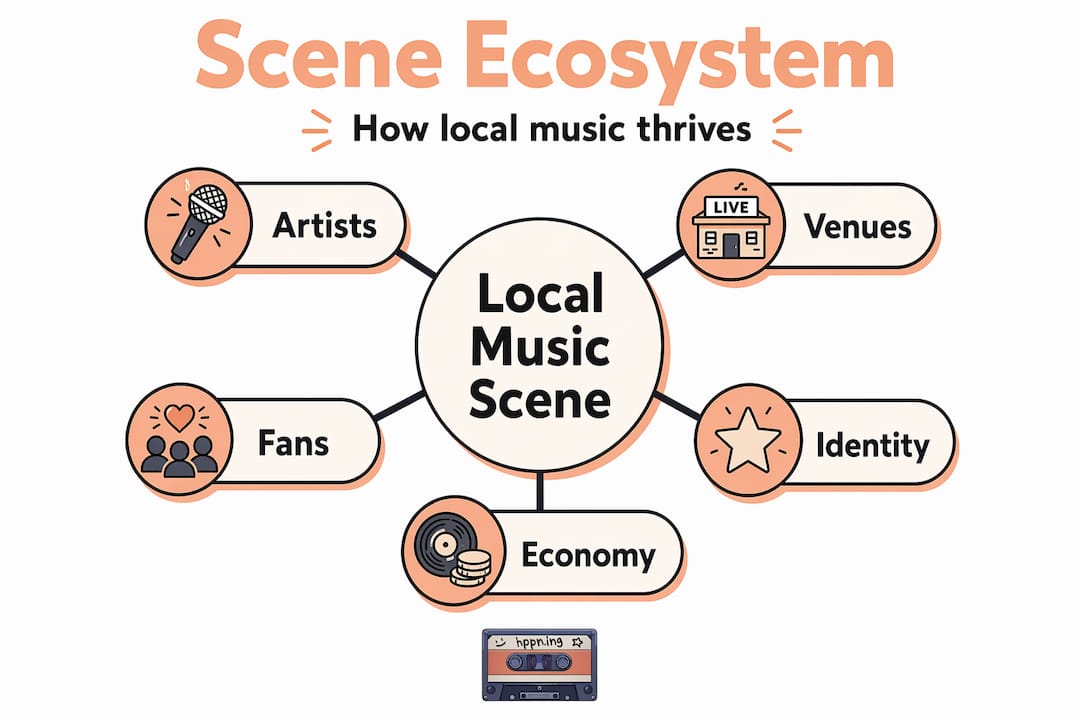
A local music scene is not just a collection of bands and bars. It is a living ecosystem made up of artists, independent venues, dedicated fans, event organizers, promoters, record shops, and rehearsal spaces. Every part supports the others. Remove one piece and the whole structure weakens. Understanding this helps explain how local music influences community identity in ways that go far beyond the music itself.
Local scenes serve as a platform for expressing the values, stories, and struggles that define a place. Think about the sound of New Orleans or the specific energy of the Seattle grunge movement before it went global. Neither of those things was manufactured from the top down. They grew from local communities, specific neighborhoods, and real people working with modest resources but enormous passion.
Here is what actually makes up a functioning local music scene:
- Artists and bands who commit to playing local shows consistently and building a real fanbase before chasing national attention
- Independent venues that take risks on unknown acts and give communities a physical gathering place
- Dedicated fans who shape local live music by showing up, spending money, and spreading the word
- Community organizations including booking agencies, zines, and local media that amplify what is happening
- Informal networks of musicians who share gear, knowledge, rehearsal space, and encouragement
Each of these elements reinforces the others. When they align, a scene develops its own identity, one that reflects the specific culture and character of its city or neighborhood.
The real economic weight of local music
The numbers here are genuinely striking. Beyond Chicago's $2.8 billion output, the data reveals that every $100 ticket purchased by an out-of-town attendee generates roughly $335 in additional local spending. That money flows into hotels, restaurants, transportation, and retail. A single independent venue functioning consistently can anchor an entire block of neighborhood businesses.
But here is the tension that makes this story complicated. Despite this economic power, only 22% of Chicago's independent music venues were profitable in 2024. High rent, staffing costs, licensing fees, and thin ticket margins push most venues to the edge of survival. Meanwhile, grassroots venues face over a 100% increase in business tax liability in some markets, threatening closures that would be irreversible.
| Economic Benefit | Operational Challenge |
|---|---|
| $2.8B annual output (Chicago alone) | Only 22% of venues profitable in 2024 |
| ~17,000 jobs supported | Rising business tax liability over 100% |
| $184.9M in tax revenue generated | High rent and licensing costs |
| $335 in local spending per $100 out-of-town ticket | Thin margins on ticket sales |
| Tourism and neighborhood business support | Staff shortages and post-pandemic debt |
"Independent venues are the heartbeat of a city, building local culture and identity before city policies even reflect them." — Chicago Independent Venue Insights
This framing matters. Venues are not just spaces where music happens. They are, as this research makes clear, cultural infrastructure that shapes neighborhoods before policymakers even notice the change is occurring.
Pro Tip: If you care about keeping local venues alive, spend money on-site when you attend shows. Buying a drink, a T-shirt, or a vinyl record directly at the venue puts money where it has the greatest impact on survival.
How local scenes develop emerging artists
Most successful musicians did not start on festival stages. They started in someone's basement, a 60-person club, or a community arts space where failure was survivable and experimentation was expected. The importance of local music to artist development is almost impossible to overstate, because local scenes provide exactly the kind of low-stakes, high-feedback environment that allows genuine creative growth.

The most effective local scenes do not happen by accident. According to research on sustainable scene building, successful local scenes operate as cooperative systems where artists share email lists, coordinate scheduling to avoid competing with each other, and rotate support slots so newer acts get exposure alongside more established ones. That kind of intentional cooperation turns a collection of isolated musicians into a real community.
Here is a practical framework for what that looks like in action:
- Coordinate show schedules across multiple venues so artists are not competing for the same audience on the same night
- Build shared marketing channels like combined email lists, social media cross-promotion, and joint event calendars
- Create mentorship pipelines where experienced local acts actively bring up newer artists through support slots and co-bills
- Establish cooperative spaces including rehearsal rooms, recording studios, and gear libraries that lower barriers to entry
- Document and celebrate the scene through local media, video content, and community archives that preserve its history
There is also a larger cultural trend working in local scenes' favor. As audiences seek authenticity amid the overwhelming volume of global digital content, locally rooted music is gaining a distinct appeal. This "glocal" shift rewards artists who connect their sound to a specific place and community rather than chasing a generic global aesthetic.
Pro Tip: If you are an emerging artist, treat your local scene as your first label, your first PR firm, and your first fanbase all at once. The relationships you build locally will outlast any algorithm.
Local scenes, social cohesion, and cultural identity
The social function of a local music scene goes deeper than entertainment. These spaces operate as third places, the term sociologists use for environments outside home and work where genuine community connection happens. Public spaces and live music create environments where people from different backgrounds share an experience, build trust, and form bonds that would not develop anywhere else.
Consider what is happening with the Atlanta DIY scene, where musicians are using shows and community events to respond directly to urban gentrification and political repression. This scene is not just making music. It is practicing community care, building mutual support networks, and creating spaces where activists, artists, and neighbors can organize. That is local music culture significance in its most powerful form.
The benefits of this kind of scene extend across the whole community:
- Cross-cultural connection where people who would not otherwise interact share a physical and emotional space
- Shared narrative and memory built through years of attending shows at the same venues and seeing the same artists grow
- Safe spaces for marginalized voices where artists from underrepresented communities can speak without filters
- Collective resilience that sustains communities through economic downturns, social upheaval, and cultural erasure
- Political and social agency when scenes become platforms for community-centered advocacy and resistance
"Supporting local music builds resilient communities and preserves cultural identity and sovereignty. Intentional support amplifies the unique creative voice enabling global competition." — FACTOR's Meg Symsyk
This point about sovereignty is worth sitting with. When a local music scene disappears, it is not just a loss of entertainment options. It is a loss of a community's ability to tell its own story. Local music culture significance lies in its role as a mirror that reflects who a community actually is, not who outside forces say it should be.
Practical ways to support your local music scene
Caring about local music scenes is only meaningful if it translates into real action. The good news is that support does not require money or expertise. It requires presence, intention, and consistency.
- Show up to local concerts, especially small ones. A 30-person crowd at an independent venue is the difference between an artist getting booked again and never being called back.
- Spend money at venues directly, including on food, drinks, and merchandise rather than only on tickets purchased online in advance.
- Follow and share local artists on social media, add them to your playlists, and tell people in your network about them.
- Use discovery platforms to find local music hotspots and connect with shows you might otherwise never hear about.
- Join or start local music advocacy groups that push back against venue-threatening tax increases, zoning changes, and noise ordinances.
- Get involved in the scene directly by volunteering at shows, contributing to local music media, or helping with event promotion.
You can also take a more active role by helping bring live music to your area if your neighborhood lacks consistent programming. The barrier is lower than most people assume. A backyard show, a local open mic, or a pop-up performance in a public space can plant the seed of something that grows into a real scene over time.
My honest take: what we lose when these scenes disappear
I have watched local scenes in three different cities shrink over the past decade. Not disappear overnight, but fade. A venue closes here. A promoter gives up there. Artists start skipping local shows to chase streaming numbers instead. And then one day you realize the scene that once felt alive and electric is now just a memory people talk about over drinks.
What I have come to understand is that the loss is never just about the music. When a local scene dies, a community loses the one space where its identity was being actively written in real time. You cannot replace that with a playlist or a festival that rolls through town once a year. Those things are consumption. A local scene is creation.
What the statistics do not capture is the feeling of watching an artist play their first real show to 20 people who care, then watching that same artist pack the venue two years later because the whole community decided to invest in them. That arc is only possible in a local scene. It does not happen on a streaming platform. It does not happen at a stadium.
I also think we are dangerously close to a tipping point. The combination of rising venue costs, the dominance of algorithm-driven music discovery, and the general drift toward consuming music passively rather than experiencing it live has created real fragility in local music ecosystems. The scenes that survive will be the ones where people decide, intentionally and repeatedly, that showing up matters more than scrolling.
— Ari
Discover your local scene with Hppn
If this article has convinced you that local music deserves more of your attention, the next step is actually finding it.
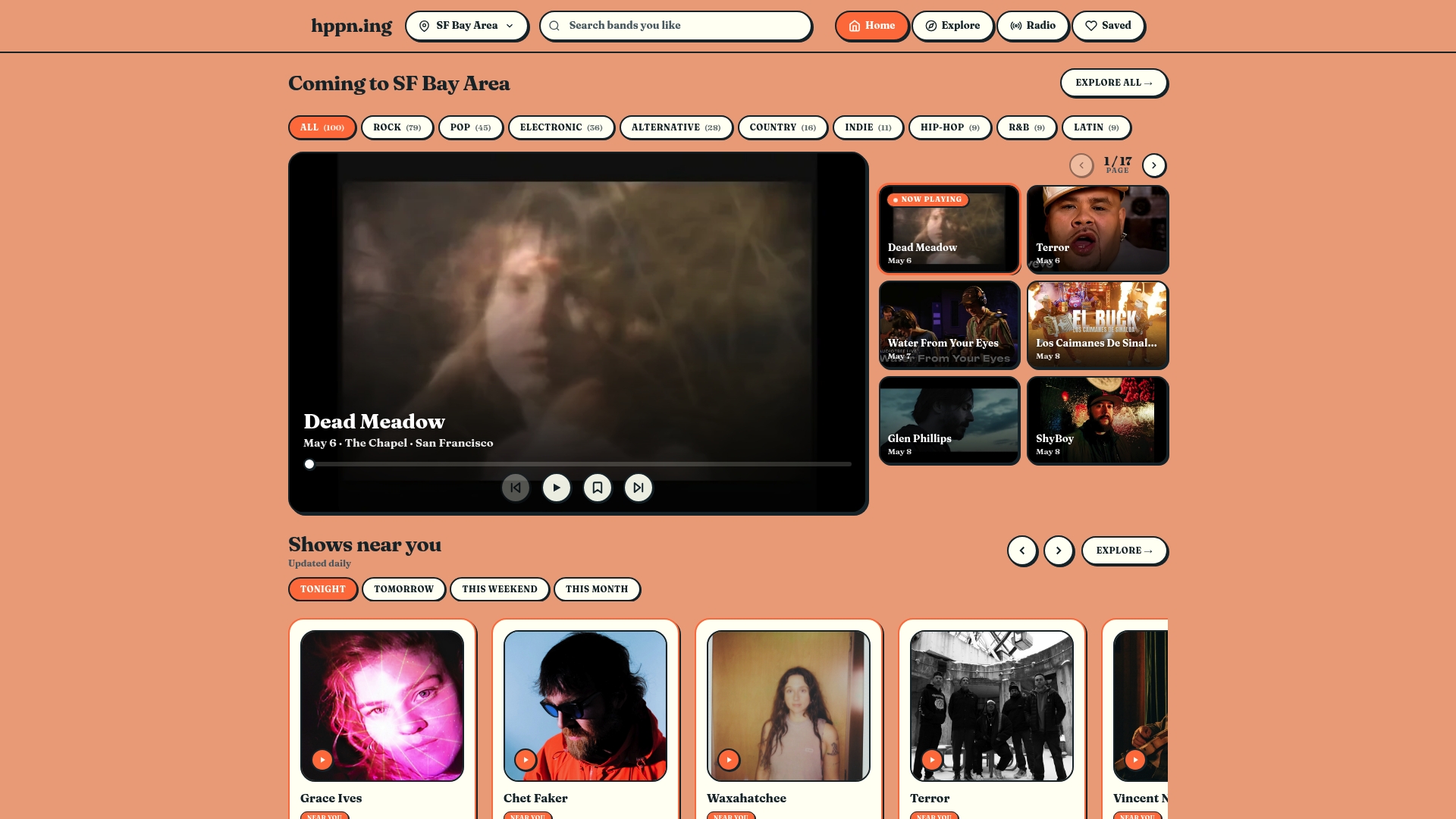
Hppn is built specifically for this. The platform lets you preview artists and find shows near you before you commit to going, so you can discover emerging local talent with confidence rather than guessing. You can browse trending local artists in your city, watch video and audio previews, and get to know a scene before you walk through the door. Hppn also features a community space where fans and artists discuss local scenes, share recommendations, and keep each other informed about what is happening nearby. Unlike platforms that push only mainstream acts, Hppn exists to surface the artists and venues that make your city worth living in.
FAQ
Why do local music scenes matter to communities?
Local music scenes create jobs, build community identity, and provide spaces for social bonding and cultural expression. They function as economic anchors and cultural infrastructure that neighborhoods rely on far beyond entertainment.
What is the economic impact of independent music venues?
Independent live music venues in Chicago alone generate $2.8 billion in annual economic output and support nearly 17,000 jobs, with out-of-town concert attendees generating roughly $335 in local spending for every $100 ticket purchased.
How do local music scenes help emerging artists?
Local scenes give emerging artists consistent performance opportunities, collaborative networks, and low-stakes environments to develop their craft. Cooperative structures like shared scheduling and rotating support slots accelerate career development in ways that streaming platforms cannot replicate.
What threatens the survival of local music venues today?
Rising operational costs, tax increases of over 100% in some markets, and thin profit margins are the primary threats. Only 22% of Chicago's independent venues were profitable in 2024, reflecting a widespread financial fragility in the sector.
How can I personally support my local music scene?
Attending local shows consistently, spending money directly at venues, sharing local artists with your network, and using discovery platforms to find emerging acts are the most direct ways to keep a local scene healthy and growing.