
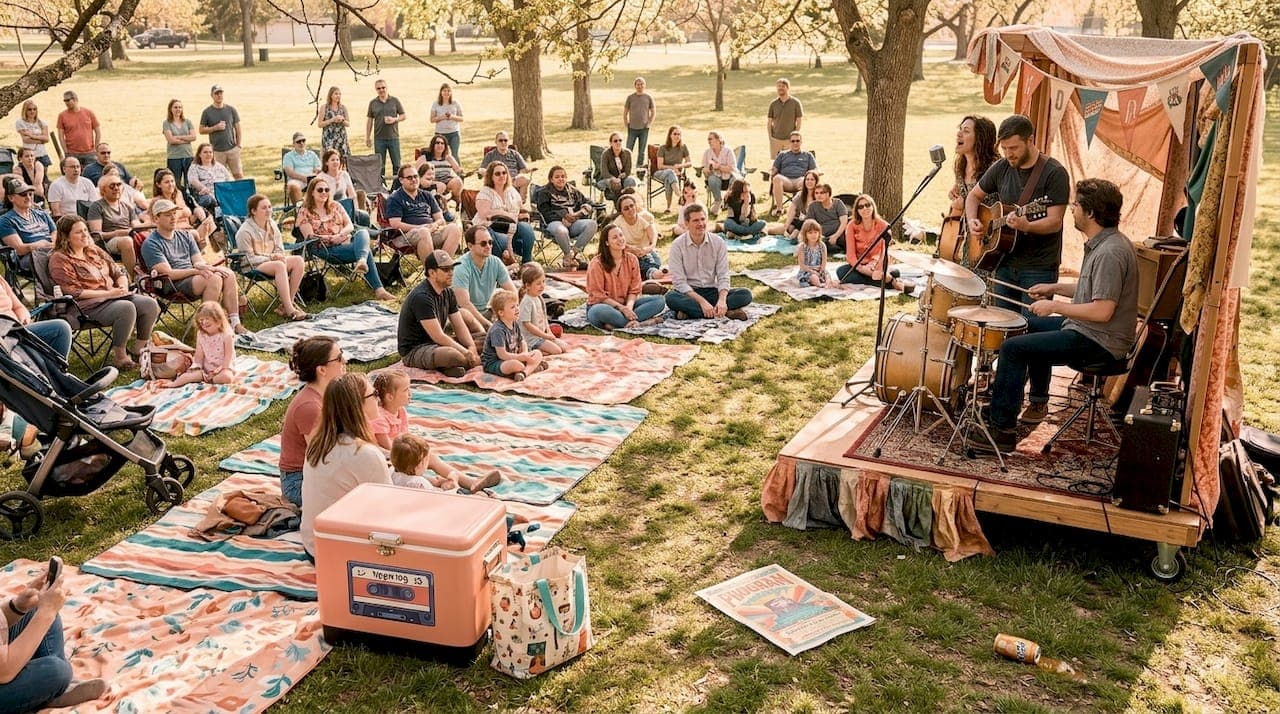
Most people think of a concert in a park as a nice freebie, a pleasant afternoon with no real stakes. That framing seriously undersells what's actually happening. The role of public spaces in live music is one of the most underappreciated forces in urban life, shaping how neighborhoods connect, how local economies pulse, and how communities hold together under pressure. What looks like a guitarist playing to a picnic crowd is actually social infrastructure in action. This article breaks down what that really means, and why you should care.
Table of Contents
- How public spaces catalyze community through live music
- Economic and cultural impact of free live music in public venues
- Why live music in public spaces feels uniquely powerful
- Public spaces as dynamic hubs for cultural resistance and urban identity
- How collaborative music-making builds belonging and placemaking
- Rethinking public spaces: Why supporting grassroots live music is vital to urban life
- Discover and support live music in your community today
- Frequently asked questions
Key Takeaways
| Point | Details |
|---|---|
| Public spaces foster community | They act as essential social infrastructure where live music promotes social ties and democratic engagement. |
| Economic benefits are significant | Free live music in public spaces stimulates local economies with high returns on investment. |
| Live music experience is unique | Physical attendance triggers stronger emotional and physiological reactions than streaming. |
| Music shapes urban culture | Public music venues serve as sites of cultural resistance and identity formation. |
| Active participation matters | Collaborative music-making builds belonging and strengthens place-based identities. |
How public spaces catalyze community through live music
Sociologist Eric Klinenberg introduced a concept that reframes how we think about cities. He argues that public spaces function as "social infrastructure," meaning the physical places around us, parks, libraries, community centers, actively shape how often and how deeply people interact. These aren't passive backdrops. They are the architecture of social life.
Live music is one of the most effective ways to activate that infrastructure. A silent plaza asks nothing of you. A plaza with a band playing asks you to stop, listen, look around, maybe talk to the stranger next to you. That shift matters more than it sounds.
"Social infrastructure is foundational to democracy. Physical spaces enable face-to-face dialogue that is vital against social media echo chambers." — Independent Commission on Neighbourhoods
This is the part that most entertainment coverage misses. Public music events don't just bring people together in the same location. They create the conditions for community bonds that hold when things get hard. Neighbors who've stood next to each other at a free summer concert are far more likely to check in on each other during a crisis.
Free and accessible public performances are especially powerful because they remove the economic and social barriers that keep people in separate bubbles:
- No ticket price means no demographic filter on who shows up
- Open outdoor settings reduce the social anxiety of "formal" venues
- Proximity to residential areas makes attendance spontaneous rather than planned
- Diverse lineups signal to different communities that the space belongs to all of them
Pro Tip: If you want to understand a neighborhood's real social fabric, attend one of its free outdoor concerts. The crowd tells you everything ticket-gated shows cannot.
Economic and cultural impact of free live music in public venues
The social case for public live music is compelling. The economic case is even harder to ignore.
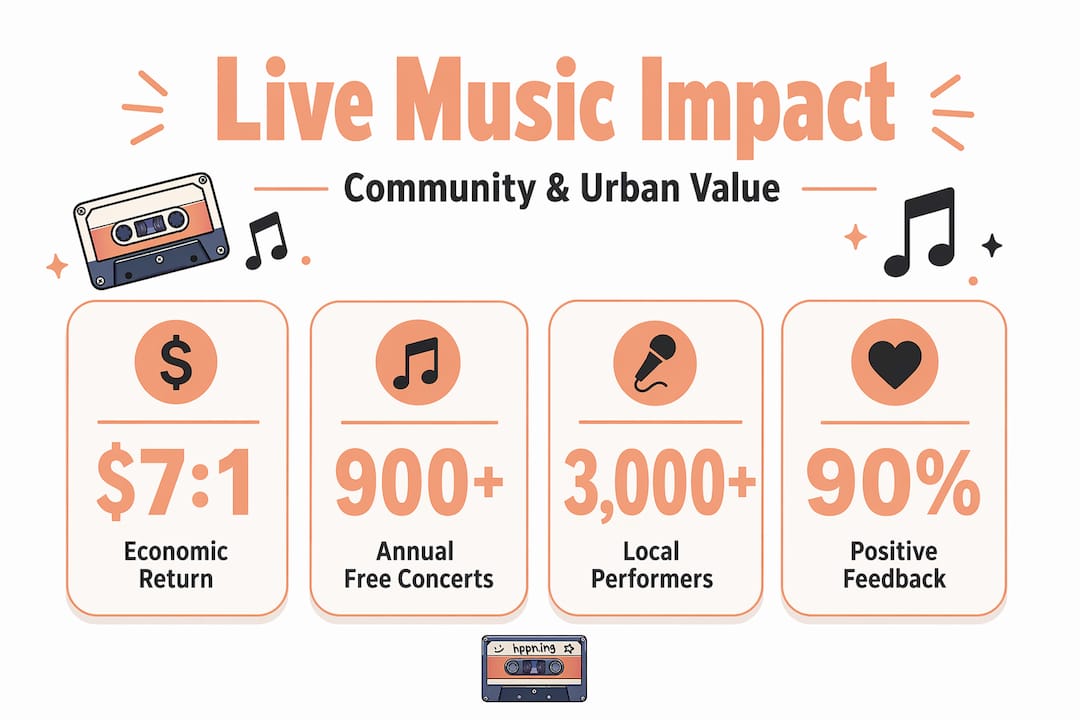
Research tied to the Levitt Foundation's national concert program found that $1 invested in free public-space music can generate up to $7 in local economic activity. That multiplier comes from the way concerts pull people out of their homes and into neighborhoods, where they spend on food, parking, drinks, and retail before and after the show.
The Levitt Foundation runs one of the clearest real-world tests of this theory. They present over 900 free concerts annually across more than 90 U.S. towns, deliberately targeting underused or neglected public spaces to restore foot traffic and neighborhood confidence.
| Factor | Ticketed venue concerts | Free public space concerts |
|---|---|---|
| Economic barrier | High (ticket cost) | None |
| Audience diversity | Narrow (age, income filtered) | Broad |
| Local spending radius | Concentrated near venue | Spread across neighborhood |
| Space activation | Venue only | Park, plaza, surrounding blocks |
| Artist exposure | Established acts | Emerging and local talent |
Here's how a well-run public concert initiative actually works, step by step:
- Identify underused space. City planners or nonprofits scout plazas, riverbanks, or parks that see low daily foot traffic.
- Program accessible formats. Lawn seating, free admission, and family-friendly scheduling remove friction for first-time attendees.
- Curate local lineups. Booking emerging local artists keeps money circulating in the community and builds genuine neighborhood pride.
- Track economic spillover. Businesses near concert venues log foot traffic and sales data before and during the series.
- Build on momentum. Consistent programming trains the public to expect and plan around these events, compounding the benefit each season.
Pro Tip: If you're involved in bringing live music to your community, document attendance and nearby business revenue from the start. That data is your strongest argument for continued funding.
Why live music in public spaces feels uniquely powerful
You've probably felt it. A performer plays something in an open-air setting and the emotional hit lands differently than it does through headphones. That's not nostalgia or imagination. There's real science behind it.
A recent study on live music's "liveness" factor found that physical co-presence of musicians in live settings significantly boosts psychological and physiological responses, including elevated heart rate, stronger emotional intensity, and heightened attention, compared to watching the same performance via livestream.
"The energy exchange between performer and crowd in a live public setting creates a feedback loop that neither the artist nor the audience can manufacture alone."
This connects to a concept called kama muta, a Sanskrit-derived term psychologists use to describe the feeling of being suddenly moved or emotionally overwhelmed. Live concerts in shared public spaces are exceptionally good at triggering this response because multiple reinforcing factors are present at once.
What makes the live music experience irreplaceable in person:
- Shared physical rhythm. When a crowd sways or claps together, your nervous system synchronizes with the people around you.
- Unpredictability. A singer's voice cracks, a chord rings out longer than expected. Those imperfections carry emotional weight that edited recordings scrub clean.
- Environmental immersion. Wind, sunlight, the smell of grass or rain. The setting fuses with the music in ways a screen never can.
- Social witnessing. Watching strangers react emotionally around you amplifies your own response. Seeing someone tear up makes you feel it more.
Digital streaming is extraordinary for discovery. It is genuinely poor at delivering the physiological and emotional depth of being physically present for a performance.
Public spaces as dynamic hubs for cultural resistance and urban identity
Live music in public spaces doesn't just happen in cities. It helps shape them.
Research on live music in Lisbon frames public-space performances as acts of cultural resistance against the touristification and commodification that price local communities out of their own neighborhoods. When a local band sets up in a square that's being eyed by real estate developers, they're not just making music. They're asserting that the space belongs to the people who live there.
This plays out differently in different cities, but the pattern is consistent:
- Grassroots musicians occupy underused or threatened public spaces.
- Regular performances build audience habits and community attachment to that space.
- Community attachment creates political and social resistance when the space faces commercial development.
- The music scene becomes part of the neighborhood's identity, embedded in how residents describe where they live.
| Scene type | Who controls it | Cultural function | Risk of displacement |
|---|---|---|---|
| Commercial music venues | Private owners | Revenue-driven | High |
| Festival grounds (ticketed) | Promoters / city permits | Tourism-focused | Medium |
| Grassroots public spaces | Communities / artists | Identity-driven | Lower when organized |
| Temporary pop-up sites | Independent artists | Experimental | Variable |
The audiences matter here as much as the musicians. When you show up to a free performance in a community park, you're not just a consumer. You are part of the mechanism that justifies that space's continued public use. Spotlighting local talent through public venues is one of the most direct ways to push back against the sterilization of urban culture.
If you want to find more live shows that serve this function rather than just filling arenas, you have to actively seek out the grassroots tier of your local scene.
How collaborative music-making builds belonging and placemaking
There's a difference between watching live music and making it together. Both matter. But participatory music experiences in public spaces do something that observation alone cannot: they build shared identity from the inside out.
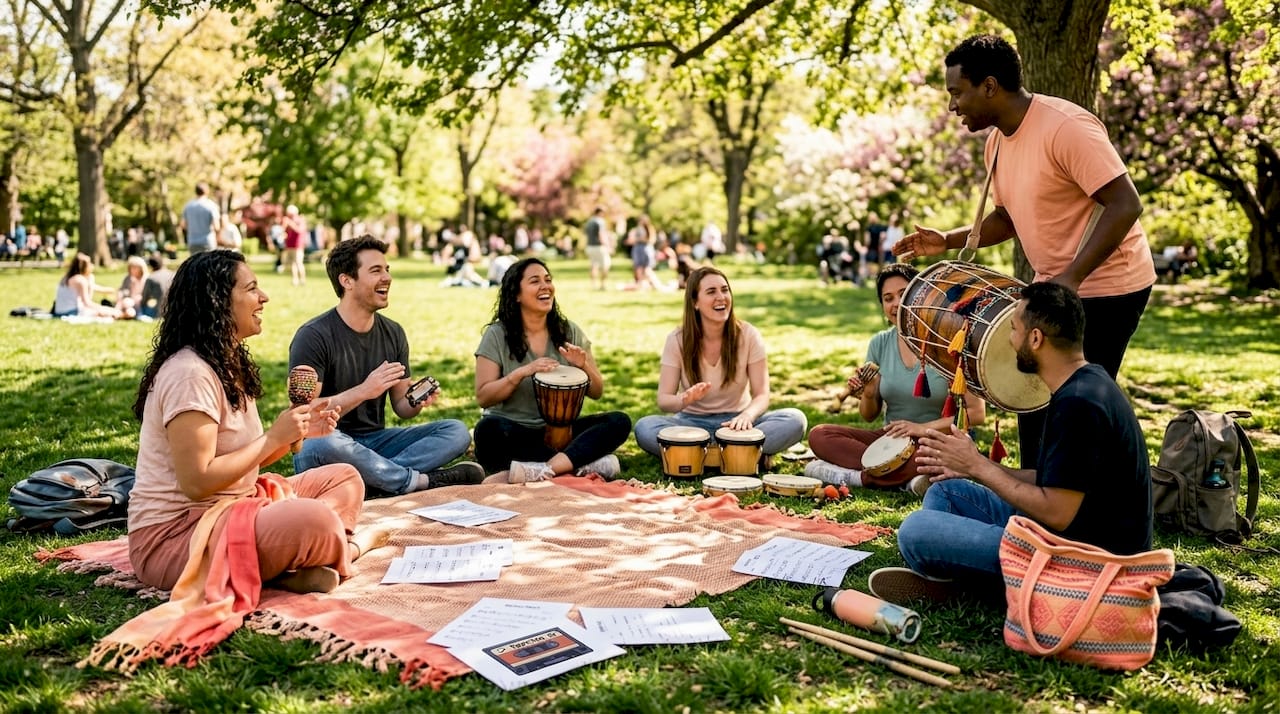
The Bradford Dhol Project is one of the clearest examples. This UK initiative used collaborative dhol drumming workshops to foster trust and cultural exchange across fragmented communities. Participants didn't just learn a skill. They formed shared memories attached to a specific place, which is exactly how neighborhoods develop the kind of community identity that resists erosion.
Instruments carry cultural weight. A dhol is not just a drum. It carries the history and identity of the communities that built their celebrations around it. When someone outside that tradition learns to play it alongside someone inside it, something more than music is exchanged.
What participants in public music collaborations actually walk away with:
- Trust built through synchronized effort. Making rhythm together with strangers requires you to listen, adapt, and rely on each other.
- Cultural literacy. Learning an instrument tied to a different tradition builds genuine understanding, not just tolerance.
- Place attachment. The space where you made music together becomes meaningful. You remember it differently than a place you simply passed through.
- Social confidence. Non-musicians who participate in low-stakes public workshops often report reduced anxiety in group social situations afterward.
Pro Tip: If your city offers free music workshops tied to public events, attend even if you've never touched an instrument. The point isn't performance. The point is connection.
Rethinking public spaces: Why supporting grassroots live music is vital to urban life
Here's the uncomfortable truth that most urban planning conversations and music industry conversations both manage to avoid: grassroots live music in public spaces is not a cultural amenity. It is social infrastructure. And we treat it like decoration.
We fund concert halls and stadium tours and call it cultural investment. Meanwhile, the free Saturday afternoon show in the park, the one that's been running for twelve years on a shoestring budget, where three generations of a neighborhood show up, where the opening act is a 19-year-old who has never played for more than 40 people, gets cut the moment the city needs to reallocate funds.
That's a fundamental misreading of value. As the Neighbourhoods Commission report makes clear, public spaces are foundational to democracy in ways that digital technology cannot replace. The algorithm cannot do what the plaza does. A playlist cannot do what a park concert does.
What we've seen, time and again, is that the public spaces where live music genuinely thrives share a few non-negotiable qualities: consistent programming that people can plan around, genuine community involvement in curation (not just consumption), and protection from commercial pressure that would price out the performers and the audiences who make those spaces meaningful.
The most vibrant urban neighborhoods in the world are not the ones with the most polished venues. They're the ones where music leaks out of public spaces, where you stumble onto something unexpected on a Tuesday evening. That doesn't happen by accident. It happens because communities and city governments make a deliberate choice to protect those spaces and the live music culture that fills them.
You have a role in that. Showing up is a vote. It's not metaphorical. Attendance data is what keeps free programming funded.
Discover and support live music in your community today
You now understand what's really at stake when a band plays a free show in your neighborhood. The question is what you do with that understanding.
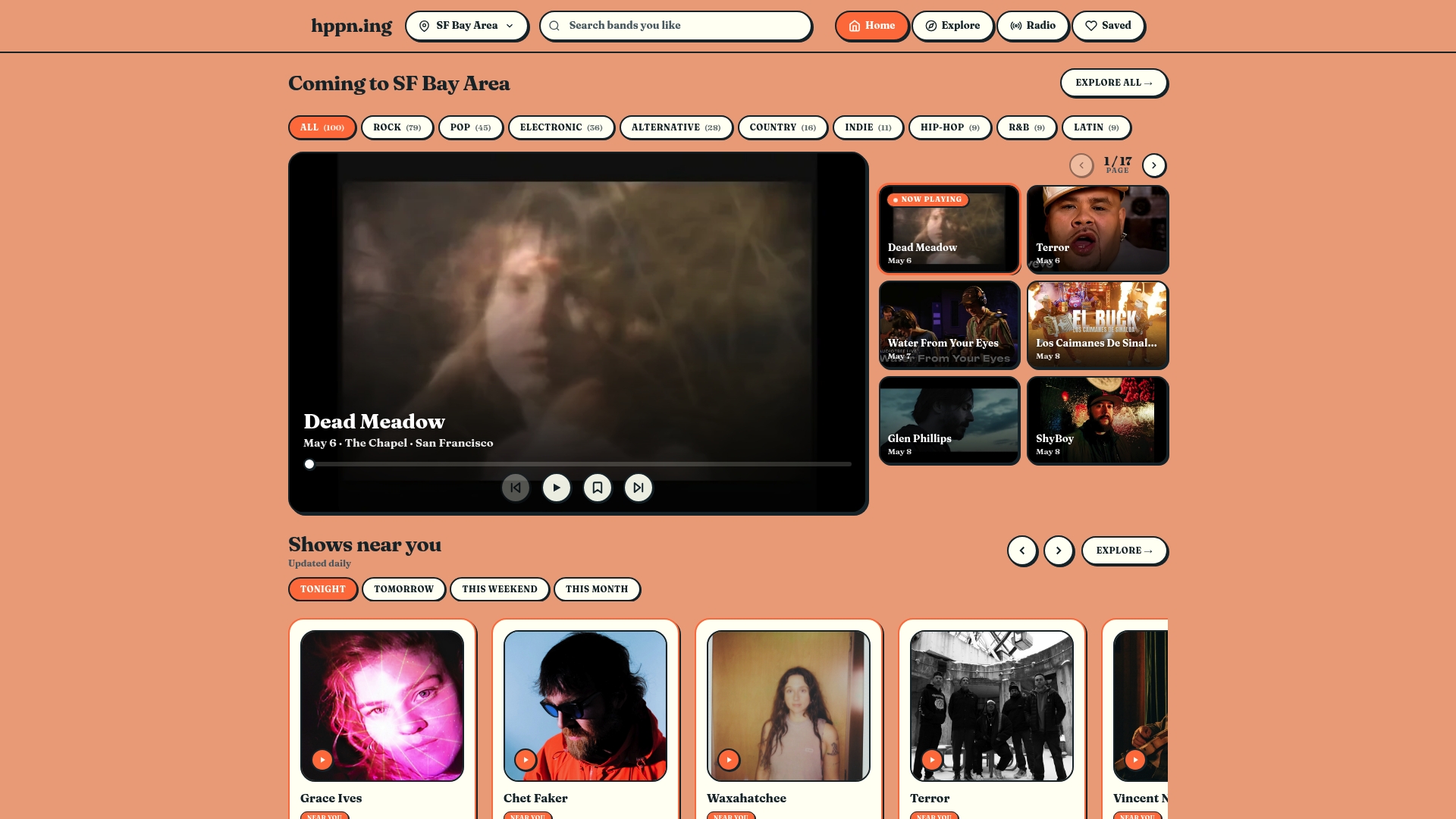
Hppn.ing is built specifically for the music fan who wants more than what the mainstream surfaces. You can discover live music near you by location, preview emerging artists through video and audio before you commit to the show, and find the underground performers who are actively shaping your city's sound right now. Beyond shows, community live music discussions let you connect with other fans who share your appetite for the real, local, and undiscovered. When you want to go deeper on who's performing, search and preview local artists directly on the platform. The grassroots scene in your city is alive. Hppn.ing helps you find it.
Frequently asked questions
Why are public spaces important for live music experiences?
Public spaces provide accessible venues that foster social interaction, cultural exchange, and emotional experiences that digital platforms cannot replicate. As Eric Klinenberg documents, these physical places function as social infrastructure crucial for face-to-face connection.
How does free live music in public areas benefit local economies?
Each dollar invested in free public-space music initiatives can generate up to $7 in local economic activity through spending on dining, parking, and other neighborhood businesses surrounding the event.
What makes live, in-person music more impactful than livestreams?
Live music triggers stronger emotional and physiological responses, including elevated heart rate and heightened attention, because physical co-presence of musicians activates social and sensory systems that screens simply cannot engage.
How can individuals support grassroots live music in public spaces?
Attend free concerts consistently, engage directly with local musicians after shows, participate in community music projects, and advocate for city policies that protect public spaces for live performance use.
What role do musicians and audiences play in shaping urban public spaces?
Both musicians and audiences actively negotiate urban identities and resist commercial pressures by inhabiting public spaces, making live music a site of cultural production and community belonging rather than passive entertainment.