
You love live music, but your neighborhood feels like it's stuck on repeat: the same three venues, the same cover bands, and zero buzz about anyone new. That frustration is more common than you'd think, and the good news is that you don't need a record label or a city arts council to fix it. This guide walks you through every practical step, from reading your local scene to landing funding, so you can bring more live music to your community and give emerging artists the spotlight they deserve.
Table of Contents
- Understand the local music scene and set your goals
- Gather tools, contacts, and key resources
- Step-by-step: Ways to host or boost live music locally
- Find and feature emerging artists in your community
- Funding and sustaining your live music efforts
- A fresh perspective: Why every neighborhood needs its own local music pipeline
- Discover, connect, and ignite your local music scene with hppn.ing
- Frequently asked questions
Key Takeaways
| Point | Details |
|---|---|
| Start with venue fit | Assess the right spaces, contacts, and timing before booking live music. |
| Use spotlight formats | Showcase events with multiple artists make it easier for emerging talent to connect with audiences. |
| Leverage local grants | Funding options like Levitt and local city programs can make live series possible for communities. |
| Pair new and local acts | Mixing new talent with familiar artists creates excitement and keeps local music vibrant. |
| Sustain through networking | Build momentum with networking breaks, Q&A, and digital tools to grow your local scene. |
Understand the local music scene and set your goals
Before you book a single act or rent a PA system, you need to know what you're working with. Every neighborhood has its own musical DNA, and ignoring it is the fastest way to plan an event nobody shows up to.
Start by mapping what already exists:
- Active venues: bars, coffee shops, galleries, parks, and community centers that already host events
- Crowd types: who attends, what age range, what genres get the most energy
- Event gaps: nights with no programming, underserved genres, or neighborhoods with no live music at all
- Booking windows: most venues plan 4 to 8 weeks out, so timing your pitch matters
Using concert calendars is one of the fastest ways to spot those gaps. Browse what's already scheduled, then look for the blank spaces. A Tuesday night with nothing going on is an opportunity, not a dead end.
As Berklee Online notes, one repeatable path to book local shows is to identify the right rooms, find the correct booking contact, and time your outreach to the venue's booking window. That three-step sequence sounds simple, but most first-timers skip the research phase and pitch the wrong room entirely.
Pro Tip: Attend at least three local events before you pitch or plan anything. You'll learn the unwritten rules of each venue, spot the regulars who become your early supporters, and avoid rookie mistakes that kill credibility fast.
Clarify your main goal before moving forward. Are you trying to create a regular monthly series? A one-off showcase to test the waters? A platform specifically for emerging artists who've never played a professional stage? Your goal shapes every decision that follows.
Gather tools, contacts, and key resources
With your goals clear, it's time to gather the right resources so you're ready to pitch, connect, or apply.
Booking outreach works best when you treat every venue as a unique relationship, not a generic recipient. According to Berklee Online, outreach should account for fit, including capacity, stage size, demographics, age restrictions, and concept alignment, and use venue-specific materials to reduce friction for promoters.
Here's what you need before you reach out to anyone:
- An EPK (Electronic Press Kit) or one-sheet for each artist you're representing, including bio, photos, streaming links, and press quotes
- Demo links that are easy to access, ideally video clips from past performances
- Social proof such as follower counts, past show attendance numbers, or press mentions
- A clear pitch summary that explains the event concept in two sentences or less
- A list of target contacts with names, emails, and notes on each venue's booking style
| Resource | Contact type | Materials needed | Purpose |
|---|---|---|---|
| Venue booker | Booking manager or owner | EPK, demo, pitch summary | Secure a performance slot |
| City arts office | Program coordinator | Event proposal, nonprofit status | Apply for city grants or permits |
| Local music forum | Community peers | Event details, artist profiles | Build word-of-mouth and support |
| Sponsorship contact | Local business owner | One-sheet, audience data | Offset event costs |
You can find peer organizers and community discussions on platforms like hppn.ing/notes, where local music fans share tips, venue recommendations, and event ideas in real time. These conversations are often more current than any printed guide.
Pro Tip: Never send the same generic email to every venue. Mention a specific show you attended there, name the booker if you know them, and explain exactly why your event fits their audience. Personalization converts at a much higher rate than mass outreach.
Step-by-step: Ways to host or boost live music locally
Once you're prepped, the next move is taking action. Here's a range of proven strategies to actually make live music happen in your area.
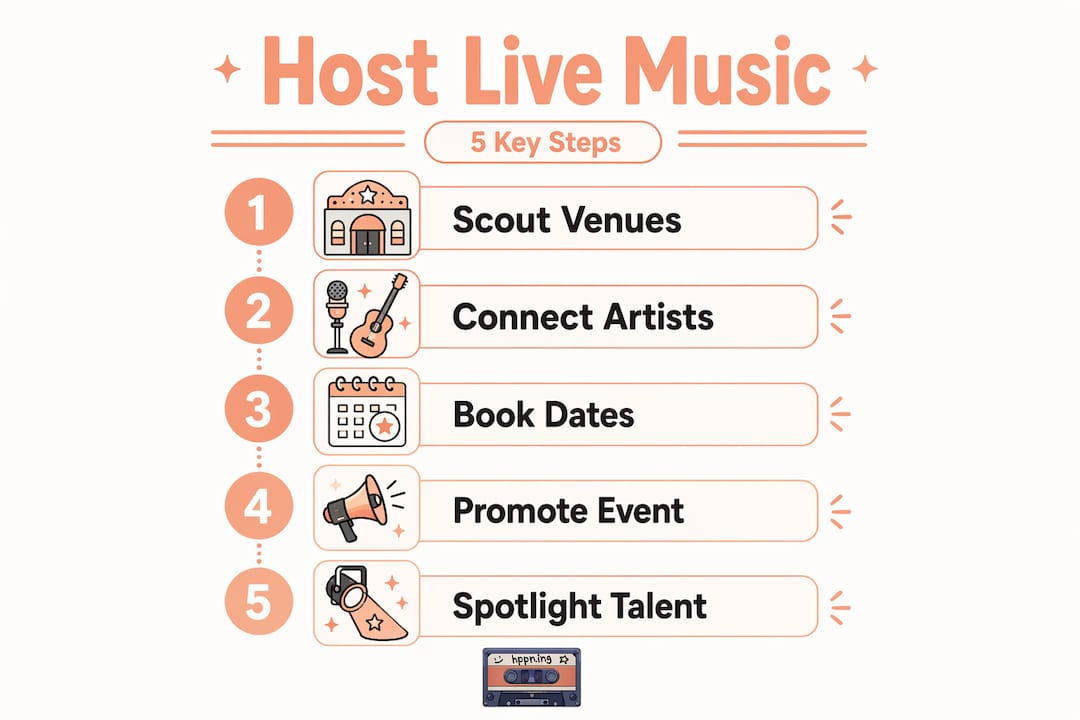
Curated spotlight formats like listening showcases, rotating short sets, Q&A sessions, and networking breaks are practical tools for spotlighting local artists and creating genuine connection between performers and audiences. These formats lower the stakes for everyone involved and make events feel more like community gatherings than formal concerts.
Here's a numbered action path for planning your first event:
- Choose your format: DIY house show, venue showcase, outdoor pop-up, or institutional series
- Lock a date at least six weeks out and confirm the space in writing
- Book three to five artists with varied styles to maximize audience appeal
- Create a simple promotional plan: social posts, local event listings, and flyers
- Set a door price or donation model that covers your costs without pricing people out
- Run a post-event debrief to capture what worked and what to improve
| Approach | What's required | Pros | Cons |
|---|---|---|---|
| DIY (house/pop-up) | Minimal budget, personal network | Fast to launch, low overhead | Limited capacity, no built-in audience |
| Venue-driven | Booking relationship, EPK | Built-in audience, professional setup | Less creative control, revenue split |
| Municipal/city grant | Application, eligibility check | Free or subsidized, public reach | Slow process, competitive |
| Nonprofit series | 501(c)(3) status or partnership | Access to major grants, credibility | Administrative overhead |
The Levitt Music Series Grants program is a multi-year matching-grant model that activates underused public spaces with 7 to 10 free outdoor concerts per year, specifically designed for municipalities and nonprofits. At the city level, programs like the City of Champaign Live Entertainment Grants reimburse eligible costs for live music events with caps per event and per year, making them accessible for smaller organizers.
Important: Most grant programs require you to be a registered nonprofit or partner with one. Check eligibility requirements before investing time in an application.
Pro Tip: Short rotating sets of 20 to 30 minutes per artist reduce barriers for emerging performers who don't have a full set ready. They also keep audiences engaged and give you room to feature more talent in a single night. Check trending artist charts to find rising acts worth including in your lineup, and use hppn.ing to discover live shows already happening nearby that you can model your own events after.
Find and feature emerging artists in your community
Once you have your event structure, focus on drawing up-and-coming talent and helping new artists connect with your audience.
The most effective emerging-artist events share one trait: they lower the barrier to entry while raising the perceived value of the show. A multi-artist showcase with five acts and short sets is a proven format for giving new performers professional stage experience without overwhelming them or your audience.
Intentional pairing also works. Programs that pair emerging talent with established local or regional acts via tours or showcases create a structured route for audience discovery. When a known act brings their crowd and a new artist opens for them, both sides win.
Event ideas that boost discovery:
- Themed nights built around a genre, era, or neighborhood identity
- Voting showcases where the audience picks a winner who gets a return booking
- Artist pairings that match a new act with a locally beloved performer
- Listening parties for debut releases followed by a short live set
- Open discovery nights where artists submit a 10-minute audition set
| Format | Number of artists | Set length | Avg. cost | Outcome |
|---|---|---|---|---|
| Multi-artist showcase | 4 to 6 | 20 to 30 min | $300 to $800 | High artist exposure |
| Paired billing | 2 | 30 to 45 min | $200 to $500 | Audience crossover |
| Voting showcase | 3 to 5 | 15 to 20 min | $150 to $400 | Community engagement |
| Listening party | 1 | 20 to 30 min | $100 to $300 | Focused artist spotlight |
Use digital tools to promote your lineup before and after the show. You can search for local artists on hppn.ing to preview their music, check their following, and decide if they're the right fit for your event format.
Funding and sustaining your live music efforts
To keep the energy going, you'll need resources. Here's how to find funding sources and set your project up for long-term success.
Independent venues can pursue practical, operational funding through Live Music Society's Toolbox grants, which are aimed at improving the live music experience and increasing local programming capacity. These grants are specifically designed for small, independent venues that need equipment, infrastructure, or programming support.
Stat callout: The Levitt Music Series Grants program offers up to $40,000 per year in matching grants, while the Live Music Society Toolbox grants provide up to $10,000 per venue for operational improvements.
Steps to apply for funding:
- Identify which grant type fits your organization: city, nonprofit, or venue-focused
- Confirm eligibility requirements, including nonprofit status, location, and event minimums
- Gather supporting materials: past event data, community letters, artist bios, and budgets
- Submit your application during the open window and track all deadlines carefully
- If the grant includes a public voting phase, build your community engagement plan early
The Levitt grant cycle for 2026 to 2028 included a public voting process before final recipient selection, which means community mobilization is part of the application itself, not just the event planning.
Pro Tip: Always check whether a grant requires matching funds before you apply. Many programs expect you to raise a portion of the budget independently, so knowing this upfront helps you plan your sponsorship and ticket revenue strategy alongside the grant timeline.
A fresh perspective: Why every neighborhood needs its own local music pipeline
Here's the conventional wisdom: only cities with a "scene" can sustain live music. Only places with the right clubs, the right press, and the right density of musicians can produce something worth paying attention to. That belief stops more local music efforts than any funding gap ever could.
The reality is different. Most music discoveries don't start in a famous city. They start in a church basement, a backyard, a coffee shop with twelve seats, or a park gazebo on a Tuesday evening. The artists who later fill theaters almost always trace their story back to a small, intentional event where someone gave them a slot and a crowd.
Spotlight formats, grant cycles, and networking events aren't shortcuts to a scene. They're the infrastructure that makes a scene possible in the first place. A neighborhood that runs a consistent monthly showcase for two years has built something real: a shared musical identity, a network of artists who know each other, and an audience that shows up because they trust the curation.
You don't need to wait for a famous venue to open or a booking agency to notice your city. The pipeline starts with one event, one artist, one audience. Join local music discussions and you'll find that other fans in your area are already thinking the same way. The difference between a neighborhood with a scene and one without is usually just one or two people who decided to start.
Discover, connect, and ignite your local music scene with hppn.ing
Ready to keep the music rolling? Here's how to stay connected and grow your own scene even faster.
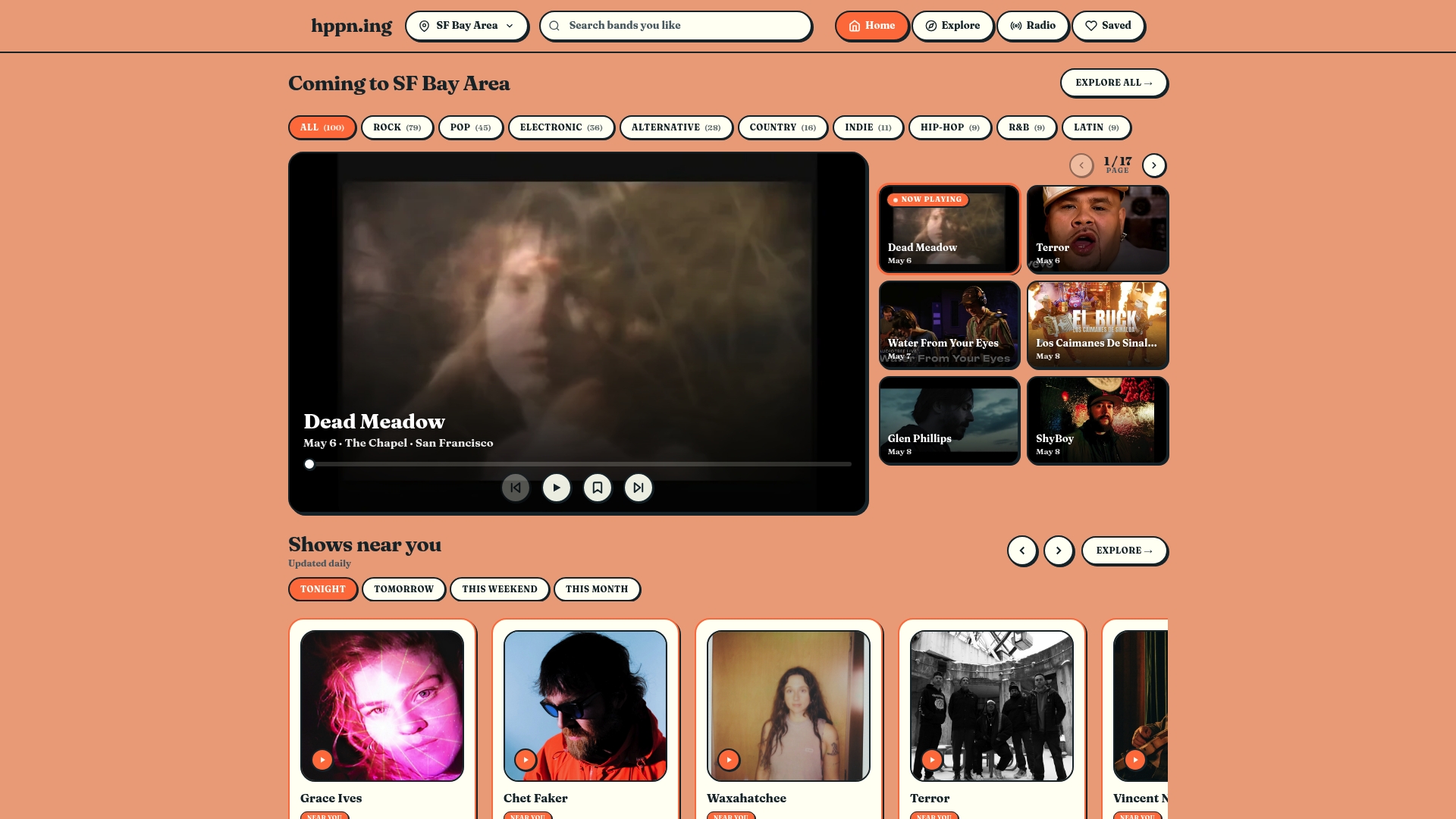
Hppn.ing is built for exactly this moment. Whether you're scouting talent for your next showcase or looking for events to attend this weekend, the platform puts everything in one place. Discover local shows happening near you, browse trending artists who are building momentum right now, and search and preview artists by location and genre before you book them. Every tool you need to find, feature, and connect with your local music community is already waiting for you.
Frequently asked questions
How do I find local venues open to live music?
Attend smaller shows in your area and talk to venue staff directly. You can also use community forums and event listings to identify which rooms are actively booking and who the right contact is.
What's the fastest way to spotlight emerging artists?
Organize a multi-artist showcase with short sets of 20 to 30 minutes each. Pairing new acts with established local performers also accelerates exposure by sharing existing audiences.
Where can I get funding for local live music events?
Start with city-level grants, then explore nonprofit programs like the Levitt Music Series Grants, which fund 7 to 10 free outdoor concerts per year. Venue-focused options like the Live Music Society Toolbox grants are also worth pursuing.
How can I make my music events more interactive and engaging?
Add Q&A sessions between sets and build in short networking breaks. Spotlight formats like listening showcases give audiences a reason to stay engaged rather than just passively watch.
Do I need to be part of a nonprofit to apply for most music grants?
Major programs like the Levitt Music Series Grants require local nonprofit status, but city-level programs such as the City of Champaign Live Entertainment Grants also serve for-profit businesses and individual organizers.