

You showed up to your favorite venue last weekend, only to find out the show you wanted to see sold out three weeks ago. Sound familiar? Missing local concerts because you simply didn't know they were happening is one of the most common frustrations for live music fans. Local concert calendars exist to fix exactly that problem. This guide breaks down what they are, how they work, which ones are worth your time, and how to squeeze every last drop of value out of them so you never miss another show in your city.
Table of Contents
- What is a local concert calendar?
- How do local concert calendars work?
- Types of concert calendars and how they compare
- Limitations and pro tips for getting the most out of concert calendars
- How to use local concert calendars to support your local music community
- Why the best concert discoveries happen through local calendars and what people miss
- Find your next local concert with hppn.ing
- Frequently asked questions
Key Takeaways
| Point | Details |
|---|---|
| Centralized event listings | Local concert calendars make it easy to keep track of upcoming live shows in your area. |
| Choose the right calendar | Aggregator apps, local media, and city sites all serve different concert-goer needs. |
| Don’t miss underground gigs | Rely on community tips and venue socials to catch shows not listed on major platforms. |
| Boost your music community | Sharing, attending, and supporting events through calendars helps keep your local scene vibrant. |
What is a local concert calendar?
A local concert calendar is a curated or aggregated list of upcoming live music events organized by city, region, or neighborhood. Think of it as your personalized show schedule for your local music scene, updated regularly and often searchable by genre, venue, date, or artist name.
There are two main types you'll run into:
- Curated calendars: These are maintained by local media outlets, music blogs, or venues themselves. They're hand-picked, often reflecting the editorial taste of a specific community. City weeklies and music publications fall into this category.
- Aggregator calendars: These pull data automatically from multiple sources, ticketing platforms, artist submissions, and venue feeds. National platforms that personalize by location are the most common example of this type.
It's worth knowing how these differ from general event calendars. A broad city events page might list a jazz concert alongside a basketball game, a food festival, and a theater production. A dedicated concert calendar filters all of that noise and keeps the focus on live music.
"A good local concert calendar doesn't just tell you what's happening. It helps you feel connected to the music culture of your city."
City-specific calendars from established publications like Westword Concerts in Denver and Phoenix New Times, along with municipal sites and national platforms that personalize by location, show just how varied the landscape is. Each has its own strengths depending on what you're looking for.
If you're just getting started with discovering local music, a concert calendar is the single most efficient tool you can add to your routine.
How do local concert calendars work?
The mechanics behind concert calendars are more interesting than most people realize. They don't just magically populate with show listings. There's a whole ecosystem of data sources feeding into them.
Where the data comes from:
- Venue submissions: Most venues submit their event listings directly to local media and aggregator platforms. This is often the most reliable source for accurate show details.
- Artist and manager submissions: Touring artists or their management teams submit tour dates to platforms like Bandsintown, which then distributes that information to fans.
- Ticketing platform feeds: When a show goes on sale through a major ticketing system, that data often flows automatically into aggregator calendars.
- User submissions: Some platforms allow fans or promoters to add events manually, which helps capture smaller or DIY shows that might otherwise be missed.
The personalization layer is where modern apps really shine. National aggregator platforms can use your phone's location to surface shows near you, and many go further by analyzing your listening habits to recommend artists you might not have searched for on your own. This means a fan who listens to indie folk will see a very different calendar than someone who listens to hip-hop, even in the same city.
Common features you'll find across most concert calendars include genre and venue filters, direct ticket purchase links, artist preview tools so you can preview artists before committing to a show, and push notifications for upcoming events.
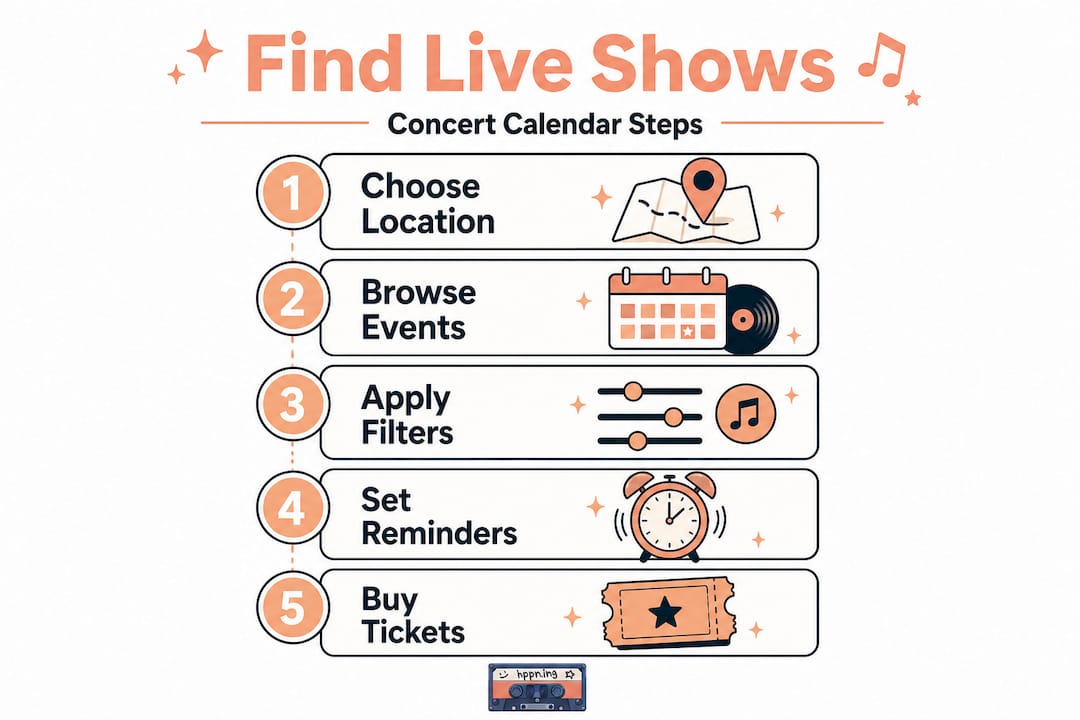
The automation factor is huge. Before these tools existed, keeping up with every venue's website, every artist's social media, and every local publication was a part-time job. Now, a well-configured concert calendar does most of that work for you.
Bandsintown sends over 1 billion discovery notifications monthly, integrates with Apple Music, and serves roughly 95 million fans worldwide. That scale tells you something important: the demand for automated concert discovery is enormous, and these tools have matured significantly.
Pro Tip: Connect your streaming app to your concert calendar app when possible. This lets the platform cross-reference your listening history and surface shows from artists you already love but might not have thought to search for manually.
Types of concert calendars and how they compare
Not all concert calendars are built the same, and choosing the right one depends on what you value most. Here's a side-by-side look at the main types:
| Type | Best for | Weakness |
|---|---|---|
| National aggregators | Automation, notifications, wide reach | Can miss hyper-local or underground shows |
| Local media calendars | Curated picks, community feel | Less personalization, updated less frequently |
| Municipal/government sites | City-run festivals and public events | Very limited scope, often outdated |
| Ticketing platforms | Quick ticket purchase | Discovery tools are minimal |
As the Bandsintown vs Songkick comparison shows, even within the aggregator category there are meaningful differences. Bandsintown leans heavily into artist-fan connection and personalized discovery, while Songkick has historically focused on tracking your favorite artists and alerting you when they tour near you. Local publications offer something neither can fully replicate: editorial curation that reflects what actually matters to a specific music community.
Here's how to think about building your personal concert calendar stack:
- Start with a national aggregator for broad coverage and automated notifications.
- Add a local media calendar from your city's music publication for curated picks and underground coverage.
- Follow key venues directly through their websites or email lists for the most accurate and timely information.
- Check ticketing platforms only when you're ready to buy, not as your primary discovery tool.
- Use a platform like hppn.ing to track trending artists and stay connected to what's bubbling up locally before it hits the mainstream.
Ticketing platforms like Eventbrite are useful for purchasing but tend to surface events based on sales potential rather than musical relevance to your taste. They're a checkout counter, not a discovery engine.
Pro Tip: For a guide to secure concert ticketing, bookmark a reliable resource before you need it. Ticket fraud spikes around high-demand shows, and knowing how to verify a legitimate purchase in advance saves real headaches.
Limitations and pro tips for getting the most out of concert calendars
Here's the honest truth: even the best concert calendar has blind spots. Understanding where these tools fall short is what separates fans who catch every show from those who still miss the ones that matter most.
Where calendars commonly fall short:
- Underground and DIY shows: A basement show, a pop-up in a record store, or a house concert organized through a private Facebook group rarely makes it onto any aggregator. These events live and die by word of mouth.
- Last-minute additions: Some shows are announced only days before they happen. Aggregators may not catch these fast enough to be useful.
- Calendar sync bugs: Sync issues between platforms can cause duplicate listings, incorrect dates, or shows that appear on one calendar but not another. Calendar sync bugs have been reported in platforms like Songkick, so always double-check key show details directly with the venue before you make plans.
- Venue-specific quirks: Some smaller venues don't submit to aggregators at all, meaning their shows only appear on their own websites or social media.
"The most unforgettable shows are often the ones nobody told an algorithm about."
Strategies to fill the gaps:
- Sign up for email newsletters from your three or four favorite local venues. These often go out before any aggregator picks up the listing.
- Follow local promoters and bookers on social media. They announce shows early and often.
- Join your city's live music community boards and groups. Fans share tips, flyers, and last-minute show announcements constantly.
- Build a personal meta-calendar by syncing your concert app with Google Calendar or Apple Calendar. Add manual alerts for shows you're serious about attending so they don't slip through.
- Check local record shops. Many still post physical flyers for upcoming shows and are plugged into scenes that don't exist online.
The combination of automated tools and human networks is what gives you the most complete picture of your local music scene. Neither alone is enough.
How to use local concert calendars to support your local music community
Using a concert calendar to find shows is just the beginning. The fans who actually strengthen their local music scenes go a step further and use these tools to give back to the community that creates the music they love.
Here's how to move from passive consumer to active participant:
- Show up for emerging artists. When you spot an unfamiliar name on a local calendar, take a chance. Attending a show for an artist with 200 fans is worth ten times as much to them as one more face in a sold-out arena crowd.
- Share events with your network. When you find a show worth attending, post it. Text a friend. Share the event link. Word of mouth is still the most powerful marketing tool a local artist has.
- Submit corrections and missing events. If you notice a show isn't listed on your preferred calendar, submit it. Most platforms have a simple submission form. This small action helps the whole community.
- Promote underrepresented artists. Use your own social media to highlight artists you discover through local calendars, especially those from communities that tend to get less visibility on mainstream platforms.
- Join local discussions on music community platforms where fans, artists, and promoters share information in real time.
As research on local music promotion confirms, local scenes thrive on non-aggregated promotion like flyers and social sharing for events that big platforms miss. Your personal network is part of the infrastructure that keeps live music alive in your city.
Pro Tip: After attending a show you found through a local calendar, leave a review or comment on the platform where you discovered it. This helps other fans and signals to the platform that these kinds of events are worth surfacing more often.
Why the best concert discoveries happen through local calendars and what people miss
Here's an opinion worth sitting with: the most memorable live music experiences rarely come from the biggest platforms. They come from a tip on a community board, a flyer stapled to a telephone pole, or a friend who heard about a show through a local publication that nobody outside the city reads.
Big aggregators are genuinely useful. They save time, send smart notifications, and make it easy to track artists you already know. But their strength is also their limitation. They optimize for scale, which means they're best at surfacing what's already popular or what's already been officially announced. The weird, intimate, career-defining shows that happen in small rooms often don't make it into their systems until after the fact, if at all.
The fans who build the deepest connection to their local music scene are the ones who treat community music boards and hyper-local resources as seriously as any app. They know the promoters by name. They follow the venues that take risks on new artists. They're the first to hear about a touring band adding a surprise date or a local act playing their first headline show.
There's also something worth saying about the relationship between discovery and support. When you find an artist through a local calendar and show up to their gig, you're not just a consumer. You're part of the reason that artist keeps going. That's a different kind of experience than streaming a playlist alone. The algorithm can point you toward music. Only you can decide to walk through the door.
Find your next local concert with hppn.ing
Ready to stop missing shows and start building a real connection with your local music scene?
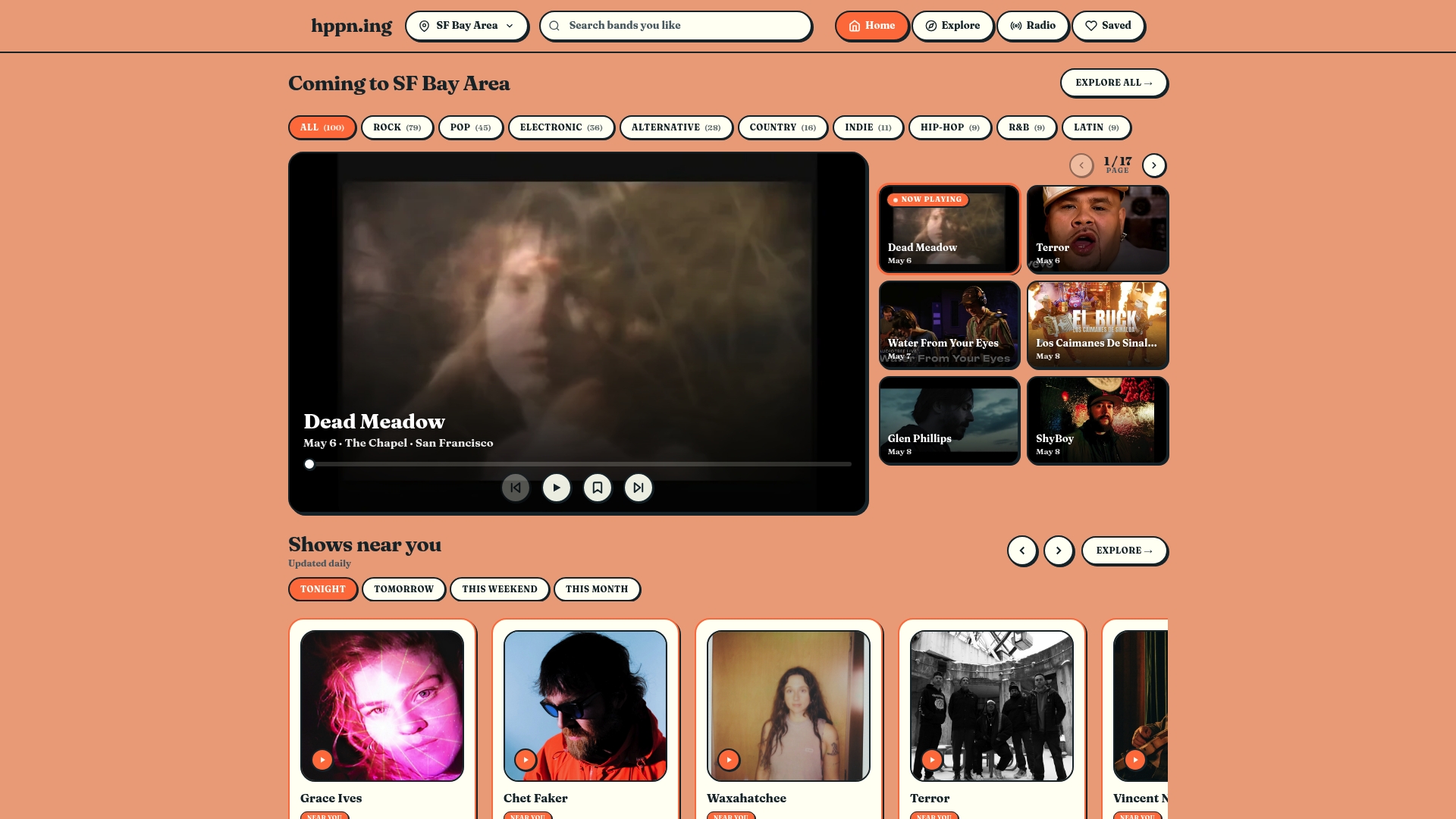
Hppn.ing brings together everything covered in this guide into one focused platform built specifically for live music fans. You can find live music near you by browsing upcoming shows in your city, preview and follow local artists before you commit to a ticket, and check out see trending artists to stay ahead of what's rising in your scene. Beyond discovery, hppn.ing gives you a place to connect through music community notes where fans and artists share tips, recommendations, and real-time updates. It's the local concert calendar experience built for fans who want more than just a list of dates.
Frequently asked questions
How accurate are local concert calendars?
Most calendars cover official listings well, but underground gigs may be missed or added late due to sync issues or the absence of formal submissions. Always verify key show details directly with the venue.
What should I do if a concert isn't listed on my calendar?
Check the venue's website and artist social media first, then submit the event to your preferred calendar platform. Local scenes rely heavily on non-aggregated promotion for events that slip through the cracks.
What's the difference between a concert calendar and a ticketing site's event list?
Concert calendars focus on discovery and community, while ticketing sites are primarily built for transactions. As the aggregator comparison data shows, ticketing platforms prioritize sales over comprehensive local event coverage.
Can I get reminders for events I add from a concert calendar?
Yes. Bandsintown's notification system sends over a billion discovery alerts monthly, and most apps also allow you to sync events directly to your phone's native calendar for additional reminders.