

You've been there before. You scroll through your usual app the morning after a show, only to find photos flooding your feed from exactly the kind of intimate, electric gig you would have killed to attend. Your favorite underground artist played a venue three miles from your house, and you had no idea it was even happening. This gap between great live music and the fans who would love it isn't a niche problem. It's a daily frustration shared by millions of concert goers, and it's precisely why live music aggregators exist.
Table of Contents
- What is a live music aggregator?
- How do live music aggregators work?
- Why use a live music aggregator? Benefits for fans
- Community-driven and fan-first platforms
- The trade-offs: Coverage, freshness, and community
- Discover more shows and join the live music community
- Frequently asked questions
Key Takeaways
| Point | Details |
|---|---|
| Centralized event discovery | Live music aggregators gather show listings from many sources for quick searching. |
| Notifications & artist tracking | Fans get notified about relevant shows based on favorite artists and locations. |
| Coverage varies | Not all shows or venues appear, so cross-checking with other sources is valuable. |
| Community engagement | Some platforms let fans contribute setlists, show memories, and discussions. |
What is a live music aggregator?
Think of a live music aggregator as a giant funnel. On one end, you have hundreds of separate streams of event data: ticketing companies, venue box offices, independent promoters, local blogs, artist newsletters, and indie media outlets. On the other end, you get one clean, searchable list of shows happening near you. The aggregator's entire job is to pull all of that scattered information together and make it usable.
A live music aggregator centralizes and normalizes live concert and event information from many sources, including ticketing vendors, venues, promoters, and other publications, into one searchable and discoverable place for fans. That word "normalizes" matters more than it sounds. Different venues format their event listings in completely different ways. One calls a show a "concert," another calls it a "live performance," and a third lists it under an artist's full legal name rather than their stage name. Aggregators clean all of that up so you can search for a single artist and actually find everything.
Understanding how concert calendars work gives you a clearer picture of the infrastructure behind these searches. Local concert calendars are often one of the key data sources that aggregators pull from, especially for smaller markets and underground scenes where big ticketing platforms may have limited reach.
Here's a quick look at what fans gain from using a live music aggregator:
- One-stop searching across hundreds of venues and promoters without jumping between tabs
- More event options because the aggregator surfaces shows you'd never find through a single ticketing site
- Underground and local event discovery from smaller venues, DIY spaces, and independent promoters
- Artist tracking so you follow a performer once and get alerted whenever they book a show in your area
- Price comparison across multiple ticket vendors for the same event
"A live music aggregator doesn't just save time — it fundamentally changes what you think is possible in your local music scene, because it shows you options you didn't know existed."
The scale of what aggregators index is genuinely hard to wrap your head around. We're talking about platforms that cross-reference millions of event records every single day just to keep listings current.
How do live music aggregators work?
Knowing what an aggregator does is useful. Understanding how it does it helps you use these tools more effectively and catch their blind spots before they cost you a ticket.
Here's a simplified breakdown of what happens behind the scenes:
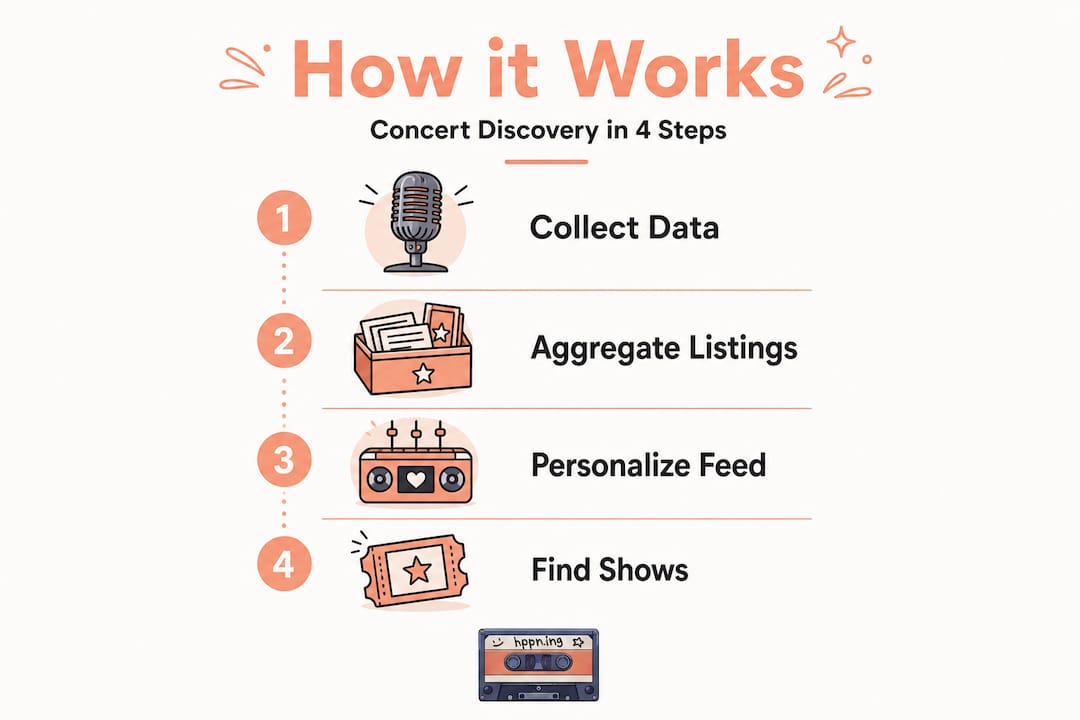
- Data collection: The platform sends automated requests (called crawlers or API calls) to ticketing vendors, venue websites, artist management systems, and partner data feeds on a regular schedule.
- Data merging: Multiple sources may list the same event, so the system identifies duplicates using artist names, dates, cities, and venue names, then merges them into a single listing.
- Normalization: Inconsistent formatting gets cleaned up. Dates convert to a standard format, artist names match to verified profiles, and venue addresses get standardized.
- Publishing: The cleaned listing goes live on the platform, where fans can search, filter, and interact with it.
- Updating: The cycle repeats continuously. New shows get added, canceled events get removed, and ticket availability statuses update as often as the upstream sources allow.
The reach of this process extends well beyond any single website. Live music aggregation distributes across other ecosystems via integrations and automated syncing, with event listings appearing on streaming services' artist pages. Amazon Music's partnership with Bandsintown is a real-world example: when an artist updates their tour dates on one platform, that data flows automatically into the music streaming experience millions of listeners already use every day. The event finds the fan, not the other way around.
This is powerful, but it comes with limitations. Automated pipelines are only as fresh as their sources. If a venue updates their booking calendar once a week, the aggregator reflecting that venue's shows could be six days behind on a new announcement.
Pro Tip: If you spot a show you're seriously considering attending, especially for a hot underground act, click through to the actual ticketing vendor to confirm availability and pricing before making plans. Aggregators are great for discovery but treat them as a starting point, not the final word. For more on staying safe when purchasing, check these tips for safe ticket access.
Why use a live music aggregator? Benefits for fans
With a grasp of the technology, it's time to show what all this engineering actually means for you at ground level.
The most immediate benefit is coverage. Instead of checking five different apps to piece together your city's weekend lineup, you get everything in one place. But the deeper benefit is discovery. Aggregators regularly surface shows that would never reach you through a single-platform search, and that's where they get genuinely exciting.

Here's a comparison of what different aggregator platforms typically offer:
| Feature | Mainstream event apps | Dedicated live music aggregators | Community-first platforms |
|---|---|---|---|
| Artist tracking and alerts | Limited | Yes, core feature | Yes, with fan community layer |
| Underground/local coverage | Low | Medium to high | High (fan-contributed) |
| Ticket options and pricing | Basic | Multiple vendors shown | Varies |
| Streaming service integration | Sometimes | Often via API partnerships | Rarely |
| Fan community tools | None | Limited | Full feature set |
| Show history and setlists | None | Rare | Yes |
Fans who follow artists on dedicated aggregators receive notifications or recommendations when shows are announced nearby, and they get listings with multiple ticket options and prices side by side. That's a meaningfully different experience from stumbling across a poster on a telephone pole two days after tickets sold out.
The breadth of live music discovery platforms is often measured in the number of concerts, venues, and registered fans they support. That scale acts as a real proxy for how well they cover underground and local shows. More sources indexed means more obscure gigs making it into your search results.
Real use cases that matter for serious fans:
- Catching secret shows announced with short notice when artist-tracking alerts fire instantly
- Multi-city discovery for fans who travel or want to road trip for a particularly rare performance
- Faster ticket buying when aggregators link directly to easy ticket purchasing flows
- Price watching across vendors for the same show, so you're not overpaying on a secondary market
- Exploring trending live artists in your area before they outgrow the small venues that make seeing them so special
This last point deserves emphasis. There is a very real window of time when an artist is playing 200-capacity rooms and every seat feels personal. Aggregators that prioritize local and underground coverage help you find those artists during that window, not after they've already graduated to arenas.
You can also preview artist profiles on platforms designed for discovery, which lets you hear an artist before committing to a ticket. That's a small feature with a big impact on whether you actually show up to the show.
Community-driven and fan-first platforms
Aggregators aren't just about finding tickets. Some platforms have evolved into genuine fan communities where the value comes as much from what other fans contribute as from automated data feeds.
There's a meaningful difference between a pure event listing tool and a fan-first platform. A pure listing tool does one thing well: it tells you what's happening and where to buy a ticket. A fan-first platform adds layers. Users contribute setlists from shows they attended. Fans post memories, reviews, and photos. Community members flag pop-up shows that never made it into any official listing. The result is something closer to a living archive of live music culture than a simple calendar.
Some platforms built around fan-contributed show history and setlists shift the value proposition away from ticketing freshness and toward archival and community context. That's a genuinely different kind of utility. If you're trying to figure out whether an artist typically plays a certain deep cut live, no automated aggregator will tell you that. But a community platform where fans log every show in detail absolutely will.
"The most valuable thing about community-driven music platforms isn't the data they collect — it's the collective enthusiasm of fans who treat every show like it deserves to be remembered."
Key community features to look for in fan-first platforms:
- User-submitted setlists logged in real time from the crowd
- Show memories and reviews from fans who attended past events
- Community discussion threads tied to specific artists or venues
- Local knowledge boards where fans share unlisted or word-of-mouth events
- Artist timelines showing full touring histories pulled from fan contributions
Pro Tip: For underground gigs and pop-up shows, local fan communities often know before any aggregator does. Tap into live music discussion spaces in your city where fans share tips and announcements that never make it into formal listings. These conversations are often where the most exciting discoveries start. It's also worth noting that community-driven platforms tend to catch events in less-covered scenes faster, simply because enthusiastic fans are actively watching.
Fraud is also a real concern in the live music ticket space. Platforms that prioritize fraud-cut ticketing practices add a meaningful layer of security when you're buying for in-demand shows.
The trade-offs: Coverage, freshness, and community
Here's the honest take: no live music aggregator has perfect, real-time data. Every platform has gaps, delays, and edge cases. Understanding those limitations isn't cynicism. It's how you use these tools at their best.
Show announcements and ticket availability can be delayed or change after aggregation, which means fans may encounter stale or sold-out listings. The real-time promise depends entirely on how fresh the upstream sources and update pipelines actually are. Some venues update their systems hourly. Others do it manually, twice a week. That inconsistency flows directly into the aggregator you're using.
This doesn't mean aggregators aren't worth using. It means the smartest fans layer their strategies. Relying on one single source for show discovery, even the best aggregator available, means accepting whatever gaps that source has built into it.
Here's a more resilient approach to live music discovery:
- Use an aggregator as your primary discovery layer for breadth and convenience
- Follow your favorite artists directly on their social channels so you catch announcements the moment they go live
- Subscribe to newsletters from local venues that book the genres you care about
- Check using local concert calendars as a complement, especially for hyper-local and DIY scenes
- Participate in fan communities where members share word-of-mouth info
The fans who catch the most shows aren't the ones with the fanciest app. They're the ones who've built a layered, diversified discovery habit. Aggregators make that habit much easier to maintain, but they work best when you treat them as one powerful tool in a larger toolkit rather than the only tool you need.
For genuinely hot underground shows where tickets move fast, be flexible. Check directly with the venue. Cross-reference multiple sources before assuming something is still available. And when you do find something real, move quickly.
Discover more shows and join the live music community
Ready to apply what you've learned? Get involved and never let another show slip past you.
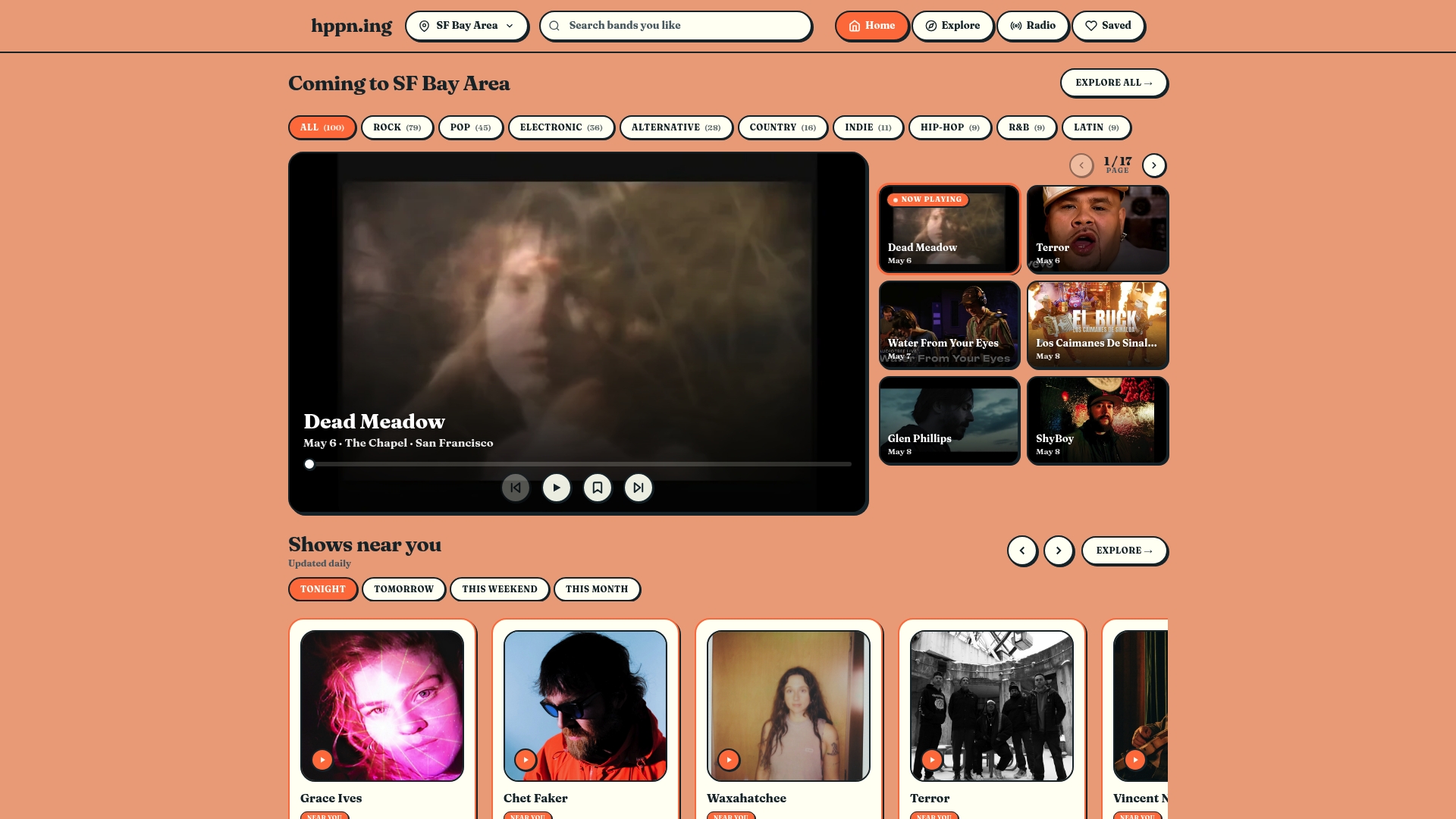
At hppn.ing, we built the platform specifically for the kind of music fan who reads an article like this one. We care about the underground artist playing their third-ever show at a 100-person bar. We care about the touring act coming through your city for one night only, on a Tuesday, with almost no promotion. Discover live music near you with personalized event browsing, real-time artist previews, and location-based concert discovery built from the ground up for fans who want more than the mainstream offers. You can explore trending artists in your area, preview their sound before committing, and join the live music community where fans share tips, memories, and show announcements the second they drop. Your next favorite show is already out there. Let's make sure you actually find it.
Frequently asked questions
How does a live music aggregator find underground or local shows?
Aggregators pull from diverse sources, including local venues, independent promoters, and regional publications, to surface lesser-known events that larger ticketing platforms often miss.
Will I always find every show listed in my city?
Not always. Coverage depends on which sources the aggregator indexes, and availability can shift after a listing is first published, so always verify directly with the venue for high-demand shows.
Can I buy tickets directly from a live music aggregator?
Many aggregators show ticket options and prices side by side and link out to affiliated ticketing vendors, though the actual purchase typically happens on the vendor's platform.
Do live music aggregators cover community-driven features?
Some platforms go well beyond listings, offering fan-contributed histories and setlists, user reviews, and community discussion threads that add a rich layer of context for both past and upcoming shows.