

Every city has a musical heartbeat, but most people never find it because they're looking in the wrong places. The assumption that only massive concert halls or famous entertainment districts qualify as true music hotspots leaves the most vibrant scenes completely invisible. A local music hotspot is actually a place or cluster of places where live music is frequent, audiences show up consistently, and emerging artists get real performance opportunities that build a recognizable community over time. This article breaks down exactly what defines a hotspot, how to measure one, and how to find yours.
Table of Contents
- What defines a local music hotspot?
- How experts measure music hotspots
- Practical signs: How to spot a music hotspot in your city
- Why small venues drive big music communities
- A new way to think about music hotspots
- Ready to find your own local music hotspot?
- Frequently asked questions
Key Takeaways
| Point | Details |
|---|---|
| Hotspots are community-driven | Local music hotspots thrive on frequent live shows and a supportive, engaged audience. |
| Small venues have big impact | Intimate grassroots venues are often the backbone of a city’s music scene and spark artist growth. |
| Measurable music energy | Hotspots can be identified by concert frequency, venue concentration, and artist buzz metrics. |
| Easy ways to spot them | Recurring shows, new artist lineups, and active scene notes are clear signals of a vibrant hotspot. |
What defines a local music hotspot?
With assumptions set aside, it's essential to clarify what sets a true music hotspot apart from just another live music venue.
A music hotspot isn't defined by its seating capacity or its Instagram presence. It's defined by what happens inside, and more importantly, what keeps happening. Regularity matters enormously here. A venue that hosts three concerts a year and a venue that curates a new lineup every single weekend are not the same thing, even if their sound systems are identical.
The cultural function of the space is what separates a hotspot from a one-off event location. Many hotspots are grounded in grassroots or small-venue ecosystems where curation and community roles matter as much as the music itself. The person booking the acts, the regulars who show up week after week, the bartender who knows which local band is about to break out — these are all part of what makes a space a hotspot rather than just a room with a PA system.
There's also a distinction worth making between grassroots venues by size and by their primary cultural and community function. A small listening room in a converted warehouse and a medium-sized independent theater both qualify as hotspots if they share the same mission: consistent programming and a real commitment to local talent.
Here are the core elements that define a local music hotspot:
- Frequency: Live music events happen on a regular, recurring schedule, not just occasionally
- Community support: A loyal audience shows up specifically because they trust the curation
- Emerging talent focus: New and developing artists are consistently given stage time
- Independent curation: Booking decisions are made by people invested in the local scene, not corporate formulas
- Cultural identity: The venue has a recognizable sound, vibe, or genre focus that makes it a destination
| Feature | Standard live music venue | Local music hotspot |
|---|---|---|
| Event frequency | Occasional or seasonal | Weekly or more |
| Artist selection | Mix of touring and local acts | Strong focus on local and emerging artists |
| Community role | Transactional (buy ticket, watch show) | Participatory (regulars, discussions, loyalty) |
| Curation style | Popularity-driven | Community-driven |
| Discovery opportunity | Low to moderate | High |
"The best hotspots aren't the biggest venues in town. They're the rooms where the sound engineer knows every local act by name, and the audience feels like they're in on something the rest of the city hasn't discovered yet."
You can browse local live music charts to start recognizing which artists are generating real buzz in your area, and head to live music discussion boards to hear directly from fans about which venues are doing it right.
How experts measure music hotspots
Once we define what a hotspot is, the next step is understanding how their vibrancy and impact can actually be measured in the real world.
Measuring a music hotspot isn't as subjective as it sounds. Researchers and music industry analysts have developed real, repeatable ways to evaluate a city's music scene and identify where the energy is actually concentrated. These methods give you a framework to assess your own city with more precision than just gut feeling.
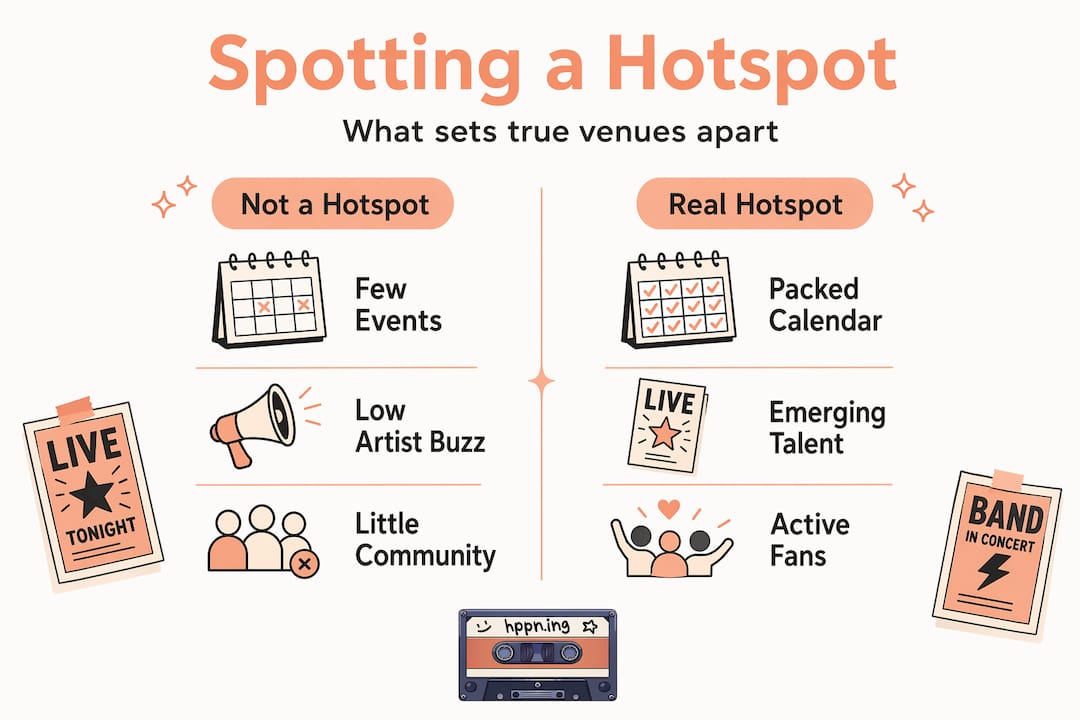
Music-city hotspot discussions are often operationalized using measurable proxies like event and venue intensity plus music-related concentration indicators, rather than a single universally agreed definition. In plain terms, that means the more live events per square mile, and the higher the density of independent music venues in a given area, the more reliably that area qualifies as a hotspot.
The role of live music in shaping community identity is increasingly well documented, and cities that invest in live event infrastructure see measurable returns in cultural tourism, creative industry growth, and neighborhood vitality. That's not just anecdotal. Cities like Austin, Nashville, Chicago, and Portland have all seen direct economic and cultural benefits tied to the concentration of their independent live music scenes.
Here's a breakdown of the key metrics used to assess hotspot status:
- Event density: How many live shows happen per month within a defined geographic area
- Venue count: The number of independent, music-focused spaces versus multipurpose event halls
- Artist activity: How frequently new and emerging acts are performing versus established touring acts
- Audience engagement: Ticket sales, social media activity tied to local shows, and community forum participation
- Media coverage: How often local acts are being reviewed, featured, or profiled in local outlets
| City factor | Low-activity scene | High-activity hotspot |
|---|---|---|
| Monthly live events | Fewer than 10 | 50 or more |
| Independent venues | 1 to 3 | 10 or more |
| Emerging artist bookings | Rare | Regular feature |
| Community forums activity | Minimal | Active and ongoing |
| Local artist discovery rate | Slow | Fast and visible |
Worth knowing: Cities that maintain a high ratio of independent venues to total population tend to produce more nationally recognized artists over time. The scene creates the ladder that artists climb.
Using local concert calendars is one of the most practical ways to start measuring hotspot activity in your area. When you check a calendar regularly, you start noticing patterns: which venues post new events every week, which artists appear repeatedly before breaking out, and which neighborhoods are generating the most consistent music activity. You can also preview local artists directly to gauge the quality and variety of talent in your city's scene.
Practical signs: How to spot a music hotspot in your city
Knowing what a hotspot looks like on paper is useful, but what about actually finding one where you live?
This is where the rubber meets the road. You don't need a research degree to spot a thriving local scene. You just need to know what to look for, and then actually pay attention.

A practical way to identify a local music hotspot is to look for evidence of ongoing, recurring live programming plus venues and community groups that consistently spotlight emerging local artists. Both signals together, not just one, indicate a real scene rather than a temporary surge of activity.
Here's a step-by-step approach to spotting a hotspot in your city:
- Search for recurring show series. Not one-off events, but "every Thursday" or "first Friday of the month" programming. Regularity is the foundation of a real scene.
- Check who's booking. If the same independent promoter or venue booker is consistently putting on local acts, that's a sign of genuine curation and investment in the community.
- Read the community notes. What are music fans in your city actually talking about? Which venues get name-dropped repeatedly? Collective enthusiasm is a powerful signal.
- Watch for new names. A hotspot constantly rotates in fresh talent. If you keep seeing the same five acts cycle through, the scene may be stagnant. New names appearing regularly means the scene is growing.
- Visit in person without a headliner. Go to a Tuesday night show at a small venue with an act you've never heard of. If the room is engaged, the staff is enthusiastic, and the music is genuinely interesting, you've found a hotspot.
- Notice the audience behavior. Are people there just killing time, or are they actually listening? A hotspot audience comes for the music first. Chatter stops when the act starts.
- Look for cross-promotion. Hotspot venues tend to recommend each other and work with local artists across the scene. Isolation and exclusivity are red flags.
Pro Tip: The best way to find a hotspot quickly in a new city is to spend 20 minutes on a live music community forum before you ever step foot in a venue. Real fans talk openly about which rooms are booking well, which shows are unmissable, and which places have lost their edge. Check out community notes to tap into exactly that kind of local knowledge.
Why small venues drive big music communities
With clear indicators for identifying hotspots, it's important to understand why small venues consistently emerge as the backbone of influential music scenes.
There's a temptation to assume that bigger venues equal better music experiences. More production, bigger stages, louder systems. But the math doesn't work that way when you're talking about community and discovery. Small venues do something that large ones structurally cannot: they close the distance between artist and audience in a way that changes both of them.
Grassroots and independent small venues are independently run, community-connected spaces that curate programming highlighting emerging talent and create an intimate, recurring scene for local music. That intimacy is not a compromise. It's the whole point.
When an artist performs in a 100-person room and can make genuine eye contact with people in the audience, the music lands differently. When a fan discovers a new favorite artist in a basement show and then watches that artist grow over the next two years, the connection to the local scene becomes deeply personal. These experiences don't scale up to arena shows.
Here's why small venues are central to healthy music ecosystems:
- Artist development: Small venues give emerging artists regular opportunities to perform, experiment, and find their sound in front of real audiences
- Real feedback loops: Artists and fans interact directly after shows, creating a genuine exchange that shapes artistic direction
- Lower financial barriers: Independent venues can take risks on unknown acts that would be too financially risky for larger operations
- Scene identity: Small rooms often have a distinctive sound or focus, which helps a local scene develop a recognizable character
- Community trust: Regular attendees build relationships with bookers, staff, and artists, turning a venue into a true community hub
"A 90-person sold-out show at a small independent venue represents something that no arena can replicate: the feeling of being one of the few people who were there when it started."
Pro Tip: When you discover live music in your area, look specifically at smaller venues with 50 to 300 capacity. These are the spaces most likely to give you a genuinely new discovery, not an act you already follow on every playlist.
A new way to think about music hotspots
Here's the editorial truth that most city guides never quite say out loud: the places listed in travel features and tourist apps are almost never the actual hotspots.
Real hotspots get discovered by word of mouth, by showing up on a rainy Wednesday night, or by following a local artist from a tiny venue to a slightly less tiny venue over the course of a year. The energy that defines a great music scene is built from the ground up, not delivered top-down by major venues, festival brands, or corporate booking agencies.
Major festivals and large theaters absolutely matter. They bring in investment, media attention, and large audiences. But they don't create scenes. They reflect them. The true creative work happens years earlier in smaller rooms, in late-night residencies, in Sunday afternoon open mics where three people show up and one of them is the person who will eventually book that artist at a larger venue.
What this means practically is that your search for a music hotspot should move toward trending artists at the beginning of their trajectory, not toward established names at the peak of theirs. The best memories from live music almost always come from being early. Being in the room when something is still forming. Seeing a band in a space so small you could touch the amplifier from your seat.
The cities that sustain great music cultures are the ones where fans show up for unknown acts, where small venues stay economically viable, and where the community treats music discovery as a genuine practice, not a passive experience. Your presence at a grassroots show is not just a night out. It's a contribution to the health of the whole ecosystem.
Ready to find your own local music hotspot?
If you've been circling the idea of getting deeper into your city's live music scene, now is the time to stop watching from the outside.
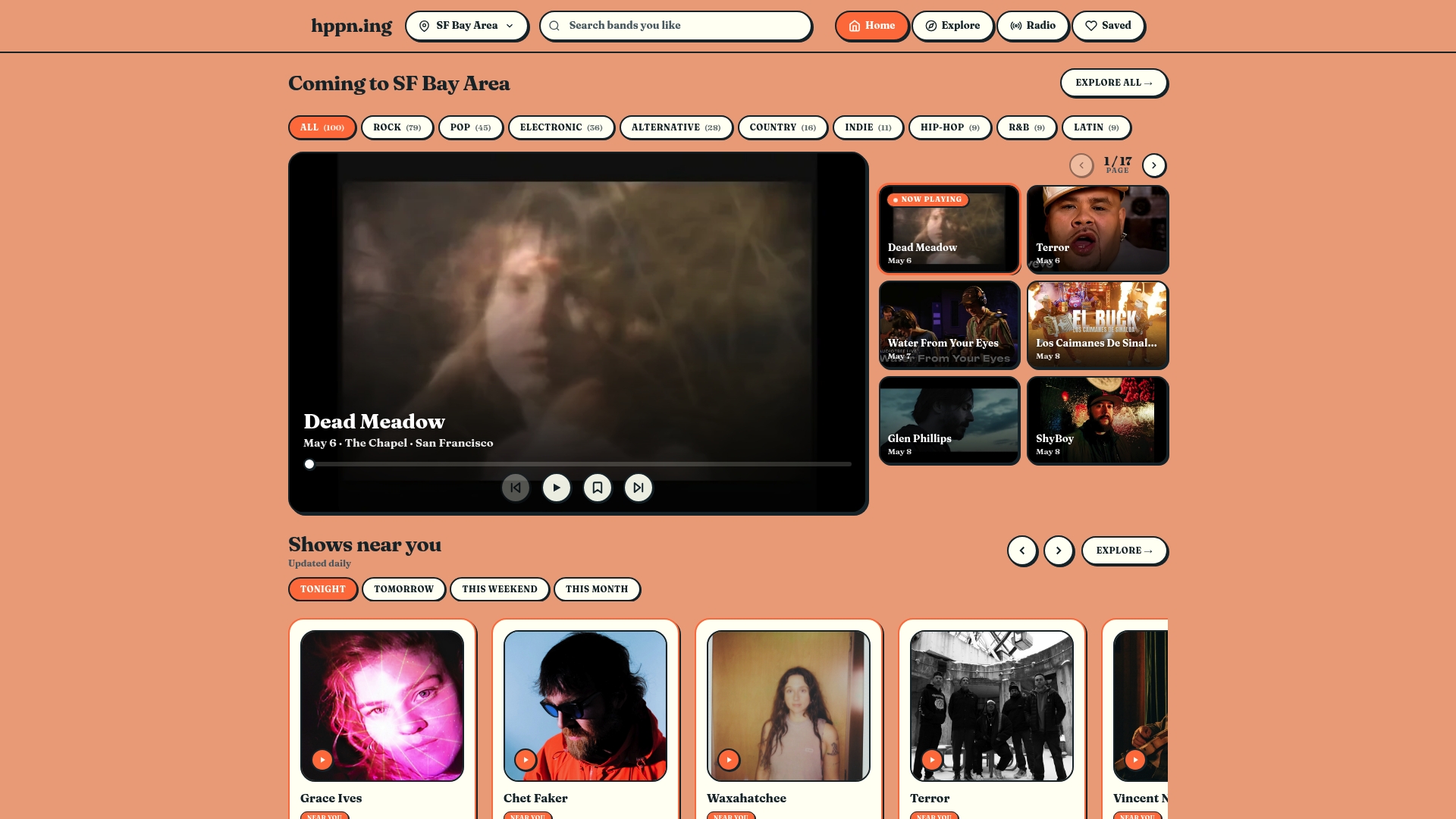
Hppn.ing is built specifically for this. You can find live music events in your city right now, filtered by location and updated in real time. You can search for artists playing near you, preview their music before the show, and discover names you've never heard of that are already drawing loyal local followings. And when you want to know which venues are actually worth visiting this weekend, join live music discussions where fans who are already embedded in the local scene share what they know. The hotspot you've been looking for is already out there. Hppn.ing helps you find it before everyone else does.
Frequently asked questions
What makes a local music hotspot different from any live music venue?
A local music hotspot consistently hosts live events, champions emerging artists, and serves as a community anchor. Many hotspots are grounded in grassroots ecosystems where curation and community roles matter as much as the music itself, which is something a standard venue doesn't prioritize.
How can I identify a music hotspot if I'm new to a city?
Look for recurring live programming, active community forums, and venues known for spotlighting local talent. Ongoing, recurring live programming combined with consistent emerging artist features is the most reliable signal that a real scene exists.
Why are grassroots venues important to music scenes?
They nurture talent at the earliest stage, foster a loyal and supportive audience, and help define a city's unique musical identity. Grassroots independent small venues curate programming that highlights emerging talent and creates intimate, recurring scenes that larger venues simply can't replicate.
Are only small venues considered music hotspots?
Not exclusively, but grassroots venues by cultural function are where the most meaningful scene-building activity tends to happen. Small, independent spaces are where new artists break through and where the earliest, most loyal fan communities form.