
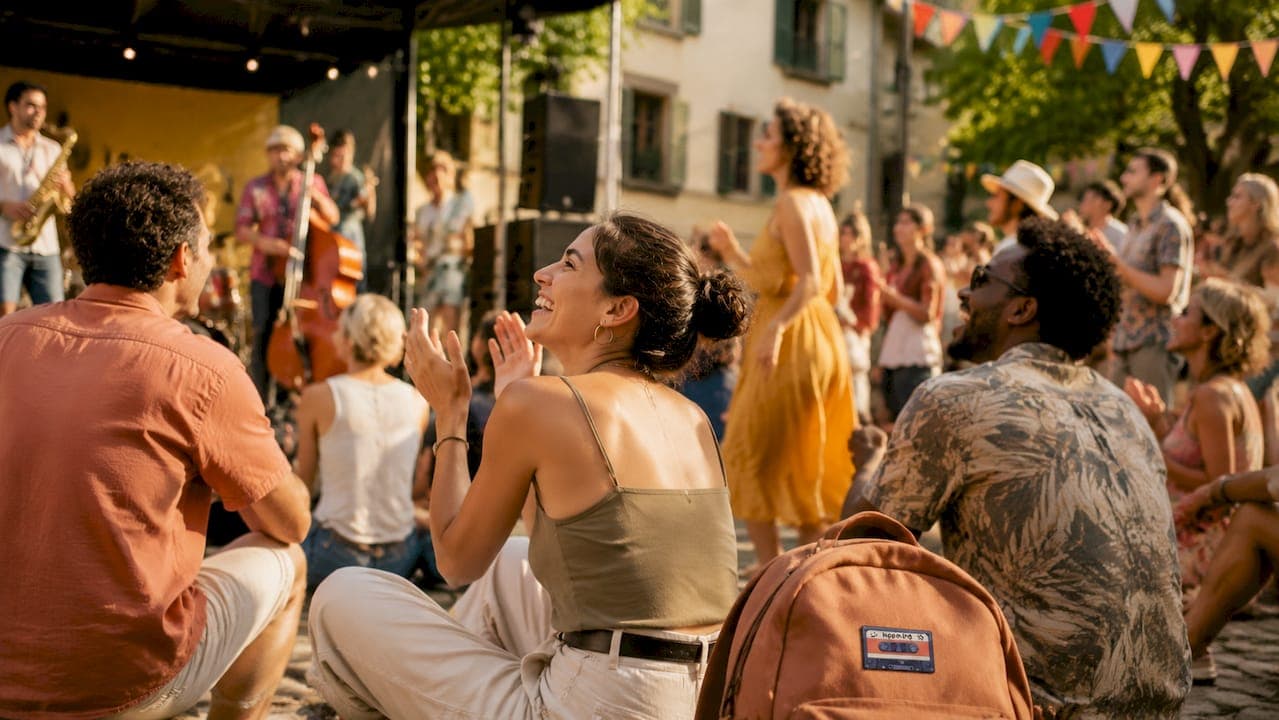
Music events strengthen communities by triggering collective effervescence, a psychological state of shared emotional connection that produces measurable gains in social bonding, well-being, and local identity. Research from the University at Buffalo confirms that audience interaction produces stronger community bonds than the technical quality of the music itself. The British Psychological Society links this shared state directly to happiness lasting up to a week after a concert. For community members and social activists, that is not a soft cultural benefit. It is a concrete mechanism for building the kind of trust and cohesion that neighborhoods actually need.
Why music events strengthen communities through collective effervescence
Collective effervescence is the term sociologist Émile Durkheim coined to describe the electric, almost sacred feeling that arises when a group shares an intense experience together. At a live concert, it shows up as the moment a crowd sings the same lyric, moves to the same beat, or falls silent at the same emotional peak. That shared state is not just pleasant. It is neurologically real.
Collective effervescence outperformed every other concert variable, including sound quality and performer skill, as the strongest predictor of meaning and enjoyment at live events. That finding reframes what makes a music event worth attending. The crowd is the product, not just the audience.
The effect also lasts. The British Psychological Society reports that happiness from collective effervescence at live music events persists for up to one week after the event ends. One week of elevated well-being from a single shared experience is a significant return for any community investment.
Three specific factors amplify collective effervescence at concerts:
- Bonding with the artist. When performers acknowledge the crowd, share personal stories, or make eye contact, the psychological distance between stage and audience collapses.
- Immersive lyrics. Songs that reflect shared experiences or cultural identity give audiences a common emotional language to inhabit together.
- Attending with friends. People who arrive with others report stronger social connections and higher meaning in life after concerts than those who attend alone.
Pro Tip: If you are organizing a community music event, build in moments that require crowd participation, call-and-response, group singing, or synchronized movement. These are not gimmicks. They are the fastest path to collective effervescence.
How do music events promote inclusivity and cultural exchange?
Live music functions as what sociologists call a "third space," a setting outside home and work where people from different backgrounds meet on neutral ground. That function is especially valuable in politically divided or economically stratified communities.
Live music gatherings act as vital resources for maintaining common humanity amid digital fragmentation. When people share a physical space and a sonic experience, their differences in income, politics, or background become temporarily less defining. That is not wishful thinking. It is a documented social dynamic.
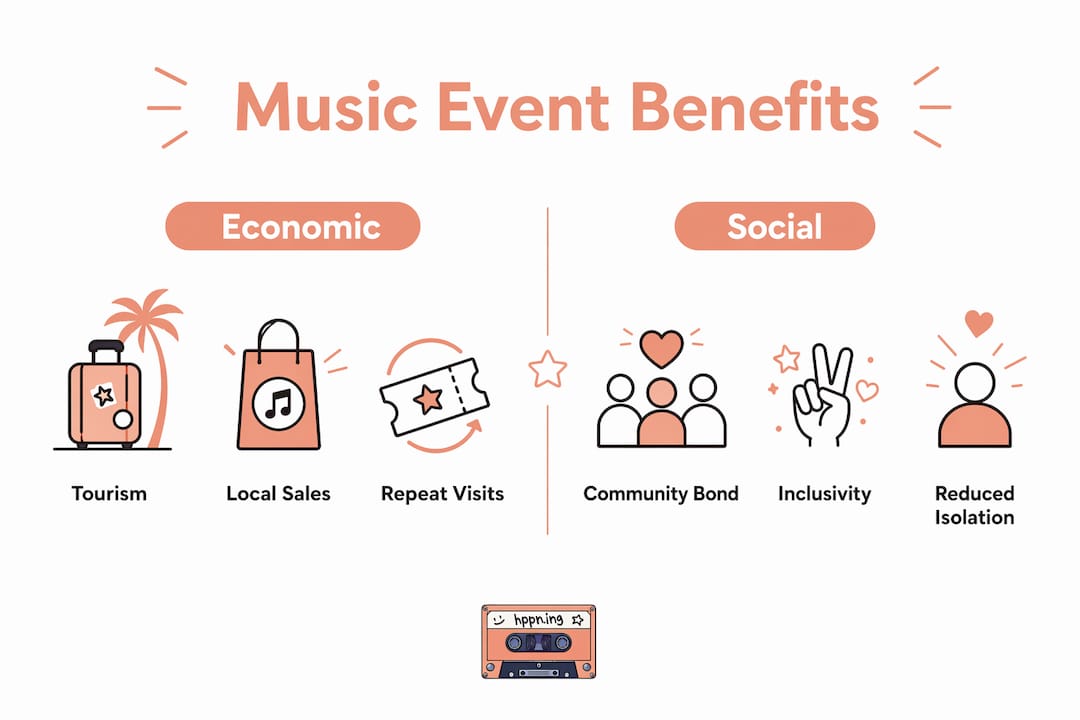
Historical evidence backs this up. Music has played a practical role in reconciliation and empathy-building across divided societies, from post-conflict communities in Northern Ireland to township music programs in post-apartheid South Africa. The mechanism is not mystical. Shared rhythm and synchronized movement physically coordinate bodies, and that coordination builds trust.
Group music participation produces this effect through a specific sequence:
- Shared attention. Everyone in the room focuses on the same sound at the same time. That shared focus is the starting point for social alignment.
- Synchronized movement. Clapping, swaying, or dancing together activates the same neural pathways as physical cooperation. Bodies in sync tend to feel more connected.
- Collective emotional release. When a crowd reacts together to a musical peak, the shared emotional response creates a memory that participants associate with each other, not just the music.
- Post-event social interaction. The shared experience gives strangers an immediate conversation topic and a common reference point, lowering the social friction of meeting new people.
"Music is one of the few human activities where participation itself is the point. You do not need credentials, shared politics, or even a common language to stand in a crowd and feel the same thing at the same time."
Platforms like Hppn make this kind of discovery more accessible by helping community members find local music scenes they did not know existed, including underground artists and neighborhood shows that rarely appear on mainstream channels.
What are the economic and social benefits of music events for local communities?
Music events deliver two categories of benefit that community organizers often treat separately but should plan for together: economic impact and social cohesion. Both are real, and both compound over time.
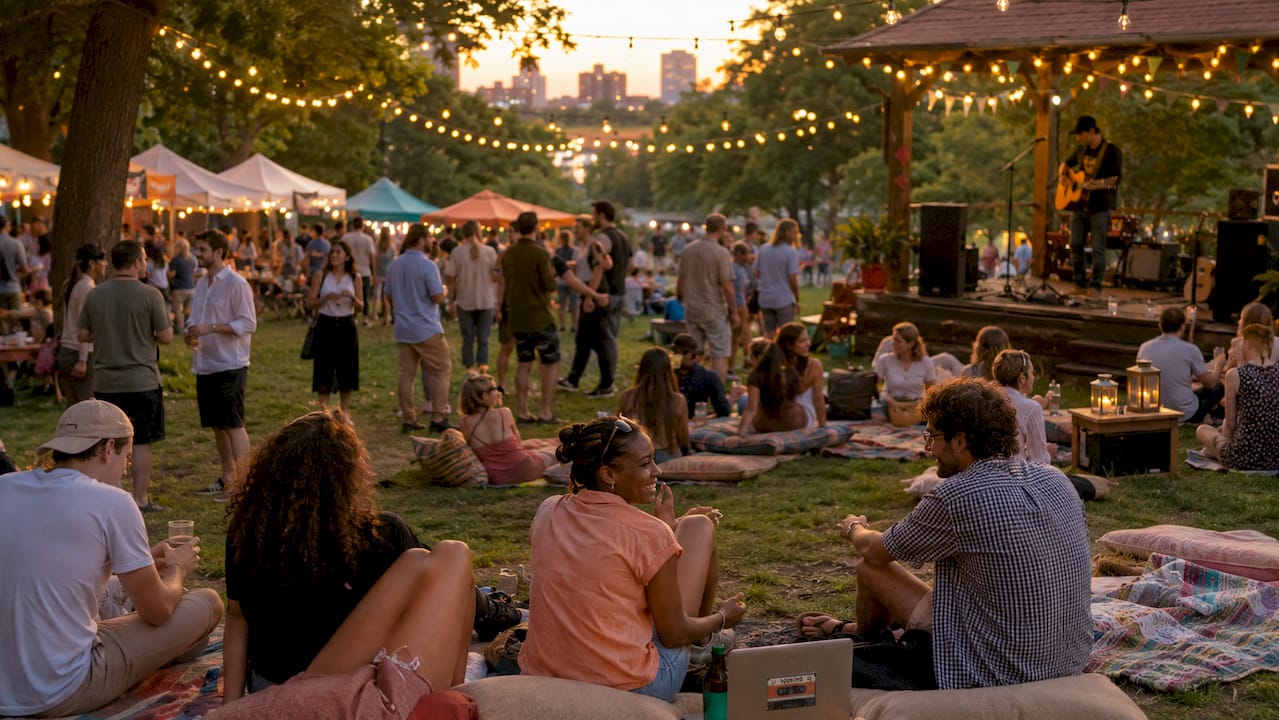
On the economic side, music festivals increase local visibility, attract tourists, and generate repeat visits that support restaurants, hotels, and small retailers. Small communities benefit disproportionately because a single well-run annual festival can put a town on the cultural map in ways that years of conventional marketing cannot replicate. The economic stimulation is direct and traceable.
| Benefit category | Specific outcome |
|---|---|
| Tourism and foot traffic | Festivals draw visitors who spend on lodging, food, and local retail |
| Artist and venue visibility | Emerging performers gain exposure; local venues build reputation |
| Community pride | Residents develop shared identity around a recurring cultural event |
| Reduced social isolation | Regular gatherings create ongoing social contact for isolated residents |
| Repeat engagement | Attendees return annually, building long-term community investment |
The social outcomes are harder to quantify but equally important. Regular music events reduce isolation by giving residents a predictable reason to gather. That matters most in rural areas and high-stress urban neighborhoods where community music practice acts as a protective buffer against fragmentation and loneliness.
Pro Tip: Pair your music event with a local market, food vendors, or community organization booths. The music draws the crowd. The surrounding activity gives people reasons to stay, talk, and return.
Community identity is another underrated output. When a neighborhood becomes known for a particular music scene or annual event, residents internalize that identity. They become advocates. They invite friends. They show up the following year. That cycle of pride and participation is how live events shape local culture over the long term.
How can activists and organizers use music events to build lasting engagement?
The difference between a music event that feels good once and one that actually changes a community comes down to intentional design. Passive attendance produces temporary enjoyment. Participatory design produces lasting social change.
Research on musical self-expression and empathy shows that programs blending individual creative voice with synchronized group activity produce stronger pro-social outcomes than events where audiences simply watch. The practical implication is clear: design for participation, not just performance.
Here is what that looks like in practice:
- Start with individual expression. Open mic formats, community songwriting workshops, or artist showcases featuring local performers give community members a stake in the event before it begins.
- Build toward collective moments. Structure the program so individual acts lead to a shared finale, a group sing-along, a collaborative performance, or a community-wide dance. The arc from "I" to "we" mirrors the psychological process of community formation.
- Treat music as an ongoing practice, not a one-off event. Long-term community building requires recurring engagement. A monthly neighborhood concert series does more for social cohesion than a single annual festival, even a large one.
- Design for physical access. Free or low-cost admission, accessible venues, and programming that reflects the actual demographic mix of the neighborhood all determine who shows up. Inclusion is a design choice, not a default.
- Partner with local organizations. Schools, faith communities, and neighborhood associations already have trust with residents. Partnering with them brings existing social networks into the event rather than starting from zero.
Bringing live music to your area does not require a large budget or a professional production team. It requires clarity about who you want in the room and what you want them to feel when they leave.
Live music also creates a neurological advantage that recorded music cannot replicate. Neural synchronization is significantly stronger during live performances than during recorded playback, especially with faster and more complex rhythms. That means the social bonding that happens at a live event is not just emotional. It is biological. Bodies in the same room, responding to the same live sound, literally synchronize with each other.
Key takeaways
Music events build community through collective effervescence, a shared emotional state that strengthens social bonds, reduces isolation, and produces measurable well-being lasting well beyond the event itself.
| Point | Details |
|---|---|
| Collective effervescence is the core mechanism | Shared emotional connection at live events predicts meaning and happiness more than music quality. |
| Live music outperforms recorded music socially | Neural synchronization is stronger in live settings, deepening the bonding effect on audiences. |
| Inclusivity requires intentional design | Free access, local representation, and participatory formats determine who benefits from music events. |
| Economic and social benefits compound together | Festivals build local identity, attract tourism, and reduce isolation simultaneously. |
| Ongoing programs beat one-off events | Recurring music engagement acts as a protective buffer against fragmentation and loneliness. |
Live music as the antidote to digital disconnection
I have watched communities spend years and significant money on engagement initiatives that produce polite attendance and little else. A well-designed music event does in two hours what a town hall meeting rarely achieves in two years. That is not an exaggeration. It is a pattern I keep seeing.
The reason is simple. Music bypasses the part of social interaction that requires trust to already exist. You do not need to know someone to share a moment with them in a crowd. That shared moment then becomes the foundation for trust. The sequence is reversed from how most community programs work, and that reversal is exactly why it is so effective.
What concerns me is how rarely community organizers treat music as a serious tool rather than a nice addition. The research on collective effervescence, neural synchronization, and pro-social behavior is not new. It is just underused. Social activists who understand this have a real advantage. They can design events that feel like celebrations but function like infrastructure.
The other thing I would push back on is the assumption that big festivals are the goal. A monthly neighborhood show at a local bar, a free outdoor concert in a park, a community choir that performs twice a year. These recurring, low-barrier touchpoints do more for long-term cohesion than a single marquee event. The goal is not spectacle. The goal is belonging.
If you are serious about community engagement through music, start by finding out what is already happening in your area. Hppn makes that search straightforward, and the local music scenes you find there are often the most authentic starting points for real community connection.
— Ari
Hppn and the live music communities around you
Finding the right live music event for your community starts with knowing what is actually happening nearby.
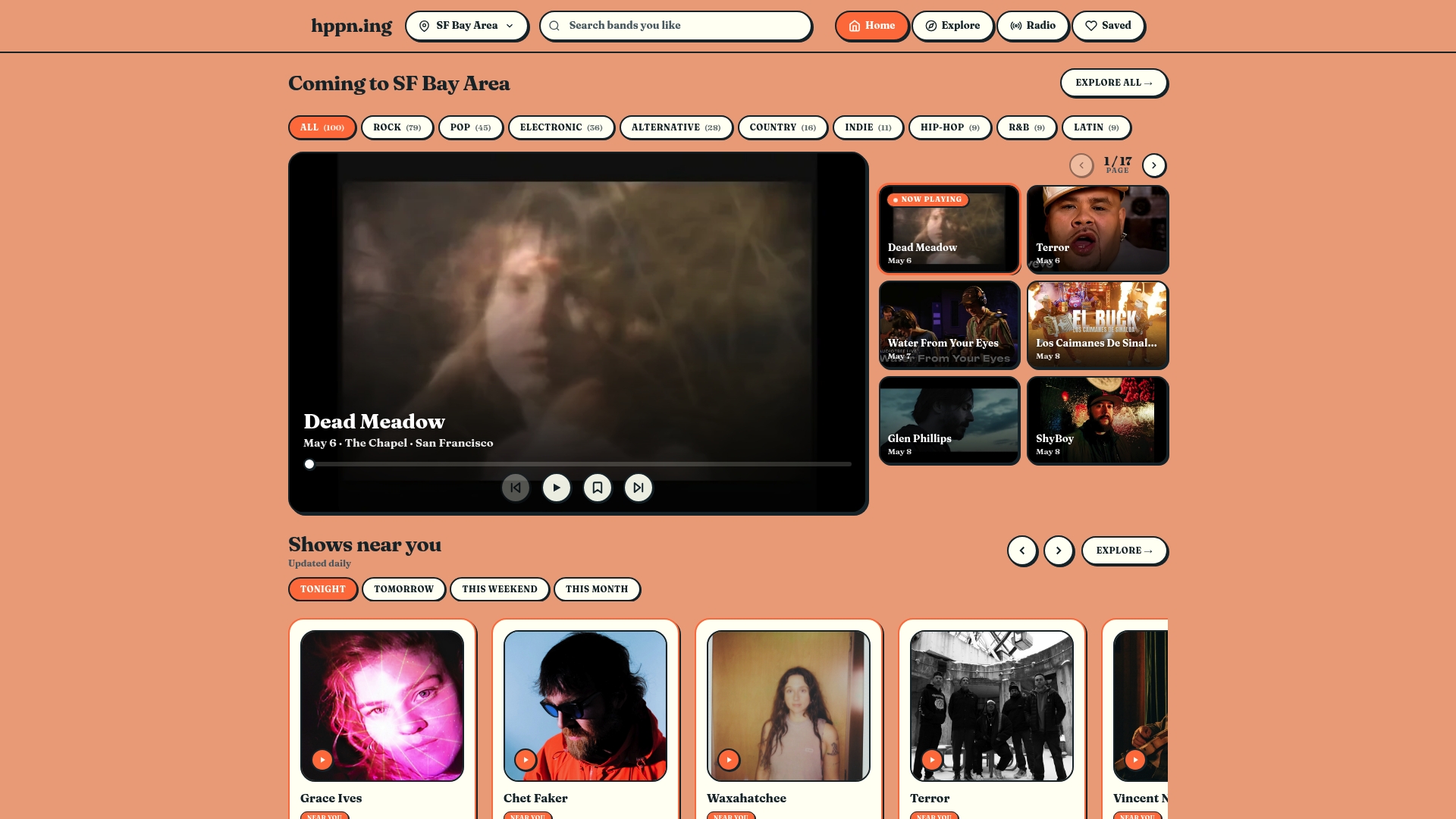
Hppn is built for exactly that. The platform lets you search local artists, preview their music before you commit to a show, and find upcoming events in your city, including underground performers and neighborhood acts that never appear on mainstream listings. For community members and activists who want to support local music scenes rather than just consume them, Hppn surfaces the artists and events that need an audience. Discover live music near you and find the shows worth showing up for.
FAQ
What is collective effervescence in music events?
Collective effervescence is the shared emotional and psychological connection that audiences experience together during live music. University at Buffalo research identifies it as the strongest predictor of meaning and community bonding at concerts, more influential than the technical quality of the performance.
How does live music reduce social isolation?
Regular live music events give community members a recurring reason to gather in person, which builds social contact and shared identity over time. Research shows that community music practice acts as a protective buffer against isolation, particularly in rural and high-stress environments.
Why is live music more socially bonding than recorded music?
Live performances produce stronger neural synchronization between listeners than recorded music does. That biological alignment deepens the emotional and social bonding that happens in a shared physical space.
How can social activists use music events for community engagement?
Activists get the strongest results by designing participatory events rather than passive performances. Programs that move from individual creative expression to synchronized group activity produce measurable pro-social behavior and lasting social cohesion.
What makes a music event inclusive for diverse communities?
Free or low-cost admission, accessible venues, and programming that reflects the actual demographic makeup of the neighborhood are the three core design choices. Live music functions as a third space where social and political differences become less defining, but only when the event is physically and financially accessible to everyone.