

A single concert night does more for your city than most people realize. Understanding why live music supports local economies means looking past the ticket stub and seeing the hotel bookings, restaurant tabs, parking fees, and bartender wages that ripple outward from every performance. Chicago's independent live entertainment sector alone generates $2.8 billion in annual economic output and supports nearly 17,000 jobs. For local business owners, community members, and policymakers, that number reframes live music from cultural amenity to economic engine. This guide breaks down exactly how that engine works and what you can do to keep it running.
Table of Contents
- Key Takeaways
- Why live music supports local economies
- Social benefits that keep people coming back
- The profitability gap threatening venue survival
- What local leaders and businesses can do now
- My take on live music as economic infrastructure
- Discover local music and support your scene
- FAQ
Key Takeaways
| Point | Details |
|---|---|
| Live music drives billions in output | Cities like Chicago and Austin generate billions annually from independent live music, supporting thousands of jobs. |
| Off-site spending multiplies impact | Hotels, restaurants, and retail benefit substantially from concertgoers spending beyond the venue itself. |
| Social bonds sustain economic demand | Shared live music experiences create lasting well-being and community ties that drive repeat attendance. |
| Venues face a profitability gap | High economic output does not protect venues from thin margins; many operate near or below breakeven. |
| Policy support determines longevity | Tax relief, funding programs, and ticketing reforms are what separate thriving scenes from declining ones. |
Why live music supports local economies
The economic effects of concerts extend far beyond the venue door. When someone buys a ticket to a show, they usually also book a table at a nearby restaurant, grab drinks at a bar down the block, and sometimes book a hotel room. That chain of spending is where the real local economy boost happens.
Chicago's data makes this concrete. Venue-driven tourism in the city produced $383.7 million in off-site spending on hotels, restaurants, bars, and neighborhood businesses in 2024 alone. San Francisco's independent stages generated $1.4 billion in total economic output and $151.9 million in annual off-site spending supporting hospitality and retail. Austin's Red River Cultural District saw its economic impact grow from $380M to $530M annually between 2021 and 2025, driven largely by visitor spending at festivals and venues.
These numbers represent wages paid to sound engineers, lighting technicians, venue staff, and security workers. They represent tax revenue collected from ticket sales, alcohol licenses, and business activity. They represent tourism dollars that would simply not exist without a compelling reason to visit.
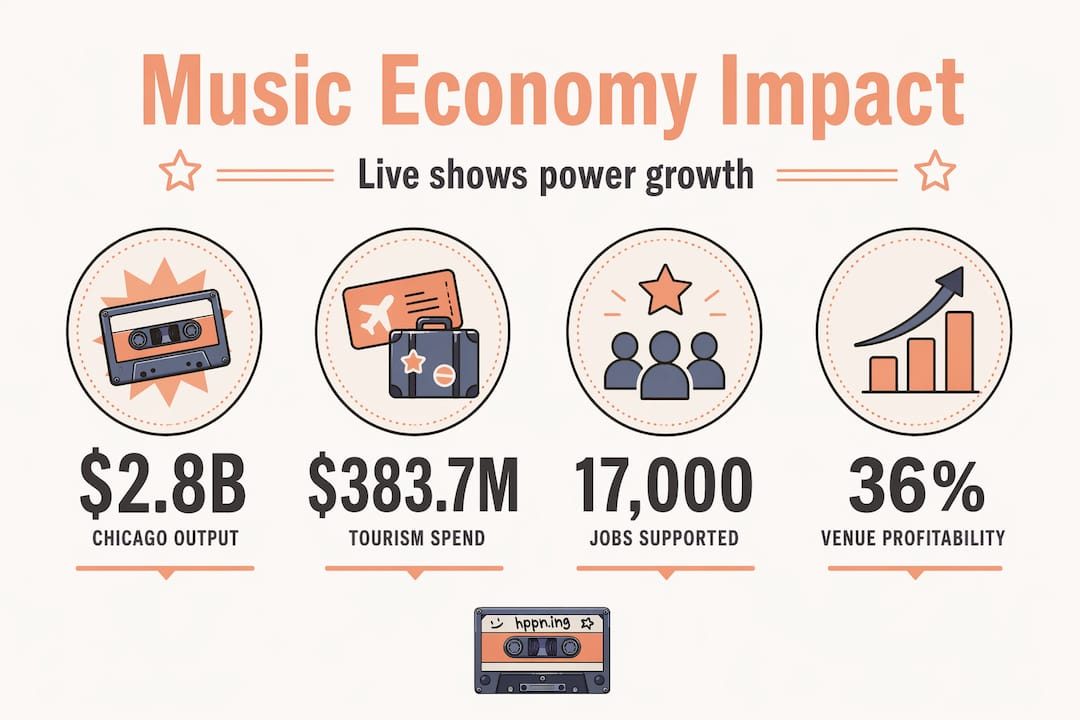
| City | Total economic output | Off-site/tourism spending | Jobs supported |
|---|---|---|---|
| Chicago | $2.8 billion | $383.7 million | ~17,000 |
| San Francisco | $1.4 billion | $151.9 million | Data pending 2026 |
| Austin (RRCD) | $530 million | Majority visitor-driven | 15-17 FTE per festival |
Pro Tip: When your city is making the case for live music funding, always request data that separates onsite venue revenue from off-site visitor spending. Off-site spending can exceed ticket sales and venue revenue, so measuring both is the only way to see the full picture.
The distinction between onsite and off-site impact matters especially for business owners near venues. If you run a restaurant within three blocks of a 500-person music venue, that venue may be generating more foot traffic for you than any marketing campaign you have run.
Social benefits that keep people coming back
Economic data tells you what live music is worth. Social science tells you why people keep showing up, which is ultimately what sustains that economic value over time.
Research on collective effervescence shows that the shared emotional connection people experience during live music events predicts well-being and social bonding, with effects that last for days after the show. This is not a vague feel-good claim. It is a measurable psychological phenomenon where strangers become temporarily synchronized through shared sound and movement. That synchronization creates loyalty to a place, a scene, and a community.
A 2026 pilot study found that live concert attendees reported stronger emotional responses and higher average heart rates than people watching the same performance via livestream. The researchers measured significantly higher "kama muta" scores, a term for the feeling of being moved or touched, in live settings versus virtual ones. No algorithm or streaming service can replicate what happens in a room full of people sharing the same music at the same time.
Here is what this means for live music community support in practical terms:
- Stronger well-being from regular live music attendance, backed by physiological data
- Deeper sense of belonging tied to local venues and scenes that people return to
- Cultural identity formed around shared music experiences that defines neighborhoods
- Civic engagement that grows when communities gather regularly around shared cultural events
- Repeat economic activity because people with strong social ties to a scene keep spending there
The social dimension of how fans and communities shape local music scenes is the invisible infrastructure underneath all those economic multipliers.
Pro Tip: Policymakers often discount social benefits because they are harder to quantify than tax revenue. Bring physiological and psychological research into budget conversations. When you can show that live music measurably improves community mental health and social cohesion, you make the case for public investment far more effectively.
The profitability gap threatening venue survival
Here is the uncomfortable truth behind the impressive economic output numbers. High aggregate impact does not mean the venues generating it are financially healthy.
In San Francisco, only 36% of independent stages reported profitability in 2024. In the UK, grassroots music venues contribute over £500 million annually to the economy while operating on average profit margins of just 2.5%, with 53% reporting no profit at all. Recent policy changes around tax burdens and national insurance led to a 19% reduction in jobs at these venues, showing exactly how quickly policy decisions can reverse economic gains.
| Metric | Chicago | San Francisco | UK grassroots venues |
|---|---|---|---|
| Total economic output | $2.8 billion | $1.4 billion | £500M+ |
| Avg. profit margin | Not published | Low (36% profitable) | 2.5% |
| Venues reporting no profit | Not published | 64% | 53% |
| Jobs at risk from policy change | Not published | Significant | 19% reduction reported |
This gap matters enormously for economic development planning. A venue can anchor an entire block of restaurants, bars, and retail shops while itself operating at a loss or near breakeven. When that venue closes, the off-site spending it generated disappears too. The restaurants lose their Friday night rush. The parking lot loses weekend revenue. The neighborhood loses its identity as a destination.
Independent venues are cultural anchors that require targeted support to remain viable, and that support needs to come from policy, not just box office sales. NIVA has framed independent stages as essential infrastructure and called for funding and ticketing policy improvements to preserve both economic and cultural value. That framing is correct. You would not expect a highway to be fully self-funding. The same logic applies to the venues that generate billions in surrounding economic activity.
What local leaders and businesses can do now
Understanding the economics is only useful if it produces action. Here are concrete steps that communities, policymakers, and business owners can take to maximize the benefits of live performances and local growth.
-
Map your venue ecosystem. Identify every independent music venue in your area and calculate their geographic reach in terms of surrounding businesses. This creates a defensible economic argument for policy support.
-
Build formal partnerships between venues and local businesses. Restaurants, hotels, and retailers near music districts can share marketing costs, create joint promotions on show nights, and develop packages that drive both foot traffic and ticket sales. Austin's Red River Cultural District uses exactly this partnership strategy between venues and local businesses to amplify economic benefits.
-
Advocate for targeted tax relief. Venue-specific tax programs that recognize thin margins can prevent closures that would otherwise wipe out millions in local economic activity. The UK example shows what happens when policy moves in the wrong direction.
-
Support festival integration into economic development plans. Music festivals and economy are not separate conversations. Single festivals in Austin generated over $2 million in economic impact and supported 15 to 17 full-time equivalent jobs each. Budget for this in your city's economic development strategy.
-
Expand access and programming diversity. Inclusive programming that serves multiple demographics broadens the audience base, increases attendance frequency, and strengthens the community ties that sustain economic demand over time.
-
Use local concert calendars as community tools. Learning how to use local concert calendars to drive community awareness is one of the simplest ways to increase venue revenue without changing anything about the venue itself.
My take on live music as economic infrastructure
I have spent years watching city planners celebrate the economic impact of live music while simultaneously failing to protect the venues producing it. The data is always impressive. The policy response is rarely adequate.
What I have learned is that communities tend to treat live music as a symptom of a healthy economy rather than a cause of one. That inversion has real consequences. If you wait for a neighborhood to be thriving before investing in its music venues, you have the causality backwards. The role of public spaces in live music is often where economic renewal actually starts, not where it ends up.
The physiological research on live versus virtual attendance confirmed something I already believed from observation. There is no substitute for being in a room with other people around a shared experience. That irreplaceability is what gives live music its economic staying power. Streaming has not killed it. If anything, the contrast has made the live experience more valued, not less.
My honest concern is the profitability gap. I see city officials point to billion-dollar impact figures while the actual venues contributing to those figures operate at 2.5% margins or less. That is not a sustainable ecosystem. It is a system living on borrowed time, and the closures come quietly, one venue at a time, until a neighborhood loses its character entirely.
The bottom line: treat venues like the infrastructure they are. Fund them accordingly. Measure both their direct and indirect economic contributions. And do not wait for a closure to prove the point.
— Ari
Discover local music and support your scene
Understanding the economics behind live music is step one. Step two is showing up.
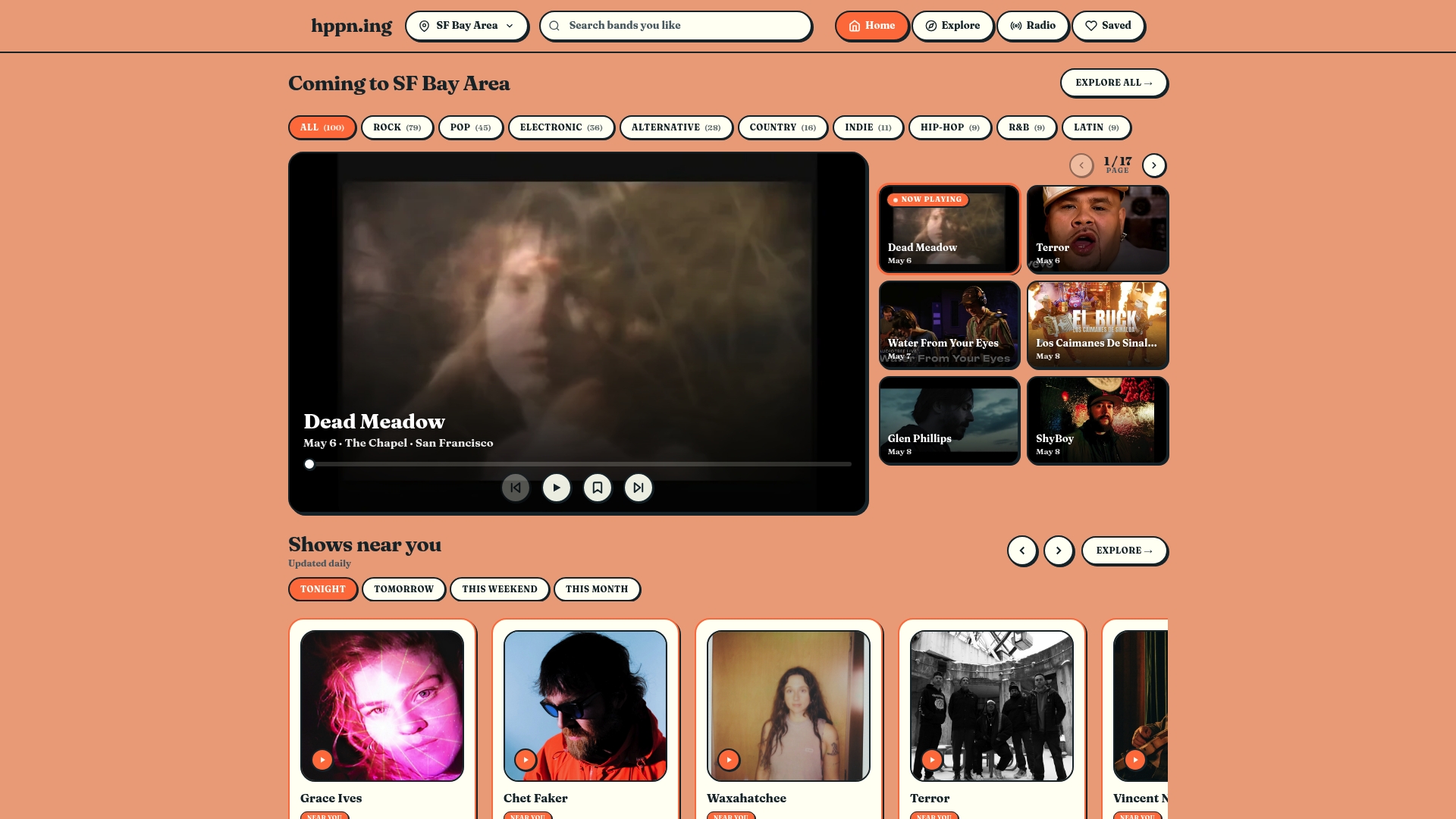
Hppn is built specifically for the kind of music discovery that keeps local scenes alive. The platform lets you browse concerts by location, preview artists before you go, and connect with a community of people who take live music seriously. Every show you attend through Hppn supports the venues, artists, and neighborhoods this article is about. You can discover live music near you and find emerging local performers who are building the next wave of your city's music identity. Want to stay current on who is trending in your area? Hppn's live music charts surface the artists gaining momentum before they sell out. Your next favorite show is closer than you think.
FAQ
How much does live music contribute to local economies?
Chicago's independent live music sector alone generates $2.8 billion in annual economic output and supports nearly 17,000 jobs, with $383.7 million flowing to off-site businesses like hotels and restaurants. Cities like San Francisco and Austin show similar patterns, confirming that live music is a major economic driver.
What is the difference between onsite and off-site economic impact?
Onsite impact includes ticket sales and venue revenue, while off-site impact covers what concertgoers spend at nearby restaurants, hotels, bars, and retail shops. Off-site spending often exceeds venue revenue, making it the larger share of live music's total economic contribution.
Why do music venues struggle financially despite high economic output?
Thin profit margins, high operating costs, and policy burdens create a profitability gap where venues generate significant surrounding economic activity while themselves operating near breakeven. In the UK, 53% of grassroots venues reported no profit despite contributing over £500 million to the broader economy.
How does live music benefit communities beyond economic impact?
Research shows that live attendance produces measurable increases in well-being, social bonding, and emotional connection through collective effervescence, with effects lasting days after the event. These social benefits drive repeat attendance, which is what sustains economic activity over time.
What can local policymakers do to protect live music venues?
Targeted tax relief, dedicated venue funding programs, and ticketing policy reforms can help venues survive their thin margins without reducing the economic output they generate. NIVA and the Music Venue Trust both frame independent venues as essential infrastructure deserving the same policy support as other economic anchors.