

Music platforms serve local communities by connecting fans to regional artists, funding local venues, and replacing passive algorithmic listening with genuine cultural participation. This shift from mainstream discovery to community-driven engagement is reshaping how towns and cities experience live music. Platforms built around local music engagement are proving that the benefits of music platforms for towns go far beyond streaming numbers. The most effective models combine curated event listings, membership funding, and infrastructure support to give regional artists a real economic foothold.
How music platforms serve local communities through community-centered models
Community-centered music platforms are defined by one core shift: listeners spend more time discovering new artists rather than replaying familiar favorites. Listeners engage with new music 43% of the time on community-focused platforms, compared to just 24% on traditional streaming services. That gap represents a fundamental change in how people relate to music and to each other.
"The goal is no longer to go viral. The goal is to build forever fans — people who show up, share, and stay." Industry executives now frame community-driven engagement as the primary metric that matters, not passive stream counts.
Peer recommendations drive this shift more than any algorithm. Fans who discover music through other listeners' "Liked By" sections engage at triple the rate of those who find it through automated suggestions. That triple engagement rate is not a marginal improvement. It signals that human curation builds trust in a way that no recommendation engine currently replicates.
Algorithmic discovery has a well-documented weakness: it rewards what already works. Songs that fit existing listener profiles get pushed forward, while unfamiliar regional artists get buried. Community-centered models invert this logic by making peer sharing the primary discovery mechanism. The result is a listening culture that actively seeks out new voices rather than defaulting to the familiar.
Platforms that convert casual listeners into active community members create a self-reinforcing cycle. Fans share artists they love, those artists gain local traction, and the community grows around shared taste rather than algorithmic coincidence. This is how music connects communities at a structural level, not just a sentimental one.
How financial support and membership communities empower local musicians
Membership-driven funding is one of the most direct ways music platforms create community impact. Sonic Guild has invested over $7.3 million across three U.S. hubs, using membership fees to fund artist grants and community events. That investment did not come from advertising revenue or venture capital. It came from fans and artists who paid to belong.
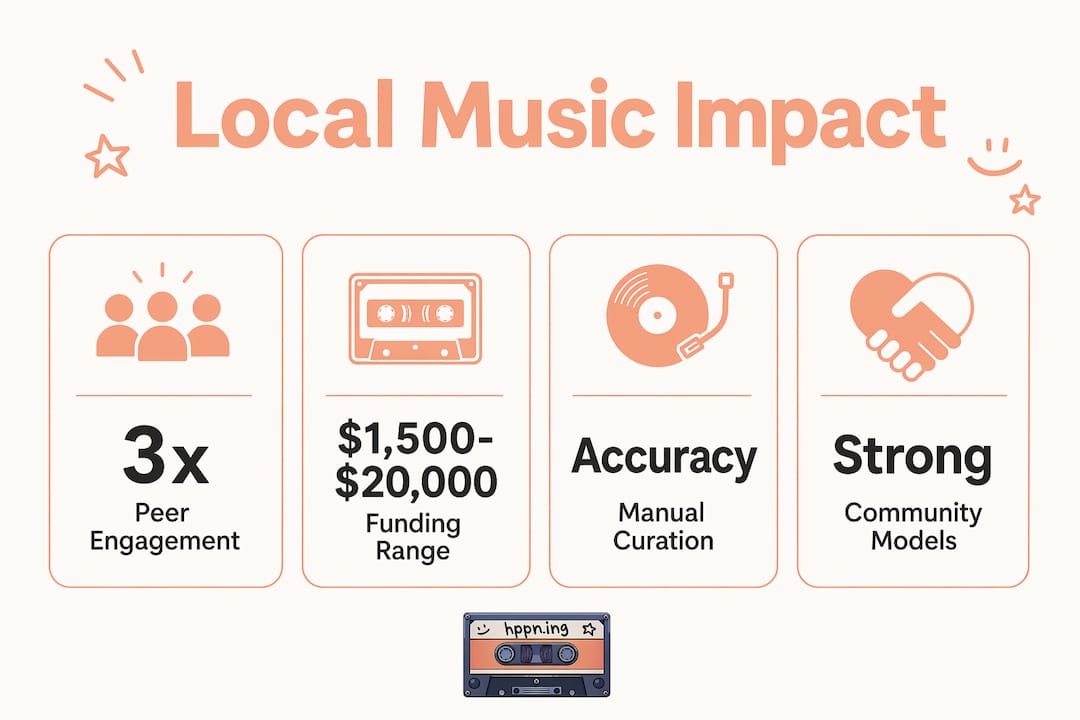
Sonic Guild's grant program awards between $1,500 and $20,000 to individual artists, with a focus on DIY musicians and marginalized communities. These are unrestricted grants, meaning artists spend the money on what they actually need: tour costs, recording equipment, or studio time. Unrestricted funding is rare in the music industry, and its absence is often what keeps promising regional artists from scaling beyond their hometown.
The programs supported by this model go well beyond financial transfers:
- Tour support grants cover travel and logistics for artists performing outside their home market.
- Production funding helps artists record at a professional level without taking on debt.
- Community event programming brings local artists in front of new audiences within their own cities.
- Inclusion initiatives prioritize artists from communities historically underrepresented in mainstream music.
Pro Tip: If you are a local artist looking for funding, research membership-based music organizations in your region before applying to traditional grants. Membership communities often move faster and impose fewer restrictions on how funds are used.
Membership models also rebuild local music economies in ways that streaming revenue alone cannot. A regional artist earning fractions of a cent per stream needs millions of plays to generate meaningful income. A $2,000 unrestricted grant from a community organization can fund an entire regional tour. The math strongly favors community investment over passive streaming as a support mechanism for independent musicians.
What curated local event platforms do for music scene vitality
Manually curated event listings outperform automated scraping in every metric that matters to local music fans: accuracy, trust, and discoverability. The Music Local app in Tallahassee lists 400 events with 1,500 weekly users, and venue operators report increased foot traffic directly tied to the platform. That is a measurable community impact from a single locally focused tool.
The founders of Music Local built the platform on a deliberate principle: human-curated listings prevent the fragmentation and inaccurate data that automated scraping consistently produces. Scraped event data often contains duplicate listings, outdated times, and missing venue details. Human curation eliminates those errors and builds the kind of reliability that keeps fans coming back.
| Feature | Automated scraping | Manual curation |
|---|---|---|
| Data accuracy | Variable, often outdated | High, regularly verified |
| Ad-free experience | Rarely guaranteed | Typically maintained |
| Local artist visibility | Algorithmic, biased toward known acts | Equal access for emerging artists |
| Community trust | Low due to errors | High due to consistency |
Centralized event calendars also solve a problem that local music fans know well: the effort required to find out what is happening nearby. Without a single source of truth, fans check multiple venue websites, social media pages, and word-of-mouth channels. A curated platform collapses that effort into one place, which directly increases attendance at shows that would otherwise go unnoticed.
The Alexandria pilot program showed similar results, with community feedback confirming both cultural and economic benefits for local neighborhoods. Finding local music festivals and smaller venue shows becomes a habit rather than a chore when the discovery process is frictionless and reliable.
How platforms address infrastructure challenges for regional artists
Supporting local artists globally requires solving problems that most listeners never see. Payment infrastructure is the most significant barrier. Platforms like SongDis distribute music to over 200 platforms with local currency withdrawals and native-language support, specifically designed to help independent African artists participate in the global digital economy. Without local currency payouts, artists in Nigeria or Ghana receive dollar-denominated payments that lose value through conversion fees before they arrive.
The infrastructure challenges go deeper than currency:
- Location verification requires trust architectures that detect and block VPN and spoofing activity. Without accurate location data, fair artist payouts based on where listeners actually are become impossible to calculate.
- Micro-payment systems must process thousands of small transactions accurately and at low cost, which demands purpose-built financial infrastructure rather than standard payment processors.
- Native-language interfaces reduce friction for artists who do not operate in English, making platform onboarding and royalty tracking accessible to a much wider global creator base.
- Local currency withdrawals eliminate conversion losses that disproportionately affect artists in economies with weaker currencies relative to the U.S. dollar.
Pro Tip: If you are an independent artist outside North America or Western Europe, prioritize platforms that explicitly offer local currency payouts. The difference between dollar-denominated and local-currency payments can represent a significant portion of your actual take-home income.
These infrastructure investments matter for community impact because they determine which artists can realistically participate in digital music economies. A platform that only serves artists with U.S. bank accounts and English-language interfaces is not a community platform. It is a platform for a specific community, and a narrow one at that. Addressing these gaps is what separates platforms with genuine global community reach from those with global reach in name only.
Practical benefits for communities and music lovers from local-focused platforms
Local-focused music platforms produce benefits that extend well beyond the listening experience. Music events increase neighborhood social capital, drive business traffic to surrounding venues and restaurants, and give communities a shared cultural identity. These are not abstract outcomes. They show up in foot traffic data, local business revenue, and the simple fact that people who attend live shows together tend to form lasting connections.
The practical benefits for music lovers and their communities include:
- Cultural preservation: Regional artists carry the sounds, stories, and traditions of their communities. Platforms that surface these artists help preserve cultural identity that mainstream algorithms routinely ignore.
- Community pride: Discovering a local artist who captures something true about your city creates a sense of pride that national acts rarely generate. That pride translates into sustained fandom and word-of-mouth promotion.
- Economic circulation: Money spent on local shows, merchandise, and memberships stays within the community far longer than streaming revenue that flows to major label accounts.
- Social connectivity: Live music events create the conditions for face-to-face connection. Platforms that make those events easy to find directly increase the frequency of those connections.
- Artist sustainability: When fans discover regional musicians through live music discovery tools and attend their shows consistently, those artists can build careers without relocating to major music markets.
The cultural importance of local scenes is well established, but the mechanism that makes them thrive is access. When fans can easily find out who is playing, preview the artist before buying a ticket, and share that discovery with friends, attendance grows. Platforms that reduce the friction between curiosity and attendance are the ones that actually move the needle for local music economies.
Key Takeaways
Music platforms that prioritize community engagement over algorithmic reach produce measurably stronger outcomes for local artists, fans, and neighborhoods alike.
| Point | Details |
|---|---|
| Community models outperform algorithms | Listeners on community-focused platforms spend 43% of their time discovering new music, nearly double the industry average. |
| Membership funding changes artist economics | Sonic Guild's $7.3 million investment shows that fan-funded grants outperform streaming micro-payments for independent artists. |
| Manual curation builds trust | Human-curated event listings like Music Local's 400-event catalog drive real venue attendance and community reliability. |
| Infrastructure determines inclusion | Local currency payouts and native-language support determine which regional artists can realistically participate in digital music. |
| Discovery friction is the real barrier | Platforms that make local shows easy to find directly increase attendance, social connection, and neighborhood economic activity. |
The uncomfortable truth about "community" in music platforms
I have spent years watching the word "community" get applied to features that are really just engagement metrics dressed up in warmer language. A playlist you can share is not a community. A comment section under a track is not a community. Real community in music requires something that most platforms are not designed to provide: the conditions for people to show up for each other repeatedly, not just for the content.
What I find genuinely encouraging about the current moment is that some platforms are building around that harder standard. Sonic Guild's membership model works because it asks fans and artists to make a real commitment, not just click a follow button. The Music Local approach works because someone is actually checking whether that Tuesday night show at the small venue downtown is still happening. These are unglamorous, labor-intensive choices. They do not scale as easily as an algorithm. That is exactly why they work.
The risk I see ahead is that "community" becomes a marketing layer applied to platforms that are still fundamentally built around passive consumption. Listeners who want genuine local engagement need to be honest with themselves about the difference. A platform that surfaces trending national artists with a local filter is not the same as one built from the ground up around regional discovery and artist support.
My honest view is that the platforms worth supporting are the ones that make it slightly harder to be passive. They ask you to engage, to share, to show up. That friction is not a design flaw. It is the mechanism by which music actually connects communities rather than just entertaining them.
— Ari
Hppn makes local music discovery worth your time
Local music scenes thrive when fans can find shows before they sell out and discover artists before they leave town. Hppn is built specifically for that moment of discovery, combining curated live music charts, artist previews, and community notes into one place designed for people who care about what is happening nearby.
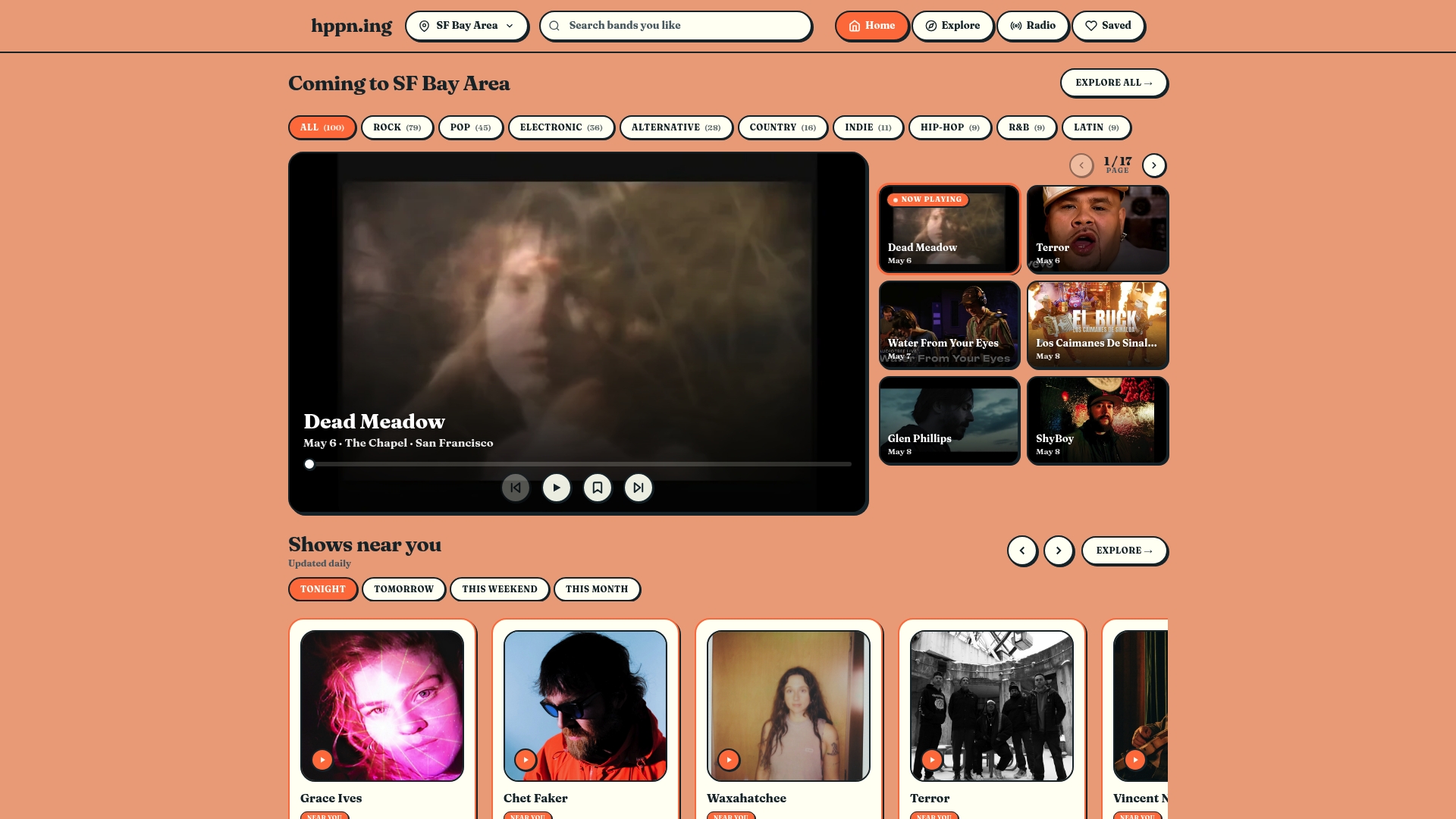
Browse live music near you to preview artists by audio and video before committing to a ticket. Check the trending local artists chart to see who is gaining traction in your city right now. Join the conversation in community notes to share what you have seen and find out what other local fans are recommending. Hppn puts the regional music scene front and center, so the artists who deserve your attention are the ones you actually find.
FAQ
How do music platforms serve local communities?
Music platforms serve local communities by surfacing regional artists, curating local event listings, and creating funding mechanisms that keep money circulating within local music economies. The most effective platforms combine discovery tools with community engagement features that go beyond passive listening.
Why does community curation outperform algorithmic recommendations?
Fans who discover music through peer recommendations engage at triple the rate of those who find it through automated suggestions. Human curation builds trust and surfaces artists that algorithms consistently overlook because they lack existing listener data.
What is the role of membership funding in supporting local artists?
Membership-driven organizations like Sonic Guild provide unrestricted grants between $1,500 and $20,000 directly to independent artists, funding tours, production, and community events that streaming revenue alone cannot support.
How do local event platforms increase venue attendance?
Manually curated platforms like Music Local eliminate the fragmented, inaccurate data that automated scraping produces, giving fans a reliable single source for local shows. Reduced discovery friction directly translates into higher attendance at smaller venues.
What infrastructure do platforms need to support artists globally?
Platforms need local currency payouts, native-language interfaces, and location-verification systems to serve independent artists outside major Western markets. Without these features, artists in regions like West Africa face conversion losses and access barriers that effectively exclude them from digital music economies.