
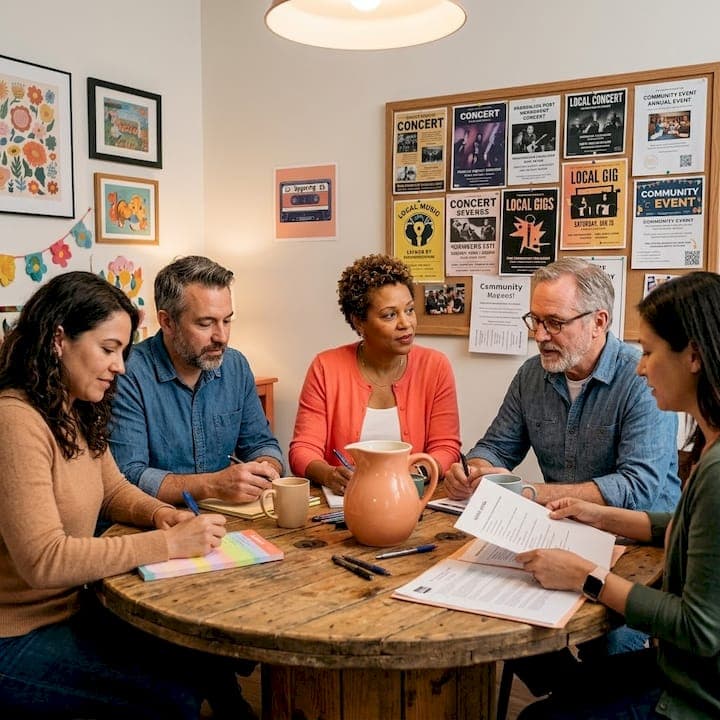
Most people assume community boards spend their time on zoning disputes and noise complaints. But understanding how community boards support live music reveals something far more interesting. These local governance bodies actively fund concerts, shape venue regulations, and decide which artists get platforms in your neighborhood. The impact of community boards on local music scenes is direct, structural, and often the difference between a thriving local music culture and a scene that quietly disappears.
Table of Contents
- Key takeaways
- How community boards support live music through funding
- Zoning and regulations that shape your local music scene
- How community advisory boards oversee music programming
- Tensions between boards, funding, and independent music scenes
- How to engage with community boards effectively
- My take on advocating for live music in local governance
- Find the live music your community is building
- FAQ
Key takeaways
| Point | Details |
|---|---|
| Boards fund live music directly | Concert series like Castle Rock's 'Tunes for Trails' use community boards to channel money toward parks through music events. |
| Zoning decisions protect small venues | Community boards establish regulatory buffers that keep large entertainment companies from displacing independent venues. |
| Committee meetings are where it counts | Most board decisions are finalized at committee level, not full meetings, so advocates must show up early. |
| CABs provide programming oversight | Community Advisory Boards evaluate music programming quarterly to align it with neighborhood needs and values. |
| Inclusive board composition matters | Boards that include working music professionals make better decisions for local musicians and diverse music communities. |
How community boards support live music through funding
The connection between community boards and live music funding is more hands-on than most residents realize. Local boards often act as the organizing backbone for recurring concert series that generate real money for community projects. Castle Rock's 'Tunes for Trails' series is a strong example: beverage sales and donations from free monthly concerts directly fund trail and park maintenance. The music is the mechanism, not the decoration.
Community-organized festivals operate on a similar model. Volunteer labor keeps costs low, and admission fees or sponsorships go back into local causes. The Three Rivers Music Festival keeps its community-first ethos intact by offering volunteers free tickets and meals in exchange for shifts, a model that only works when a board actively coordinates logistics and relationships.
Nonprofit music boards and advisory panels play a separate but equally important role. They manage programming budgets, vet grant applications, and decide which local musicians and genres get featured at publicly supported events. Understanding how music events are organized locally helps you see why board decisions carry so much weight before a single note is played.
Here is what community boards typically do on the funding and organizing side:
- Allocate public or donated funds to specific concert programs tied to parks, trails, or cultural districts
- Partner with local nonprofits to co-produce festivals that reduce costs through volunteer coordination
- Review and approve grant applications from local music organizations
- Establish recurring concert series with measurable community benefit goals
Pro Tip: If you want to pitch a concert series to your local board, tie it to a community benefit beyond entertainment. Proposals that fund trail maintenance, youth programs, or neighborhood revitalization get approved far more often than purely cultural pitches.
Zoning and regulations that shape your local music scene
Zoning is not a glamorous topic, but it is one of the most powerful tools community boards use to either protect or undermine independent music venues. When a large entertainment company moves into a neighborhood, it can price out smaller venues or trigger noise complaints that force them to close. Boards have real authority here.
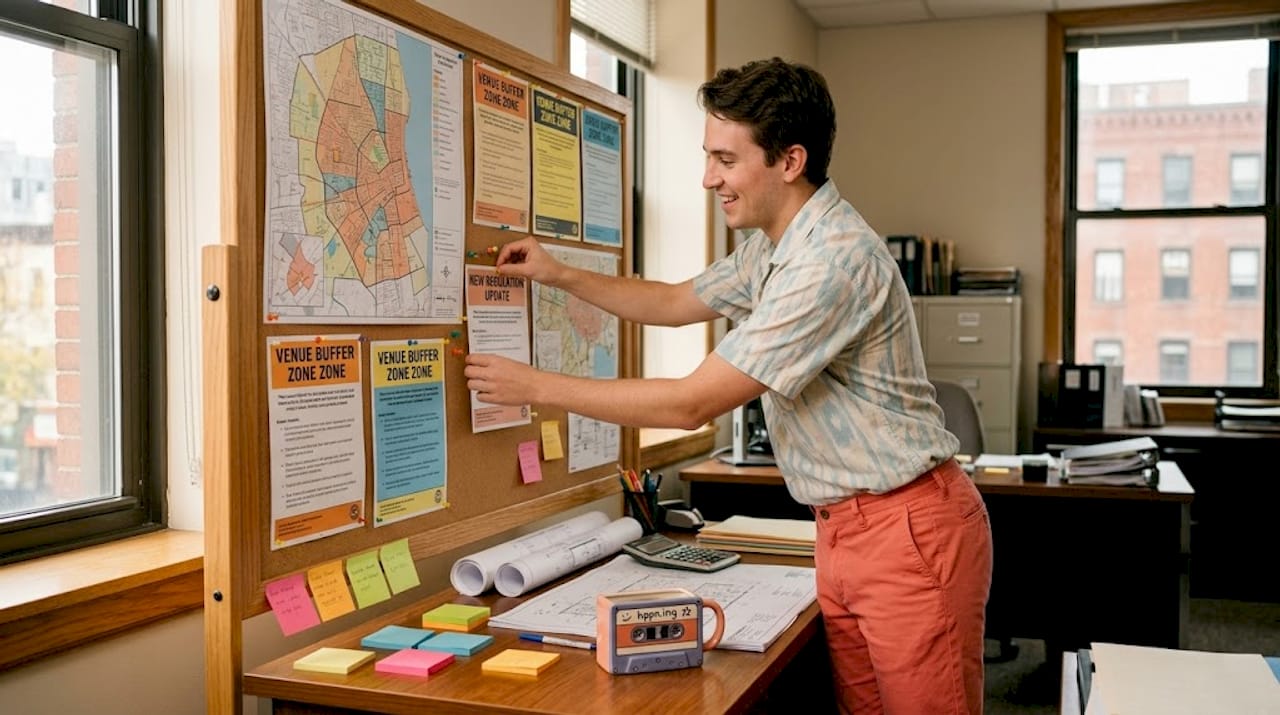
In April 2026, a Portland, Maine ruling established a 750-foot buffer between venues with a capacity over 1,000. That single zoning decision protected the ecosystem of smaller venues that make up the actual heartbeat of the city's music scene. The Maine Music Alliance's advocacy work, taken directly to community board committees, made that ruling possible.
Noise ordinances, safety codes, and licensing requirements all flow through the same regulatory channels. A venue that cannot afford soundproofing upgrades or lacks a clear emergency plan can be denied a license at the board level even when neighborhood support exists. The good news is that preparation works. A karaoke bar proposal in Beacon, New York succeeded largely because the developer submitted clear acoustic and safety documentation before the board meeting, not after questions arose.
If you are an advocate trying to influence these decisions, here is the sequence that actually works:
- Attend committee meetings, not just full board sessions. Most zoning decisions are finalized at committee level before they ever reach a full board vote.
- Document technical solutions in advance. Boards respond well to venues that arrive with noise mitigation plans, not promises to figure it out later.
- Build relationships with the land use or zoning committee members specifically. These are the people who draft the language that eventually becomes policy.
- Reference precedent from other cities. Portland's 750-foot buffer ruling gives advocates in other cities a concrete model to cite.
Pro Tip: Request the committee meeting schedule from your local board's office, not just the public calendar. Committee meetings are often less publicized but are where your input has the most weight.
How community advisory boards oversee music programming
Community Advisory Boards, commonly called CABs, serve a specific oversight function that goes beyond event organizing. They evaluate whether programming aligns with community values, reflect diverse listener needs, and measure impact over time. Their role sits somewhere between a watchdog and a collaborator.
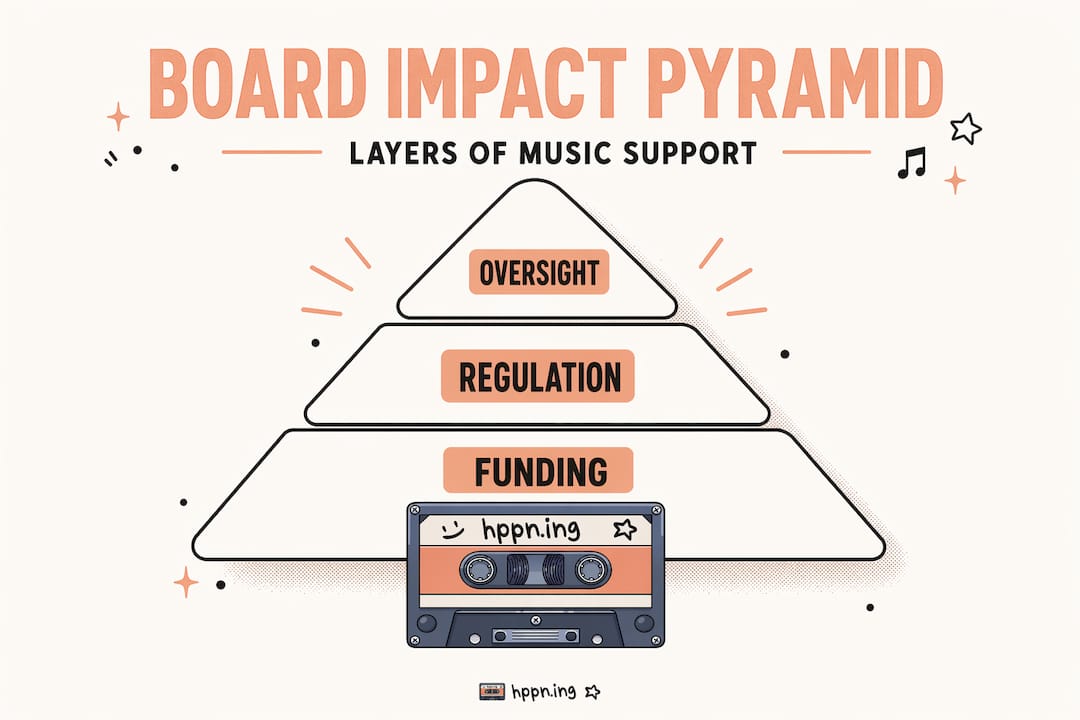
WFUV's CAB is a well-documented example of this structure in action. The board meets quarterly in March, June, September, and December. Meetings are open to the public with advance registration, which means any community member can attend and participate. That openness is significant. It means your voice can directly shape how a public radio station programs music for your region.
CABs typically handle several distinct functions:
- Reviewing audience feedback and community surveys to assess programming satisfaction
- Recommending genre diversity or underrepresented artist inclusion in regular programming
- Evaluating grant outcomes and educational music initiatives tied to the station or organization
- Recognizing music educators and community contributors through awards programs
The role of CABs in recognizing music education is worth noting specifically. When boards give public recognition to teachers, youth programs, or community organizations doing music work, it creates visibility that attracts more funding. Recognition functions as a form of amplification for supporting local musicians who might otherwise go unnoticed by larger cultural institutions.
Tensions between boards, funding, and independent music scenes
Here is the part most articles skip. Community boards and government cultural programs, even when well-intentioned, can inadvertently favor certain music cultures over others. Direct government cultural programming risks board neutrality when funding decisions reflect the tastes or networks of whoever currently sits on the board rather than the actual diversity of the local scene.
This is not a theoretical concern. When a board lacks members with active ties to music communities, the concerts and artists that get funded tend to reflect a narrow slice of what is actually happening locally. The result is that genre-specific communities, particularly those tied to hip-hop, electronic music, or immigrant cultural traditions, often miss out on resources that go to more institutionally familiar forms.
The solution is board composition. When active music professionals join nonprofit boards with real industry experience, the quality and reach of music programming expands. Concert promoter Peter Shapiro's appointment to TeachRock's board during its national expansion is a concrete example of how one practitioner-level addition can reorient an entire organization's approach.
"What can the boardroom learn from the musician? Improvisation, mutual listening, and a willingness to respond to what the room actually needs." — from European Business Review
That mindset shift, from top-down curation to genuine community listening, is exactly what the relationship between fans and local music scenes needs from the governance side.
How to engage with community boards effectively
Showing up is not enough. The community members who actually change outcomes at board meetings come prepared, arrive early in the process, and make specific asks. General frustration rarely moves boards. Specific, actionable support requests for grants or initiatives consistently gain more traction.
Here is a practical framework for community involvement in music advocacy:
- Identify your committee before the full board. Find out which committee handles cultural affairs, parks, or land use in your district. That is your primary audience.
- Speak during public comment with one specific ask. "We are requesting a formal review of the noise ordinance buffer zone for venues under 200 capacity in the arts district" beats any amount of general appeal.
- Build a coalition before you walk in. A letter signed by ten venue owners, five music educators, and three neighborhood associations carries exponentially more weight than a solo appearance.
- Follow up in writing. After attending a meeting, send a brief summary of your position and request to the relevant committee chair. Boards respond to documented engagement.
Pro Tip: Ask your city council member's office for a meeting before you attend a board session. A council member who supports your position can flag your issue to committee members in advance, giving your public comment a foundation to land on.
Community involvement in music does not require political experience. It requires consistency. The advocates who shift outcomes are often the ones who show up to three or four meetings in a row, not the ones who make a single passionate plea.
My take on advocating for live music in local governance
I've sat through enough community board meetings to know that the experience can feel disconnected from what actually matters to musicians and fans. The room often skews formal, the language is procedural, and it can seem like the decisions are already made before you speak. But I've also seen that change when the right people show up consistently.
What I've found is that the advocates who make real progress treat board participation less like activism and more like relationship-building. They introduce themselves to committee members outside of formal sessions. They find common ground before debates arise. They bring data, not just stories, and they bring stories alongside the data.
The most meaningful shift I've witnessed came in a city where a group of local musicians and venue owners started attending the zoning committee monthly, not just when a specific venue was threatened. Over time, they became a recognized voice. Board members started calling them before decisions were made, not after.
Live music is not a luxury feature of a neighborhood. It is infrastructure for community identity. When I think about the boards that get this right, they are the ones that include people who have actually been in a venue at midnight when a local band breaks through to a packed room. That experience changes what you fight for.
— Ari
Find the live music your community is building
If community boards are doing the work of supporting local music, you deserve tools that help you actually find it. Hppn is built exactly for this moment.
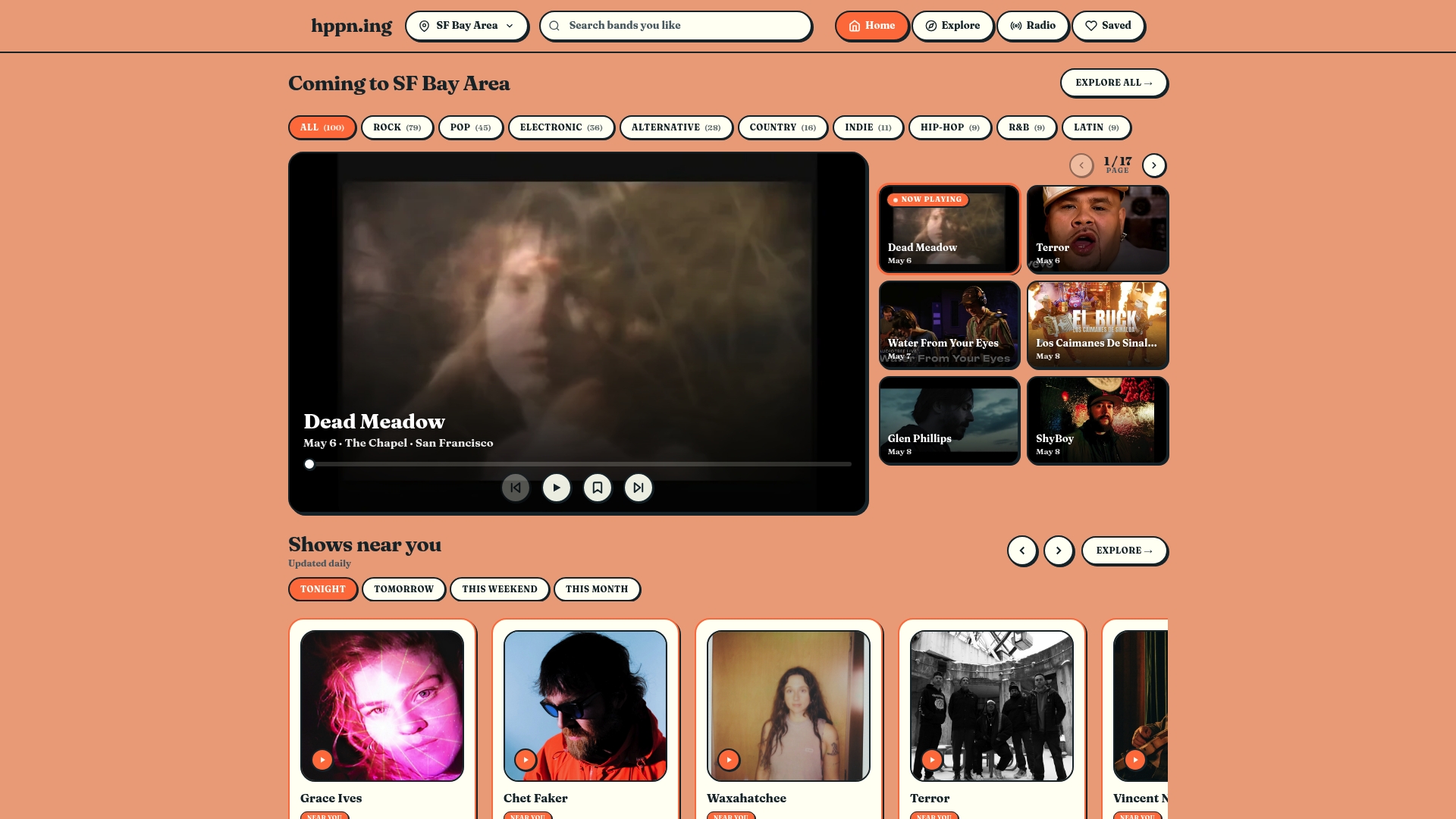
Hppn connects you directly to the local shows, emerging artists, and underground scenes that community support for music is designed to grow. You can preview artists and find shows near you, discover trending local performers before they outgrow the room, and join live music discussions tied to your city's scene. Every feature on Hppn is oriented toward the same goal community boards are working toward: making sure local music reaches the people who want it. Start exploring what is happening in your city right now at hppn.ing.
FAQ
What do community boards actually do for live music?
Community boards support live music by funding concert series, influencing zoning laws that protect small venues, and overseeing music programming through advisory roles. Their decisions directly shape which artists get platforms and which venues stay open.
How does zoning affect local music venues?
Zoning rules set by community boards can protect independent venues by creating distance requirements from larger entertainment companies. Portland, Maine's 2026 ruling establishing a 750-foot buffer between high-capacity venues is a recent example of this in practice.
What is a Community Advisory Board for music?
A Community Advisory Board evaluates music programming to check it aligns with local needs and diverse community interests. WFUV's CAB meets quarterly and is open to the public, giving residents direct input into how the station programs music.
How can I influence my local community board on music issues?
Attend committee meetings rather than just full board sessions, make specific asks during public comment periods, and build a coalition of supporters before you speak. Research shows that early committee engagement is where board decisions are actually shaped.
Why does board composition matter for music communities?
Boards without active music professionals tend to fund a narrow range of music cultures. Including working musicians or promoters, as TeachRock did with Peter Shapiro, produces programming decisions that better reflect the real diversity of local scenes.