

A tiered discovery workflow anchored by Hppn for artist preview, local trending, and community signals, combined with a national aggregator for breadth and venue or promoter channels for underground coverage, is the most reliable way to find U.S. live music worth attending.
- Use Hppn to preview artists via audio and video, spot trending local acts, read community notes, and access ticket links in one place.
- Layer in a national aggregator for broad alerts, then follow venue mailing lists and local promoters for shows that never reach the big platforms.
Start today: follow one local act on Hppn, enable show alerts, and subscribe to at least one venue mailing list in your city.
Table of Contents
- What do "community event discovery tools" actually cover?
- How do the tool-types stack up on features that matter?
- How do you pick the right discovery tool for your needs?
- A practical workflow to go from discovery to ticket in hand
- What to expect around privacy, notifications, cost, and timing
- Key Takeaways
- Why a discovery-first, community-anchored approach builds better live experiences
- Hppn brings artist preview, local discovery, and tickets together
- Useful sources and further reading
What do "community event discovery tools" actually cover?
The phrase gets used loosely, so here is what it means for live music fans: any app, site, or channel that helps you find shows, preview artists, and connect with others who care about the same music. Live music discovery works best when you treat it as a system, not a single app.
The main tool-types in play:
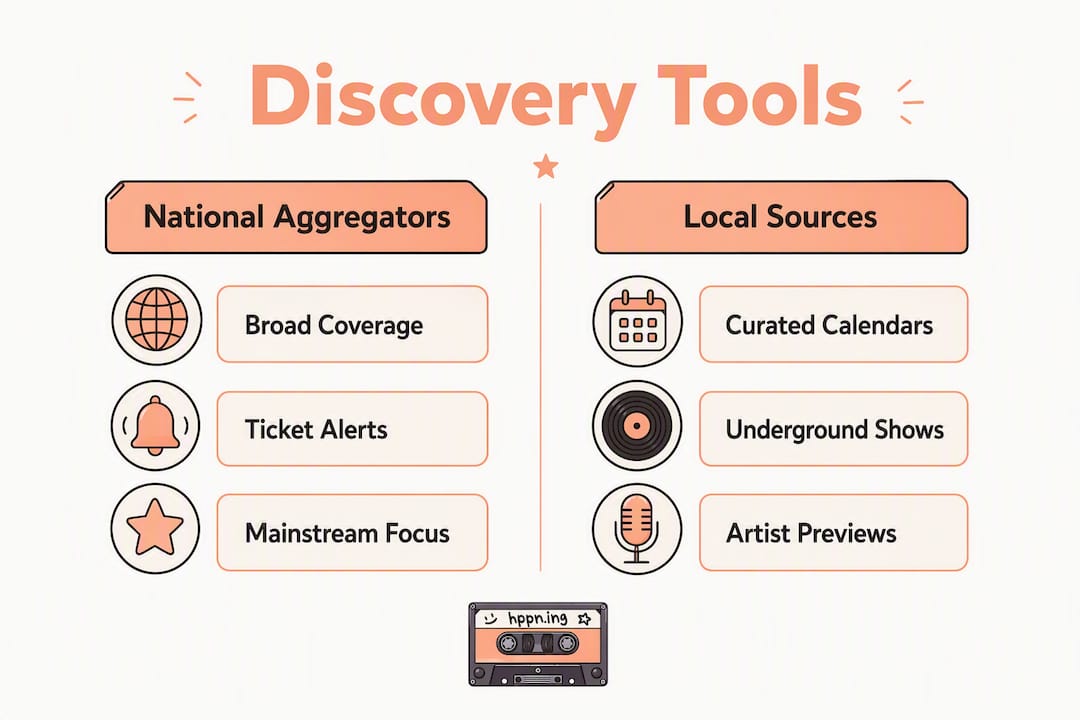
- National aggregators pull from ticket APIs, promoter feeds, and venue calendars to surface shows across the country. Strong on breadth; weak on late-added, DIY, or underground nights that never get formally listed.
- Venue and promoter calendars are often the most accurate source for show details. Venue submissions and promoter feeds catch smaller and late-added shows that aggregators miss.
- Local media and curated calendars (city weeklies, music blogs) apply editorial judgment. They surface niche and scene-specific nights that algorithmic platforms skip.
- Social media and live-clip sources function as real-time discovery. Short live-performance clips are now a primary discovery vector for younger audiences, often preceding any formal tour announcement.
- Streaming and artist-profile pages connect listening behavior to tour data. Artist pages on streaming platforms increasingly list upcoming shows, making them a useful bridge from passive listening to active attendance.
- Community boards and Discords carry word-of-mouth intelligence that no algorithm replicates. Underground and DIY shows live here almost exclusively.
Pro Tip: Don't treat these as competing options. Each tool-type has a different data source, and the gaps between them are exactly where the best shows hide.
How do the tool-types stack up on features that matter?
| Feature dimension | National aggregators | Venue/promoter calendars | Local media/curated | Social/live-clip sources | Streaming/artist profiles | Community boards/Discords |
|---|---|---|---|---|---|---|
| Discovery breadth | High | Low (local only) | Medium | Medium | Medium | Low |
| Underground/indie coverage | Low | High | High | Medium | Low | Very high |
| Artist preview (audio/video) | Rarely | Rarely | Sometimes | Yes (clips) | Yes (full catalog) | Rarely |
| Community features | Low | None | None | High | Low | Very high |
| Ticketing integration | High | Medium | Low | Low | Growing | None |
| Personalization/alerts | High | Low | Low | Algorithm-driven | High | Manual |
| Mobile usability | High | Varies | Varies | High | High | Medium |
| Cost/fees | Free + ticket fees | Free | Free | Free | Free/subscription | Free |
A few things worth unpacking from that table.
Discovery breadth vs. underground coverage is the central trade-off. National aggregators know about almost every ticketed show in a major market, but they depend on formal listings. A warehouse show, a pop-up set, or a last-minute local bill often never gets submitted. That is where venue calendars and community boards earn their keep.
Artist preview is the dimension most fans underweight. Platforms that let you hear or watch an artist before deciding whether to buy a ticket convert curiosity into attendance at a meaningfully higher rate. Social clips do this well for short bursts; streaming profiles give you the full picture.
For festival travelers, breadth and personalization matter most. Set broad alerts on a national aggregator and use streaming profiles to preview headliners. For local scene trackers, underground coverage and community features win. Lean on venue calendars, Discords, and a platform like Hppn that surfaces trending local acts alongside community notes.
How do you pick the right discovery tool for your needs?
Match your habits to the tool-type before you download anything.
- How often do you go to shows? Casual attendees (once a month or less) get enough from a national aggregator plus one venue mailing list. Regular attendees need all three tiers.
- Mainstream or underground? If you care about emerging and indie acts, a national aggregator alone will disappoint you. Add community boards and a platform built for local discovery.
- Do you need to preview artists first? If yes, prioritize platforms with in-app audio or video. Buying a ticket to a band you have never heard is a gamble most fans regret.
- How social is your music habit? If you want to discuss shows, share recommendations, or read what others say about a venue, community features become a must-have, not a nice-to-have.
- How do you buy tickets? If you want to go from discovery to purchase in one session, ticketing integration matters. Fragmented flows (discover here, buy there) create friction and missed sales windows.
Questions to ask before committing to any app:
- Can I preview artists with audio or video inside the app?
- Does it surface venue mailing lists or promoter pages?
- How reliable and timely are the notifications?
- Does it cover my city's smaller venues, not just the arenas?
Red flags to watch for:
- Show listings with no venue verification or source attribution
- Notifications that fire days after tickets sell out
- Opaque service fees revealed only at checkout
- No way to distinguish confirmed shows from rumored dates
Best practices for finding local shows consistently point to one rule: always verify show details directly with the venue before you buy, especially for smaller or underground listings.
A practical workflow to go from discovery to ticket in hand
This is the routine that actually works, built around the tracker approach that experienced local scene followers use.
- Set broad alerts on a national aggregator for your city and the genres you follow. This catches the ticketed, formally listed shows you would otherwise miss.
- Follow one local act you already like on Hppn and on their social channels. Note who opens for them, who promotes their shows, and which venues book them.
- Subscribe to venue mailing lists for two or three rooms in your city. Local concert calendars catch smaller and late-added shows that aggregators miss, and venue emails often include presale codes.
- Watch short-form clips and preview artists in-app. When Hppn surfaces a trending local act you have not heard, use the audio or video preview before deciding. A two-minute clip is a better investment than a $20 ticket to a show you leave early.
- Verify event details with the venue directly before purchasing, especially for underground or DIY listings. Dates move, venues change, and social posts go stale.
- Buy the ticket and add the show to your calendar immediately. Fast-selling shows at small venues can sell out within hours of announcement.
Concrete example: Say you discover a local four-piece through a trending clip on Hppn. You check their artist profile, preview two tracks, and see they are playing a 200-cap room next Friday. You click the ticket link, confirm the date on the venue's own site, buy, and sync the event to your calendar. Total time: under ten minutes.
Pro Tip: For underground shows, search the venue name plus the date on social platforms rather than relying on aggregators. Promoters often post the lineup the week of the show, and that post is frequently the only public record it exists.
What to expect around privacy, notifications, cost, and timing
A few practical realities that affect which tools you use and how you configure them.
- Privacy: Most discovery apps request location access to surface nearby shows. Calendar sync is optional on most platforms but useful for building a personal meta-calendar. Ticket referral links are standard practice; they do not affect your ticket price but do tell the platform which discovery source drove the purchase.
- Notifications: The biggest complaint about discovery apps is alert fatigue. Set genre and radius filters before enabling push notifications. A national aggregator with no filters will bury the one show you care about under fifty you do not.
- Timing: Major tours announce 6–12 weeks out. Local and underground shows often appear 1–2 weeks before the date, sometimes less. Check community channels and venue calendars weekly if you want to catch those.
- Cost and fees: Discovery platforms are almost universally free to use. The cost shows up at checkout: service fees on ticket purchases vary by platform and event. Live music's growing centrality to modern fandom has pushed more platforms to integrate ticketing, which means more fee structures to compare before you buy.
- Mobile apps: National aggregators and streaming platforms have polished mobile apps. Venue and promoter calendars are often web-only or inconsistently maintained. Community boards range from dedicated apps to browser-based forums.
Curated local calendars from city weeklies and music blogs are still among the best free resources for underground coverage, and they require no app, no account, and no permissions.
Key Takeaways
A tiered workflow combining Hppn for artist preview and community signals, a national aggregator for breadth, and venue or promoter channels for underground coverage is the most reliable system for finding U.S. live music worth attending.
| Point | Details |
|---|---|
| Use a tiered workflow | Pair a national aggregator for broad alerts with venue calendars and community channels for underground coverage. |
| Preview before you buy | Prioritize platforms with in-app audio or video; previewing an artist before purchase reduces regret and increases attendance. |
| Follow the tracker method | Follow one local act, map their openers and promoters, and let that network surface the rest of your local scene. |
| Verify underground listings | Always confirm show details directly with the venue before purchasing, especially for DIY or late-added events. |
| Hppn as your central hub | Use Hppn to preview artists, spot trending local acts, read community notes, and access ticket links in one place. |
Why a discovery-first, community-anchored approach builds better live experiences
The conventional wisdom says "just use the biggest aggregator." That advice works if your goal is to catch stadium tours you already know about. It fails the moment you want to find something new.
The platforms that have genuinely changed how fans experience live music are the ones that treat discovery and community as the same problem. When you can preview an artist, read what people in your city are saying about a venue, and buy a ticket without switching apps, the friction between "I might be interested" and "I'm going" nearly disappears. That is not a feature list. It is a different philosophy about what a discovery platform is for.
Hppn is built around that philosophy. It surfaces trending local and underground acts, lets you preview artists with audio and video, connects you with community notes and local music discussion, and links directly to tickets. The community benefits of attending local shows extend beyond the individual fan: local scenes grow when discovery is accessible, and platforms that center emerging artists rather than just established ones are the ones that actually move the needle for those scenes.
For U.S. concert-goers specifically, the combination of national aggregator breadth and community-anchored local discovery is not a workaround. It is the system that works.
Hppn brings artist preview, local discovery, and tickets together
Most discovery tools make you choose: broad coverage or deep community, mainstream or underground, preview or purchase. Hppn skips that trade-off.
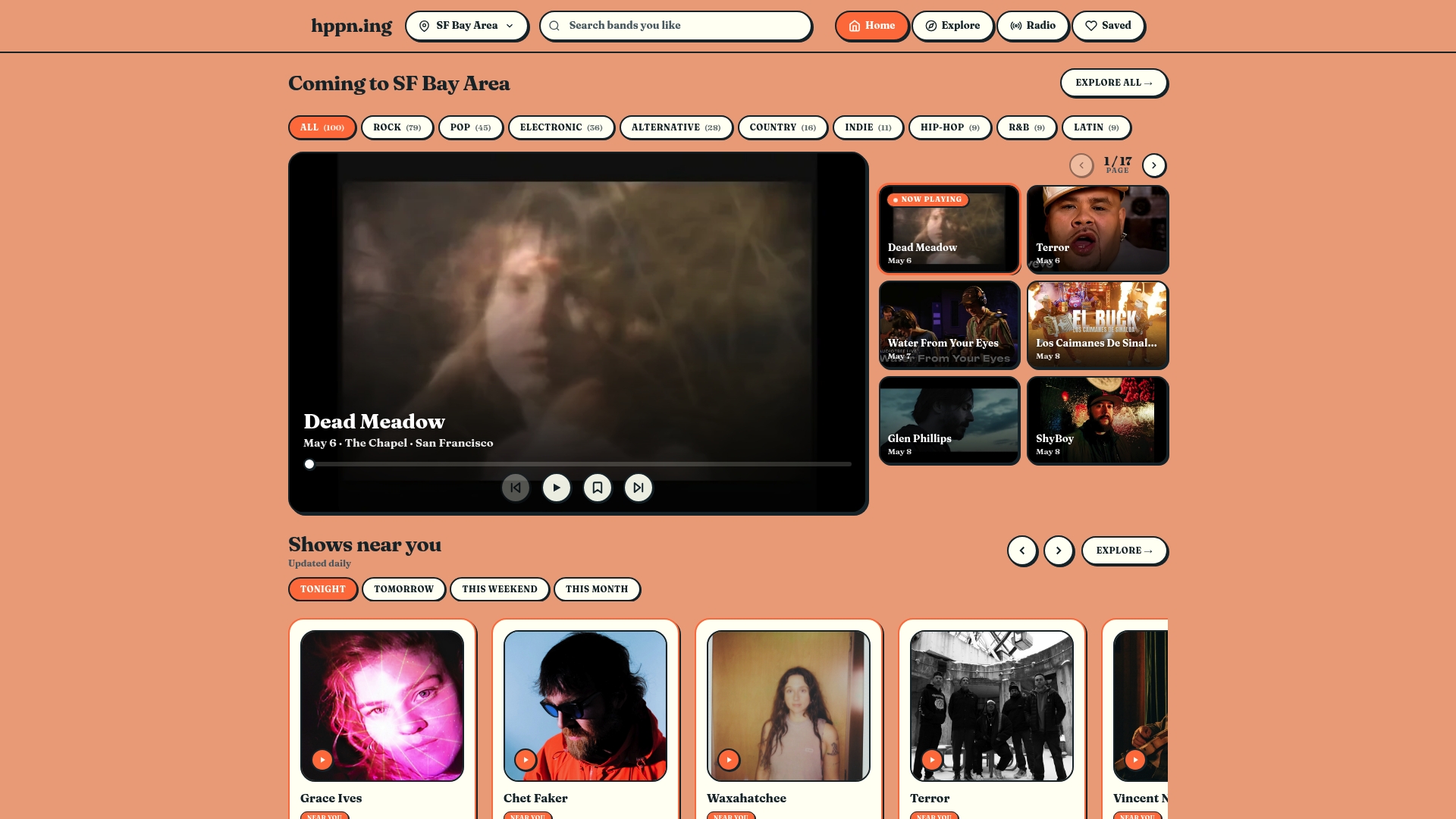
The platform is built for fans who want to find shows they will actually love, not just shows they already knew about. Browse concerts by location, preview artists with audio and video before you commit, follow trending local and underground acts, read community notes from fans in your city, and access ticket links without leaving the app.
- Artist preview: — Hear or watch an act before you decide, directly inside the platform.
- Community notes: — Real fan commentary on venues, lineups, and local scenes, not algorithmic scores.
Start discovering live music near you on Hppn, or search artists and preview music to find your next show before anyone else does.
Useful sources and further reading
The research and resources behind this guide, organized by subtopic:
- Live music discovery mechanics: What Is Live Music Discovery and How It Works and How to Find Local Concerts and Live Music Near You
- Using local concert calendars: — How to Use Local Concert Calendars to Find Live Shows
- Niche genre discovery: How to Discover Niche Music Genres Locally in 2026
- Live clips and artist discovery: Live Clips Are Powering Artist Discovery with the Next Generation of Fans and Short Live Clips and AI Reshape Music Discovery
- Streaming platforms and live music integration: Spotify, YouTube, Bandsintown Double Down on Live Music and Apple Music Concert Listings via Bandsintown and Ticketmaster
- Finding emerging talent: How Music Fans Find Emerging Talent: 2026 Guide
- Live music trends and fandom: Live Music Trends Defining Global Fandom in 2026
- Start using Hppn: Discover Live Music Near You