

Finding great local shows should not feel like a second job. Yet for most music fans, the best practices finding local shows involve more than a quick Google search. Shows are scattered across dozens of platforms, promoters vary wildly in how much they publicize events, and the truly special underground gigs almost never show up in mainstream feeds. The fans who consistently catch the best live music are not the ones who search harder. They are the ones who search smarter, using a mix of trusted sources, community relationships, and a lightweight routine that makes discovery feel automatic.
Table of Contents
- Key takeaways
- 1. Best practices for finding local shows start with the right criteria
- 2. National aggregators: useful starting point, but not the full picture
- 3. Venue websites and social media pages
- 4. Community groups on social platforms and Discord servers
- 5. Physical flyers, record stores, and offline grassroots signals
- 6. Proximity-based apps and location-first discovery tools
- 7. Comparing discovery approaches: automation, networks, and physical presence
- 8. Building your personalized local show discovery system
- My honest take on local show discovery
- Discover local shows faster with Hppn
- FAQ
Key takeaways
| Point | Details |
|---|---|
| Build a focused system | Check 2-3 trusted sources on a schedule instead of searching randomly across dozens of apps. |
| Offline signals still matter | Physical flyers and record store bulletin boards surface underground shows that never appear online. |
| Personal networks outperform algorithms | 69% of young adults find local events through personal connections, not platforms. |
| Trust signals protect your experience | Peer reviews and venue notes help you decide if a show fits your comfort and safety needs. |
| Platform blind spots are real | Most apps prioritize paid promotions, so combining digital tools with grassroots methods fills the gap. |
1. Best practices for finding local shows start with the right criteria
Before you download every event app in existence, you need a filter. Not every source deserves your attention, and not every listing is worth your time. The best local show discovery methods start with knowing what makes a source worth trusting.
Here is what to look for when evaluating any discovery channel:
- Genre relevance. A general event aggregator will surface everything from corporate conferences to county fairs. You want sources that specialize in music, and ideally in the genres you actually care about.
- Recurrence and consistency. Recurring events and scale match are the signals locals use to decide what is worth attending. A source that posts reliably is far more useful than one that goes quiet for weeks.
- Venue credibility. Look for listings tied to venues with a real track record. Peer reviews, accessibility notes, and safety details are the trust signals that tell you a show is legitimate.
- Ease of access. If checking a source takes five minutes of loading, registering, and clicking through ads, you will stop using it. The best tools fit naturally into how you already use your phone.
Pro Tip: Set a five-minute rule for any new source you try. If you cannot find a relevant upcoming show within five minutes of opening it, it probably is not worth your time on a regular basis.
2. National aggregators: useful starting point, but not the full picture
Big event platforms are the obvious first stop, and they do serve a purpose. They cover major venues, have built-in ticketing, and let you browse concerts by location in a clean interface. However, most local event apps favor events with paid promotions and high engagement, which means smaller and more meaningful shows get buried or omitted entirely.
Use aggregators to catch headlining acts and check what is happening at the city's bigger venues. Do not rely on them as your only method. The algorithm-first approach creates genuine blind spots, and the best ways to discover events often sit just outside what any single platform will show you.
3. Venue websites and social media pages
This is one of the most underrated local show discovery methods out there. Venue websites and their social media pages publish their own schedules without algorithmic interference. What you see is what is actually booked.
Follow the five or six venues in your area that consistently book artists you like. Most post their monthly lineups at the start of each month. You can also enable notifications on their social accounts so you catch announcements the moment they drop. This approach is especially effective for finding community performances at smaller clubs, art spaces, and DIY venues that rarely pay for platform promotion.
4. Community groups on social platforms and Discord servers
Some of the best tips for locating local events come from people who are already deeply embedded in your local scene. Facebook groups organized around specific cities and genres, Discord servers built around music communities, and Reddit threads dedicated to local music scenes are all gold mines for underground show discovery.
Underground shows often have no digital footprint on major platforms. They live in group chats, flyer photos posted in Discord servers, and word-of-mouth conversations happening in these tight-knit communities. Joining two or three of these groups is one of the most effective ways to get ahead of shows before they sell out or fade away unnoticed.
Pro Tip: In Facebook groups and Discord servers, use the search function to look up upcoming show announcements from the past month. You will get a quick read on how active and relevant the community is before committing your attention.
5. Physical flyers, record stores, and offline grassroots signals
The physical world still drives a significant portion of local show discovery, and most people walk right past these signals. Physical flyers and offline community boards remain some of the most reliable indicators of underground and niche events happening nearby.
Check the bulletin boards at local record stores, independent coffee shops, music instrument shops, and venue bathrooms (yes, really). These spaces attract the same audience promoters are trying to reach, so promoters put flyers there on purpose. Building a quick habit of scanning these boards when you are already in those spaces adds almost no time to your routine but surfaces shows you would never find digitally.
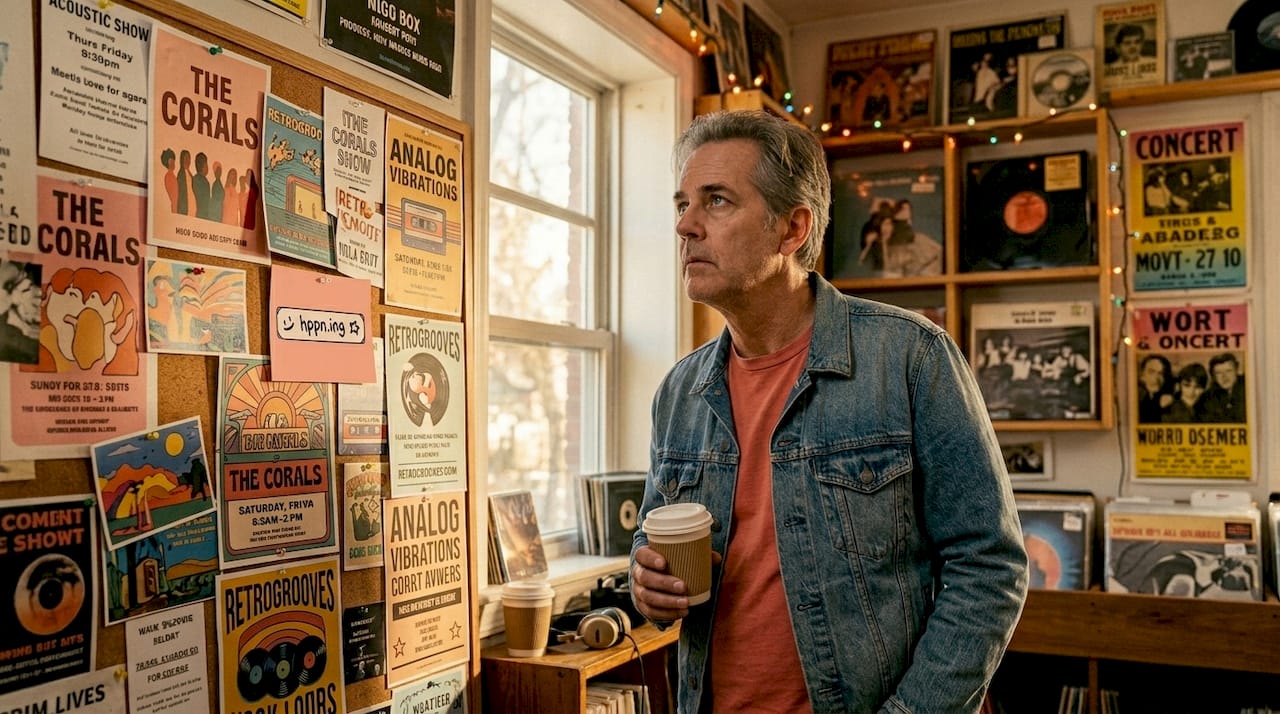
Beyond flyers, building genuine relationships with local promoters and musicians pays off in a way no app can replicate. When you become a familiar face at shows, people start telling you about upcoming events before they are publicly announced. That insider access is the real prize of being present and engaged in your local scene.
6. Proximity-based apps and location-first discovery tools
Proximity-based discovery apps surface events based on your current location, which changes the dynamic entirely. Instead of searching for something specific, you discover what is happening around you right now. This is especially useful when you are open to spontaneous shows rather than planning weeks in advance.
Platforms like Hppn take this concept further by combining location-first discovery with artist previews, so you can listen to an artist before deciding whether to show up. That combination of proximity awareness and artist context is one of the most practical approaches to how to find nearby shows without spending an hour researching every act on the bill.
7. Comparing discovery approaches: automation, networks, and physical presence
Not every method fits every lifestyle. Here is a direct comparison of the three main discovery approaches to help you figure out which combination works for you.
| Approach | Strengths | Weaknesses | Best for |
|---|---|---|---|
| Apps and aggregators | Fast, broad coverage, calendar sync | Misses underground shows, algorithmically biased | Busy professionals, casual fans |
| Personal networks | Trusted, personalized, safety aware | Requires time to build, geographically limited | Scene explorers, regulars |
| Physical presence and flyers | Surfaces hidden gems, builds community | Requires being out and about, inconsistent | Dedicated local fans, DIY scene enthusiasts |
The healthiest discovery system pulls from all three. Automation handles the routine coverage. Your personal network fills in the niche and underground gaps. Physical presence gives you access to the spontaneous and the truly local.
Fans find over two-thirds of their local events through personal networks, which says a lot about where the real signal lives. Algorithms are useful, but humans who share your taste are better curators. Nearly 476,000 members participate in concert-related Meetup groups worldwide, so the infrastructure for building these connections already exists.
8. Building your personalized local show discovery system
Here is a practical system you can set up this week. It borrows from every method above and fits into a schedule rather than a reactive search spiral.
- Pick your two or three anchors. Choose one event platform, one venue social page you trust, and one community group relevant to your scene. These are your primary sources. Checking a small set of sources on a schedule beats endless random searching every time.
- Set a weekly check-in time. Sunday evenings work well for most people. Spend fifteen minutes scanning your anchors for the upcoming two weeks and adding anything relevant to your calendar.
- Sync with a calendar and set alerts. Most platforms allow you to export events directly to Google Calendar or Apple Calendar. Use alerts set three days and one day before a show so nothing slips.
- Review the venue before you go. Spending three minutes reviewing venue layouts before attending helps you identify the best sound spots and navigate efficiently once you arrive.
- Apply trust signals before committing. Check peer reviews and venue notes to make sure the show fits your comfort level. Safety is part of the show experience.
- Use a buddy system. A simple buddy system and check-ins among friends significantly improve safety and reduce the chance of getting separated or overwhelmed at a new venue.
Pro Tip: If discovery fatigue sets in, narrow your filters. Pick one genre and one neighborhood. Specificity reduces noise and makes every discovery feel genuinely exciting rather than exhausting.
My honest take on local show discovery
I have tried every method in this article at one point or another, and the honest truth is that the system beats the tools. When I relied purely on apps, I kept seeing the same five promoted shows every week and missing everything interesting. The moment I added a Discord server for my city's punk and experimental scene, my entire experience changed. Suddenly people were posting flyers for shows I never would have found otherwise.
What I have learned is that most people overlook offline signals not because they are unaware, but because it feels counterintuitive in 2026. We are conditioned to expect that if something exists, it will appear on a screen. Local music does not always work that way. The most memorable show I attended last year was advertised only through a flyer at a record store and a single Instagram story from a local promoter I follow.
The other thing I have found is that balancing planning and spontaneity is genuinely worth thinking about. A good weekly check-in routine handles the planning side. But leaving room for a last-minute show because someone in your network texted you about it? That is where a lot of the best experiences live. You cannot automate that kind of discovery. You have to earn it by being present in your scene.
Experiment with the mix until the routine feels natural. The right system is the one you actually use.
— Ari
Discover local shows faster with Hppn
If you want a platform that was actually built around the gap between mainstream listings and the real local music scene, Hppn is worth exploring.
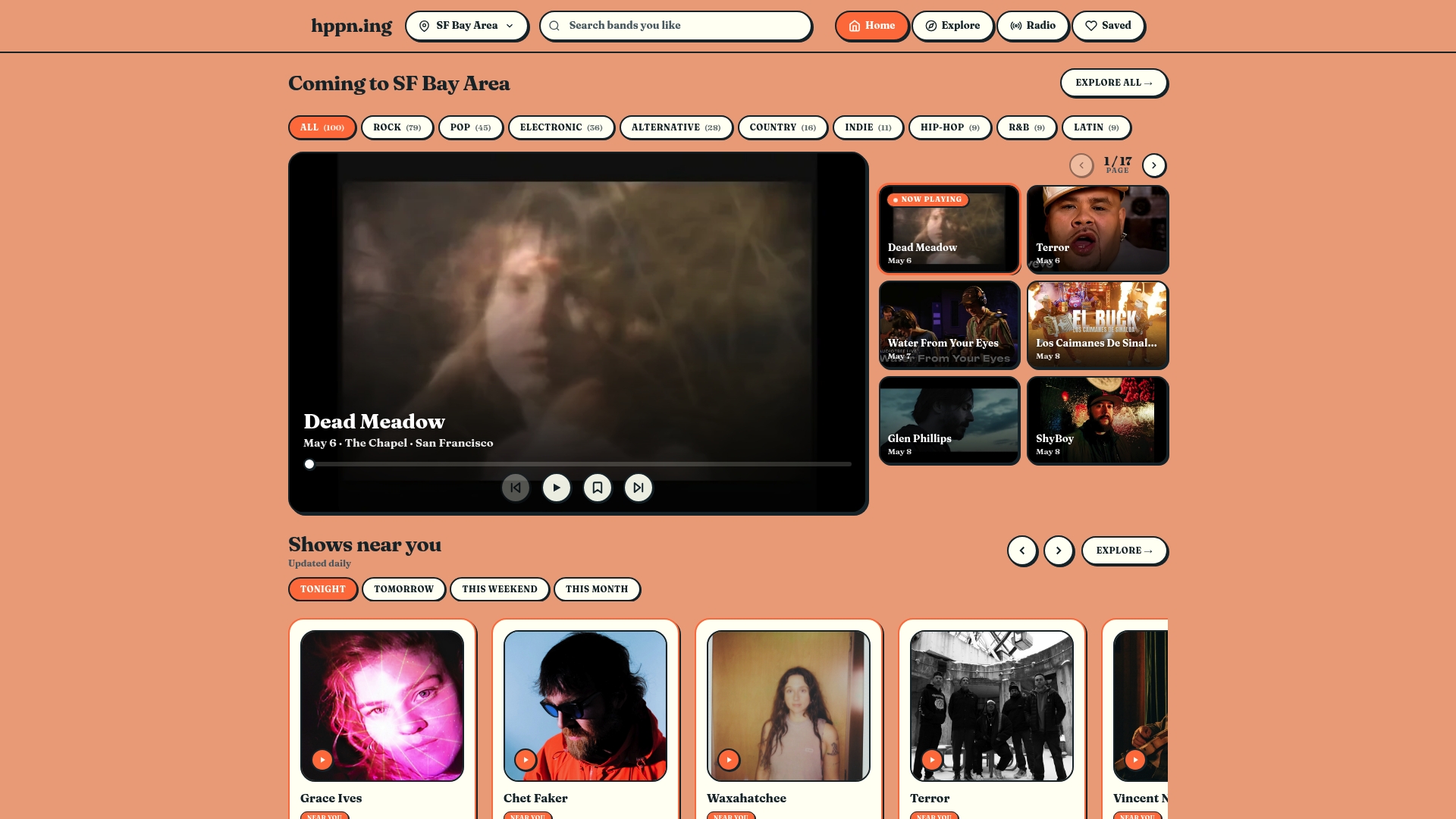
Hppn lets you browse upcoming concerts by location, preview artists through audio and video before you commit, and read community notes from fans who have already attended. You can discover trending local performers, find tickets, and get alerts for shows that match your taste. It works especially well for finding emerging and underground artists who do not show up in the usual feeds. The community notes feature functions as a peer review layer, giving you real trust signals before you walk through the door. Whether you are building your first discovery system or refining one that already works, Hppn gives you the tools to find live music nearby without the noise.
FAQ
What are the best practices for finding local shows?
The best practices for finding local shows combine a small set of trusted digital sources with community groups and offline signals like physical flyers. Checking these sources on a consistent weekly schedule is more effective than searching reactively across dozens of platforms.
How do I find underground or DIY shows in my city?
Underground shows rarely appear on major event platforms. Your best methods are joining city-specific Discord servers and Facebook groups, following local promoters on social media, and checking flyers at record stores, coffee shops, and independent venues.
Why do so many good local shows get missed?
Most event apps surface shows with paid promotions and high engagement, which leaves smaller and niche events invisible. Combining app-based discovery with personal networks and physical presence closes that gap significantly.
How important are personal networks for local show discovery?
Extremely important. Research shows 69% of young adults discover events through personal connections. People who share your taste are consistently better curators than any recommendation algorithm.
How can I stay safe when attending a new venue for the first time?
Review the venue map ahead of time, check peer reviews and accessibility notes, and bring a friend. A buddy system greatly reduces safety concerns and makes the experience more enjoyable when you are somewhere unfamiliar.