

Social proof is the fastest trust shortcut available to any artist. When a collector sees that three other buyers already own your work, when a booker finds a press quote from a respected venue, when a listener notices your track was added to a curated playlist, the decision to engage gets easier. The perceived risk drops. That is the role of social proof in artist credibility, and it works whether you have 200 followers or 200,000.
Three things you can do in the next 24–72 hours:
- Collect one testimonial. Email or text someone who attended your last show or bought your work. Ask specifically what they experienced, not just whether they liked it.
- Surface a recent metric. Add your most recent meaningful number (playlist adds, show attendance, pieces sold this year) to your bio or website hero section.
- Add one press or playlist badge. Even a niche blog mention or a small curator's playlist counts. Put the logo or name somewhere visible on your profile.
Each of these works because it reduces uncertainty for the person evaluating you. Curators, collectors, and bookers are not making decisions in a vacuum. They are looking for signals that others have already taken the risk and found it worth it.
Table of Contents
- What is social proof and why does it matter for your credibility?
- What types of social proof can artists actually use?
- How do you collect and display social proof effectively?
- How do you measure whether social proof is actually working?
- What ethical lines should artists never cross with social proof?
- How long does it realistically take to build meaningful social proof?
- How live shows and discovery platforms build reusable social proof for musicians
- Your 90-day, 8-step social proof implementation plan
- Key Takeaways
- The thing most artists get wrong about social proof
- How Hppn helps musicians turn live traction into lasting social proof
- Useful sources and further reading
What is social proof and why does it matter for your credibility?
Social proof is the psychological tendency to look at what others have done or said when deciding what to do yourself. Robert Cialdini named it in Influence, but the mechanism is older than marketing: humans default to the crowd's judgment when their own information is incomplete.

For artists, that information gap is almost always present. A collector considering a $1,500 painting cannot return it easily. A festival booker hiring an unfamiliar act is staking their event's reputation on the choice. A listener clicking on an unknown musician is betting three minutes of attention. Social proof acts as a cognitive instrument that reduces that skepticism, especially for new or emerging entities where the track record is thin.
The numbers back this up. 85% of consumers trust online reviews as much as personal recommendations, which means a well-placed testimonial from a satisfied collector carries nearly the same weight as a friend's direct referral. For artists selling work online or pitching to bookers who have never seen them perform, that is a significant lever.
The mechanism, according to The Decision Lab's primer on social proof, is imitation under uncertainty. When people do not know what to do, they copy what others have done. For artists, this means:
- Collectors look for prior sales, gallery representation, and collector testimonials before committing.
- Bookers and promoters check press coverage, past venue history, and audience engagement rates.
- Listeners respond to playlist placements, save counts, and peer recommendations before hitting play.
The practical implication: social proof does not just make you look more credible. It actively lowers the psychological cost of saying yes to you.
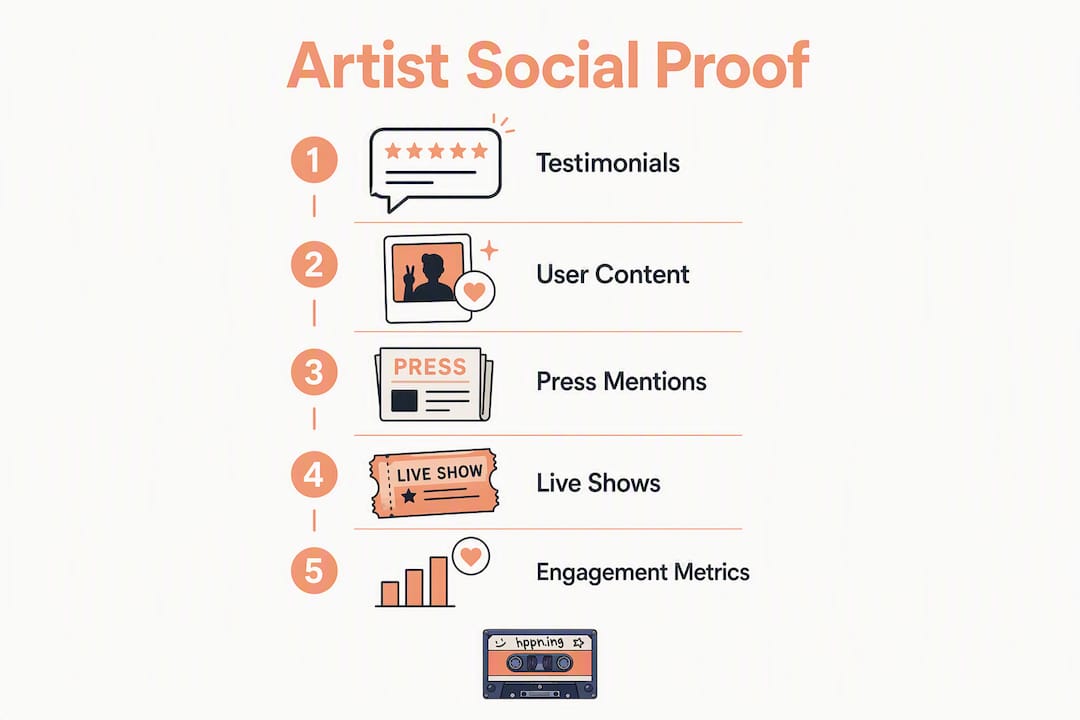
What types of social proof can artists actually use?
Not all proof is equal, and the type that moves the needle depends on your medium and career stage. Here is a breakdown of the main categories with examples tailored to visual artists, musicians, and live performers.
-
Testimonials and reviews. A sculptor whose client says "it transformed the entrance to our office" outperforms one whose client says "great work." Specificity is what makes a testimonial credible. For musicians, a venue owner's quote about crowd response beats a fan's generic "amazing show."
-
Press and editorial coverage. A feature in a local arts publication, a mention in a music blog, or even a paragraph in a neighborhood newsletter counts. For emerging artists, niche coverage often carries more weight than its circulation suggests because it signals gatekeeping.
-
Playlist and curation placements. For musicians, landing on a curated playlist, even a small one, is a form of expert endorsement. Small traction signals like playlist adds and niche blog features compound into credible momentum, and quality of signal often matters more than scale. A service like Intonality specializes in connecting independent artists with playlist curators, which is one concrete route to this type of proof.
-
Sales and availability signals. "Sold" tags on artwork listings, "limited availability" on show tickets, or "edition of 10, 7 remaining" on prints all communicate demand. These signals work because they imply others have already decided yes.
-
Audience metrics. Follower counts, monthly listeners, and engagement rates are visible proof of an existing audience. The catch: raw numbers without engagement context are weak. A musician with 800 highly engaged followers often looks better to a booker than one with 8,000 passive ones.
-
User-generated content (UGC). Photos fans post from your show, unboxing videos of your prints, or Instagram stories tagging your work are trusted far more than anything you post about yourself. UGC is proof that real people found your work worth sharing.
-
Collaborator endorsements. Being featured on another artist's project, co-billed at a respected venue, or thanked in liner notes signals peer validation. For visual artists, this might be a gallery director's recommendation or a curator's public mention.
-
Badges and verification. Claimed and verified profiles on streaming platforms, Spotify for Artists, or discovery platforms signal legitimacy to industry professionals. Platform verification unlocks visibility tools and analytics that make your credibility signals easier to surface.
-
Awards and grants. A juried show acceptance, an arts grant, or a competition placement is third-party validation with a clear standard attached. Even regional awards carry weight because they imply selection.
Career stage matters. Emerging artists should prioritize testimonials, UGC, and small press mentions since they are achievable quickly. Mid-career artists can lean on sales history, exhibit records, and platform metrics. Established artists often let their exhibition history and collector network do most of the work.
How do you collect and display social proof effectively?
Collecting proof is a system, not a one-time task. The artists who build the strongest credibility signals treat this as a regular practice, not something they scramble for before a pitch.
Collecting testimonials
- Ask within 24 hours of a positive interaction. Enthusiasm fades fast. After a show, a sale, or a commission delivery, send a short message while the experience is fresh. Capturing feedback within 24 hours of a show consistently yields more specific, usable quotes.
- Ask for outcomes, not opinions. Instead of "Would you leave a review?", try: "Could you describe what the piece looked like in your space?" or "What was the crowd's reaction during the set?" Outcome-focused prompts produce quotes that actually persuade.
- Request name, role, and permission. A quote attributed to "Sarah M., gallery director, Chicago" is worth ten times more than "a satisfied client." Always ask explicitly if you can use their name and words publicly.
- Keep 3–5 active testimonials and rotate quarterly. A small number of recent, specific testimonials outperform long lists of generic praise. Stale quotes from three years ago signal inactivity.
Where to display proof
- Hero section of your website. One strong quote or a press logo strip above the fold is the highest-value placement.
- About page. This is where skeptical visitors go to verify you. A timeline of exhibitions, press mentions, and collector quotes belongs here.
- Product and listing pages. For visual artists selling online, a testimonial near the "Add to Cart" button directly addresses purchase hesitation.
- Social media highlights and pinned posts. Instagram highlights titled "Press" or "Reviews" give visitors a curated proof archive.
- Booking outreach emails. Open with your strongest third-party quote before listing your credentials.
- Email newsletters. A short fan quote or a "this week's metric" section keeps your list warm and signals ongoing momentum.
Video testimonials and UGC are more persuasive than text alone and tend to drive higher conversion. If a fan posts a video from your show, reshare it immediately and save it to your highlights. That one clip often outperforms a month of self-promotional posts.
Pro Tip: When placing proof on a page, match the type to the visitor's likely hesitation. A booker visiting your press page needs venue quotes and attendance figures. A collector on a product page needs buyer testimonials and provenance. One-size-fits-all proof placement leaves conversions on the table.
How do you measure whether social proof is actually working?
Measurement does not require a data science background. A few focused metrics and a simple testing habit will tell you what is moving the needle.
Metrics to track:
- Conversion rate on sales or listing pages (purchases divided by page visits)
- Inquiry rate for bookings (inquiries per month, tracked in a simple spreadsheet)
- Click-through rate on "buy" or "preview" buttons before and after adding proof
- Engagement rate on posts featuring testimonials or UGC versus standard promotional posts
- Email open and click rates when a testimonial is included in the subject line or preview text
A simple testing plan:
- Pick one page where you want more conversions (your booking page, a specific print listing, your Spotify profile link).
- Add one piece of social proof (a quote, a press badge, a metric) and note the date.
- Track the target metric weekly for 30 days. Compare to the 30 days before.
- If the metric improves, keep the proof and add a second element. If it does not move, swap the proof type.
- For email, test two subject lines in the same send: one with a testimonial fragment, one without. Most email platforms let you split-test even at small list sizes.
Industry professionals evaluating musicians go deeper. Curators and A&R representatives check streaming completion rate, save rate, skip rate, and growth trajectory when deciding whether to engage. If you are pitching to industry, those are the numbers to surface prominently, not just total plays.
A red flag worth knowing: if your follower count is growing but your engagement rate is dropping, that asymmetry is visible to anyone who looks closely. It signals either bought followers or an audience that has stopped caring, and both interpretations hurt you.
What ethical lines should artists never cross with social proof?
The shortcuts are tempting and the damage is slow, which is exactly why they are dangerous.
Common pitfalls:
- Purchased followers or streams. Platforms detect inflated engagement and reduce distribution as a result. Fake or bought metrics damage long-term reach because algorithms and industry professionals both spot the pattern.
- Anonymous or generic testimonials. "A happy customer says..." is not proof. It is noise. Unattributed quotes are assumed to be invented.
- Out-of-context metrics. Citing a one-day spike as your "typical" performance, or quoting total lifetime streams as a monthly figure, is misrepresentation. Curators who dig into your actual data will find the discrepancy.
- Misleading availability claims. Fake "only 2 left" urgency on a print edition that is not actually limited erodes trust the moment a buyer notices.
Short ethical rules:
- Always get explicit consent before publishing a quote with someone's name.
- Include name and role in every attribution.
- Prefer quotes that describe specific outcomes over general praise.
- Never overstate the context of a metric.
Ethical social proof should enhance decision-making through transparency and genuine community validation, not manufacture a false impression of demand. The practical reason beyond ethics: curators, gallery directors, and A&R professionals have seen every inflated metric trick. When they spot one, they do not just discount that signal. They discount everything else you have shown them.
Pro Tip: Before publishing any testimonial, ask yourself: "Would this person recognize their quote and feel good about how it is used?" If the answer is uncertain, go back and ask for explicit permission. One awkward conversation is worth avoiding a credibility collapse.
How long does it realistically take to build meaningful social proof?
Building social proof is a 90-day minimum commitment, not a weekend project. Here is a realistic milestone map:
Days 1–30 (foundation):
- Collect your first 3 testimonials from recent buyers, attendees, or collaborators.
- Claim and verify your profiles on all relevant platforms (Spotify for Artists, Bandcamp, your gallery's artist page).
- Capture at least 1–2 pieces of UGC from a recent show or sale and get permission to reshare.
- Add one press mention or playlist placement to your website and social bio.
Days 31–60 (momentum):
- Pitch to 3–5 niche blogs, local arts publications, or playlist curators. Even one response is progress.
- Run your first simple A/B test on a listing or booking page.
- Begin tracking your core metrics weekly in a spreadsheet.
- Ask one collaborator or venue contact for a public endorsement.
Days 61–90 (compounding):
- Rotate in fresh testimonials if any of your first three are more than 60 days old.
- Assess which proof type drove the most measurable change and double down on it.
- Prepare a short "social proof packet" for booking outreach: one quote, one metric, one press mention.
Cost expectations by approach:
- DIY (near zero cost). Collecting testimonials, claiming profiles, resharing UGC, and pitching niche blogs costs time, not money. This is the right starting point for most emerging artists.
- Light paid promotion ($50–$200/month). Boosting a post featuring strong UGC or a press mention can extend reach without manufacturing fake proof. The proof itself must be real; the spend just amplifies it.
- Small PR or playlist pitch outreach ($200–$800 for a targeted campaign). Playlist pitching services and boutique music PR firms operate at this range for independent artists. Results vary, but a single strong placement can anchor your proof stack for months.
For early-stage artists, the highest-return move is always the free one: ask the people who already like your work to say so publicly.
How live shows and discovery platforms build reusable social proof for musicians
A local gig is not just a performance. Handled right, it is a proof-generation event. Here is the sequence that turns a single show into a durable credibility asset.
The sequence:
- Before the show. Ask the venue to share the event listing. A promoter's endorsement, even an implicit one through a booking, is social proof. Local promoters function as gatekeepers whose booking decisions signal legitimacy to audiences.
- During the show. Encourage fans to post. A simple "tag us if you're here tonight" from the stage generates UGC you did not have to create yourself.
- Within 24 hours after the show. Text or email the venue booker and two or three attendees. Ask for a specific quote about the crowd's energy or the set's impact. This is your highest-conversion window.
- Within 48 hours. Reshare the best UGC to your stories and highlights. Screenshot your streaming metrics if you saw a spike from the show. Note the numbers.
- Within one week. Add the venue name to your booking page. Update your bio with the show attendance figure if it is strong. Surface the metrics on your artist profile.
What to capture at every show:
- Crowd photos or video (with permission for any close-up shots of identifiable people)
- The venue's name, capacity, and date
- Any notable audience reaction moments on video
- Your streaming or discovery platform metrics from the 48 hours surrounding the show
- One quote each from the venue contact and one attendee
Active user engagement builds reputation capital, especially among younger audiences. A musician who consistently shows up in discovery feeds, gets tagged by fans, and accumulates venue endorsements over time builds a proof stack that compounds. Each show adds to the last.
Platforms like Hppn that surface local and underground artists through discovery feeds give musicians a place to make this proof visible beyond their own social channels. When a listener finds you through a discovery platform and then sees your UGC, press mentions, and fan engagement stacked on your profile, the credibility signal is immediate and self-reinforcing.
Pro Tip: Prioritize engagement rate over follower count when deciding which metrics to surface. A 12% engagement rate on 900 followers is a stronger signal to a booker than 0.5% on 15,000. Show the number that actually reflects your audience's investment.
Your 90-day, 8-step social proof implementation plan
-
Day 1–3: Audit what you already have. List every testimonial, press mention, metric, and UGC piece you can find. Note what is missing. This is your baseline.
-
Day 4–7: Collect your first three testimonials. Contact recent buyers, attendees, or collaborators. Use outcome-focused prompts. Get name, role, and permission. Success signal: three attributed quotes in hand.
-
Day 8–14: Claim and verify your profiles. Spotify for Artists, Bandcamp, your gallery's artist page, and any discovery platform where you have a presence. Success signal: verified badge visible on at least two platforms.
-
Day 15–21: Place proof on your highest-traffic page. Add your strongest quote to your website hero or booking page. Add a press logo if you have one. Success signal: proof visible above the fold without scrolling.
-
Day 22–30: Pitch for one external placement. Submit to one niche blog, local arts publication, or playlist curator. Use your new testimonials as part of the pitch. Success signal: one submission sent, follow-up scheduled.
-
Day 31–60: Run a 30-day measurement cycle. Track your target metric weekly. Note any change after adding proof. Reshare the best UGC from your next show or sale. Success signal: a measurable change in at least one metric, even small.
-
Day 61–75: Rotate and refresh. Replace any testimonial older than 60 days. Add the most recent metric or press mention to your bio. Update your booking outreach email with the strongest new quote. Success signal: no proof element on your site is older than 90 days.
-
Day 76–90: Build your proof packet. Compile one quote, one metric, and one press or playlist mention into a short document you can attach to booking or gallery inquiries. Success signal: a ready-to-send proof packet that takes under two minutes to attach to any outreach.
For musicians specifically, local gigs build the kind of reputation that compounds over time. Each step in this plan adds a layer; by day 90, you have a proof stack that speaks before you do.
Key Takeaways
Social proof is the single most efficient trust-building tool available to artists, and the artists who collect it systematically, display it strategically, and refresh it regularly convert more collectors, bookers, and listeners than those who rely on talent alone.
| Point | Details |
|---|---|
| Start with specificity | Outcome-focused testimonials from named, attributed sources outperform generic praise every time. |
| Match proof to the decision | Place venue quotes on booking pages, collector testimonials on product pages, and metrics in your bio. |
| Engagement beats follower count | A high engagement rate on a smaller audience is a stronger credibility signal to industry professionals. |
| Refresh quarterly | Rotate testimonials every 90 days; stale proof signals inactivity, not longevity. |
| Hppn amplifies live proof | Hppn surfaces local and underground artists through discovery feeds, making show-generated UGC and metrics visible to new audiences beyond your existing followers. |
The thing most artists get wrong about social proof
The conventional wisdom says: get more followers, get more reviews, get more press. More is better. That framing leads artists to chase vanity metrics that look impressive in a screenshot and mean almost nothing to the people actually making decisions about them.
What actually moves a booker or a collector is not scale. It is specificity and recency. A quote from a venue director describing how the crowd responded to your last set is worth more than 10,000 passive followers. A collector's testimonial that describes exactly where they hung your piece and how it changed the room is worth more than a hundred five-star ratings with no text.
The other thing artists consistently underestimate: the compounding effect of small, consistent proof-building over time. A musician who captures one testimonial after every show, reshares one piece of UGC per week, and pitches one curator per month will have a proof stack in six months that looks effortless from the outside. It is not effortless. It is a system.
Ethical shortcuts do not exist. Bought followers, inflated streams, and anonymous testimonials all carry the same risk: the moment a professional looks closely, the whole credibility structure collapses. And professionals always look closely. Build proof that holds up to scrutiny, and it will keep working for you long after you have forgotten you collected it.
Try the tactics in this guide after your next show or sale, and pay attention to which type of proof generates the most response. The answer will be specific to your medium, your audience, and your career stage.
How Hppn helps musicians turn live traction into lasting social proof
Most artists generate their best social proof moments at live shows, then let them disappear. A packed room, a strong crowd reaction, a fan's spontaneous video post: these are credibility assets that evaporate if you do not capture and surface them.
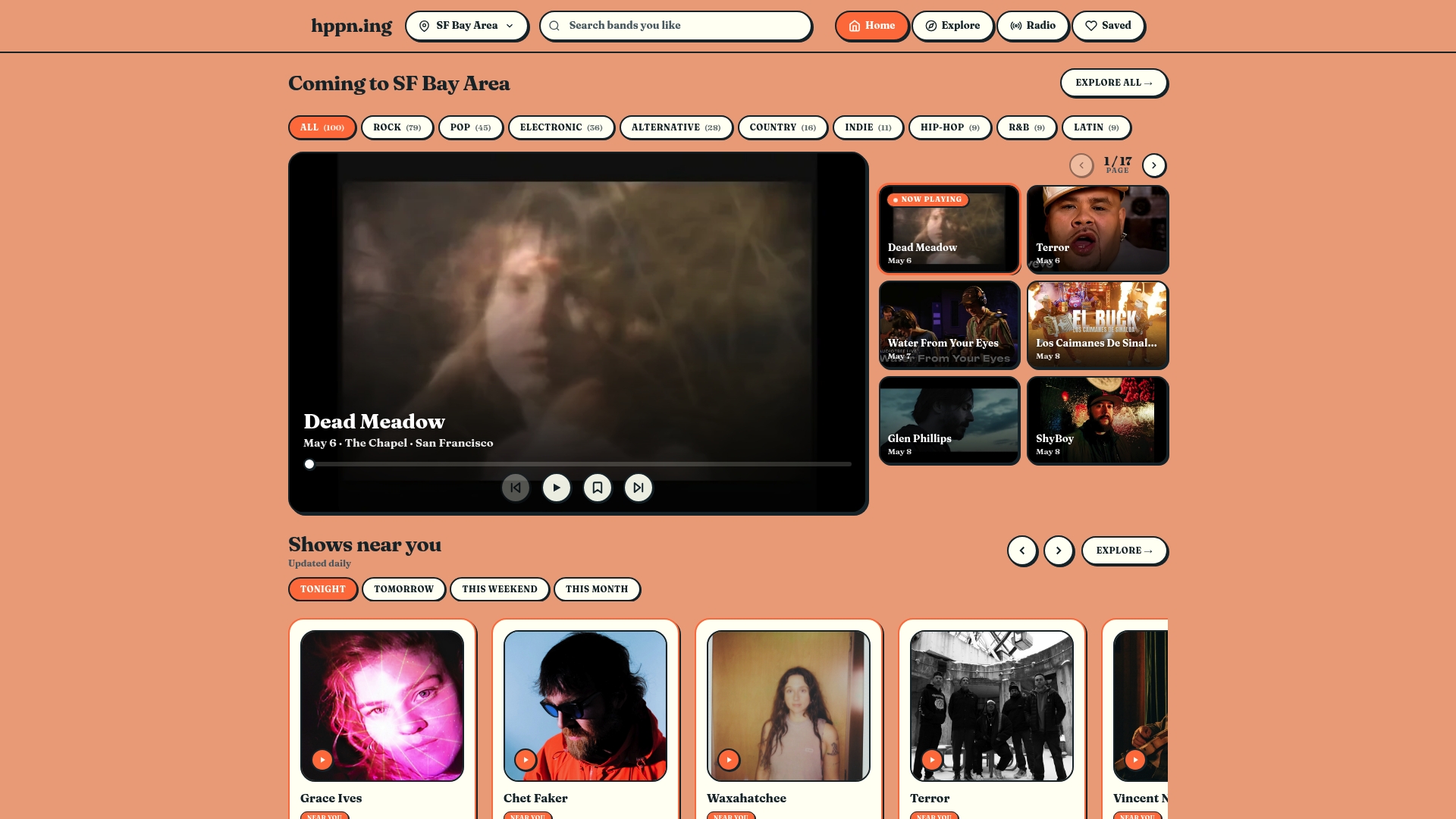
Hppn is built for exactly this gap. The platform lets musicians preview their sound and surface their shows to local audiences who are actively looking for live music, not just scrolling past it. When a fan discovers you through Hppn, engages with your preview, and then shows up to your gig, that sequence generates the kind of real, traceable engagement that looks credible to everyone who sees it afterward. Ticket demand signals, discovery plays, and fan interactions on the platform all become proof you can reference in booking outreach and on your artist profile. Hppn's community features also give fans a place to post and discuss shows, which means the UGC your performance generates has a natural home beyond Instagram stories that expire in 24 hours. Check out what a concert discovery experience actually looks like and then bring your next show to the platform where the proof can work for you long after the night is over.
Useful sources and further reading
- 2026 study on social proof and consumer trust (DOI) — Peer-reviewed research on how social proof reduces skepticism for new entities and builds reputation capital, especially among Gen Z audiences.
- The Decision Lab: Social Proof — Clear primer on the psychological mechanism behind social proof and why humans default to others' decisions under uncertainty.
- Forbes Councils: Decoding Social Proof in Consumer Psychology — Leslie Poston's piece on ethical use of social proof and why transparency is the foundation of sustainable credibility.
- Hppn blog: Why Local Gigs Build Artist Reputation That Lasts — Explains how consistent live performance creates durable reputation signals that compound over a career.
- Hppn blog: How Underground Artists Build Audiences That Actually Last — Guidance on ethical, long-term audience building for independent artists navigating discovery without major-label support.