

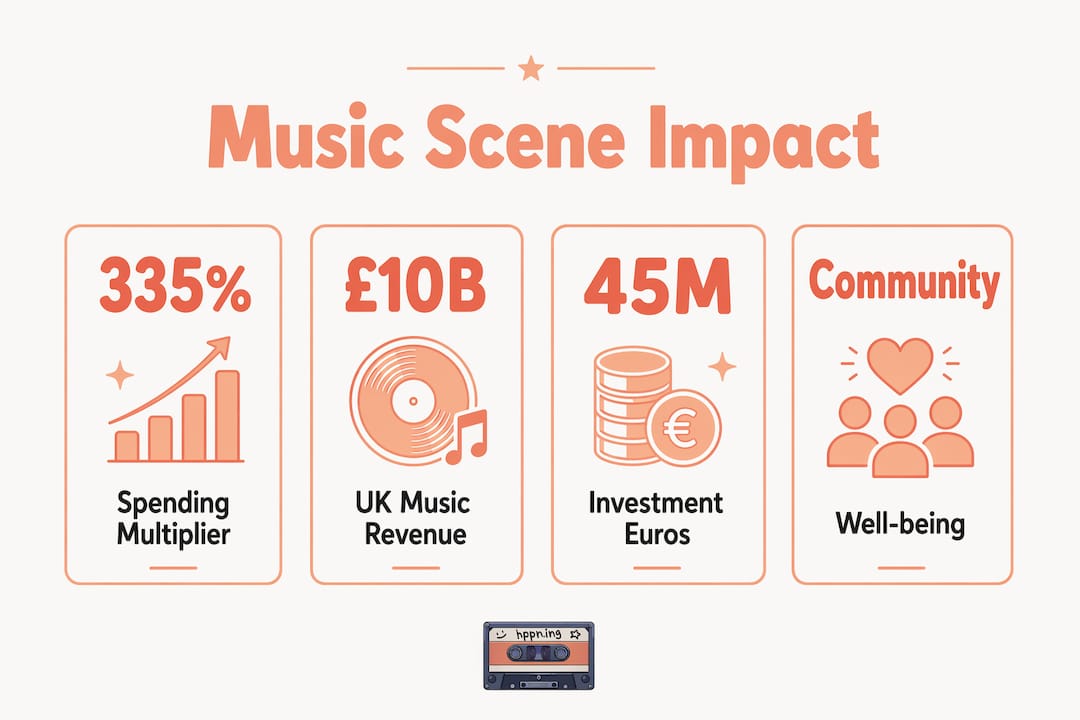
Cities invest in local music scenes because live music functions as an economic engine, a community builder, and a cultural identity marker all at once. This is not a soft cultural argument. Newcastle's music initiatives generated £364 million in economic activity and 1,300 new jobs in a single year. UK Music reports that 23.5 million music tourists attended concerts and festivals in 2024, generating £10 billion for the broader economy. For city officials and urban planners, the question is no longer whether to invest in music. The question is how to do it well.
Why cities invest in local music scenes: the economic case
Local music investment is one of the highest-return cultural expenditures a city can make. The numbers are hard to ignore. In the US, the music industry contributes over $212 billion to GDP and supports 2.5 million jobs as of 2026. That figure reflects not just ticket sales but the full chain of spending that live music triggers.
Every $100 spent on concert tickets by an out-of-town visitor generates $335 in local spending. That multiplier effect flows directly into hotels, restaurants, transportation, and retail. A single weekend festival does not just fill a venue. It fills hotel rooms, parking lots, and restaurant tables across the surrounding district.
Katowice, Poland, allocates 45 million euros annually to music-sector infrastructure as part of its post-industrial economic transition. That commitment turned a former coal city into a recognized music destination. The lesson is that music investment is not a luxury budget line. It is an urban development strategy.
| City or Initiative | Investment Focus | Economic Outcome |
|---|---|---|
| Newcastle, UK | Music ecosystem and talent development | £364M economic activity, 1,300 new jobs |
| UK Music Tourism (2024) | Concerts and festivals nationwide | £10B generated, 23.5M attendees |
| Katowice, Poland | Annual music infrastructure funding | 45M euros/year driving post-industrial transition |
| US Music Industry (2026) | Broad music economy support | $212B GDP contribution, 2.5M jobs |
Pro Tip: Do not measure music investment only by large venue revenue. Track hotel occupancy rates, restaurant covers, and retail sales on event weekends. That full-picture data makes the economic case to skeptical budget committees.
How does music strengthen community identity and well-being?
Music reflects a city's character in ways that no marketing campaign can replicate. Cities that embed music into civic identity build creative ecosystems that attract residents, retain talent, and generate sustained pride. This is the social return on cultural investment that economic models often undercount.
Birmingham's music scene illustrates both the opportunity and the challenge. The city benefits from a diverse, polycentric network of venues spread across distinct neighborhoods. Better integration and visibility of those assets would increase economic impact and visitor time spent in the city. The music is there. The coordination is not.
Active music engagement produces measurable social benefits for residents. Research and city-level reporting consistently identify the following outcomes from supported local music scenes:
- Reduced social isolation among residents who attend or participate in live music events
- Stronger neighborhood cohesion in areas with accessible, regular live music programming
- Improved mental well-being linked to music participation and community gathering
- Greater civic pride and place attachment when local artists are publicly recognized
- Increased youth engagement and career pathways in creative industries
- Higher volunteer and community participation rates around music festivals and events
These benefits compound over time. A neighborhood with a thriving music venue becomes a place people choose to live, not just visit. That preference drives property demand, business investment, and long-term tax revenue. The role of public spaces in hosting live music is central to this effect. Accessible, free or low-cost performances in parks and plazas extend these benefits to residents who cannot afford ticketed events.
What strategies do cities use to build lasting music ecosystems?
The cities that sustain thriving music scenes share one structural feature: they treat music as infrastructure, not entertainment. That shift in framing changes how budgets are allocated, how departments collaborate, and how success is measured. Here is a step-by-step framework drawn from the most effective city-level approaches.
-
Establish an intermediary organization. Generator Newcastle acts as a music ecosystem connector, linking grassroots artists with city administration, funders, and industry partners. Without this bridge, music policy stays siloed inside a cultural affairs department and never reaches the artists who need support.
-
Design venues as district anchors. Even small performance spaces catalyze surrounding investment and create gathering points that attract foot traffic and private development. A 200-seat venue in a transitional neighborhood can do more for urban regeneration than a single large arena on the city's edge.
-
Fund the software, not just the hardware. Career development programs, tour support grants, and centralized music calendars retain artists who would otherwise leave for larger markets. Physical venues are the hardware. Artist services are the software. Both are required.
-
Build a central music calendar and promote it actively. Fragmented event listings scatter audiences and reduce the visibility of local talent. A single, well-promoted city music calendar increases attendance, media coverage, and the perception of a city as a music destination.
-
Develop your city's authentic musical identity. Copying Austin or Nashville wholesale consistently fails. Every city has a distinct musical history, demographic mix, and cultural texture. Successful investment amplifies what already exists rather than importing a model from elsewhere.
-
Coordinate across city departments. Music strategy touches planning, licensing, transport, tourism, and economic development. Siloed approaches produce contradictory policies, such as noise ordinances that shut down the very venues a tourism department is promoting.
Pro Tip: Cities should transition from passive supporters to strategic amplifiers by funding musicians' international tours and export opportunities. When a local artist performs abroad, they carry the city's name with them. That visibility feeds talent recruitment and tourism back home.
What are the risks of getting music investment wrong?
Music investment produces unintended consequences when it is poorly planned. Gentrification is the most common. When a city's music scene raises an area's profile, rents rise and the artists who built that scene get priced out. This is not hypothetical. It is the documented pattern in neighborhoods from East London to East Nashville.
Leipzig offers a counter-model. The city grew its live music scene during an economic downturn by preserving affordable spaces and actively supporting musicians through city administration engagement and designated open-air venues. Affordability was the policy, not an accident. The result was a scene that retained talent instead of exporting it.
Cities also make the mistake of overinvesting in large flagship venues while neglecting the grassroots infrastructure that feeds them. A 20,000-seat arena needs a pipeline of local talent and audiences who already love live music. Without that foundation, the arena hosts touring acts that generate little local economic identity.
Common pitfalls and how to address them:
- Gentrification displacing artists: Introduce affordable workspace and rehearsal space protections alongside any music district development
- Overemphasis on large venues: Allocate a defined share of music budgets to small and mid-size venues and grassroots programs
- Siloed city departments: Create a cross-departmental music strategy group with representation from planning, licensing, tourism, and economic development
- Short-term funding cycles: Commit to multi-year funding agreements so artists and organizations can plan careers, not just projects
- Copying other cities' models: Commission a local music audit before designing any strategy, mapping existing assets, genres, and community needs
UK Music's CEO has stated directly that treating music as a policy priority produces more sustainable benefits than isolated entertainment approaches. That means music strategy belongs in the same planning conversations as transport, housing, and economic development.
Key Takeaways
Cities that treat music as infrastructure rather than entertainment generate the strongest and most lasting economic and social returns.
| Point | Details |
|---|---|
| Economic multiplier effect | Every $100 in concert ticket spending by visitors generates $335 in broader local economic activity. |
| Intermediary organizations matter | Bodies like Generator Newcastle connect grassroots artists with city policy, preventing siloed failures. |
| Software beats hardware alone | Career development programs and artist services retain talent more effectively than venues alone. |
| Authentic identity outperforms imitation | Cities that build on their own musical DNA sustain community support; copied models consistently fail. |
| Coordination prevents harm | Cross-departmental music policy avoids contradictions like noise ordinances undermining tourism goals. |
Music investment is urban planning, not arts spending
I have watched city officials treat music as a nice-to-have for years. The framing is always the same: culture is a budget line you cut when things get tight. What I have seen in cities like Newcastle and Leipzig tells a different story. The officials who treated music as a planning tool, not a cultural amenity, got results that showed up in economic reports, not just arts reviews.
The hardest part is not the investment itself. It is the coordination. Music crosses every department boundary. A licensing decision made without input from the tourism office can shut down the venue that a marketing campaign just spent six months promoting. I have seen that happen more than once. The cities that avoid it are the ones that created a dedicated music strategy role with actual cross-departmental authority.
My honest view is that most cities underinvest in the software side of music ecosystems. They build venues and call it done. But a venue without a career development program, a centralized calendar, and affordable rehearsal space is just a building. The artists who fill it need support that goes well beyond a stage. When cities fund that full ecosystem, the economic and social returns follow. When they fund only the building, they wonder why the scene never materializes.
City officials and urban planners who want to support local music communities effectively should start with a local music audit before spending a dollar on infrastructure. Know what you have. Then build on it.
— Ari
Hppn makes local music visible to the people who need to find it
City investment in music only works if residents and visitors can actually find what is happening. That is where Hppn comes in.
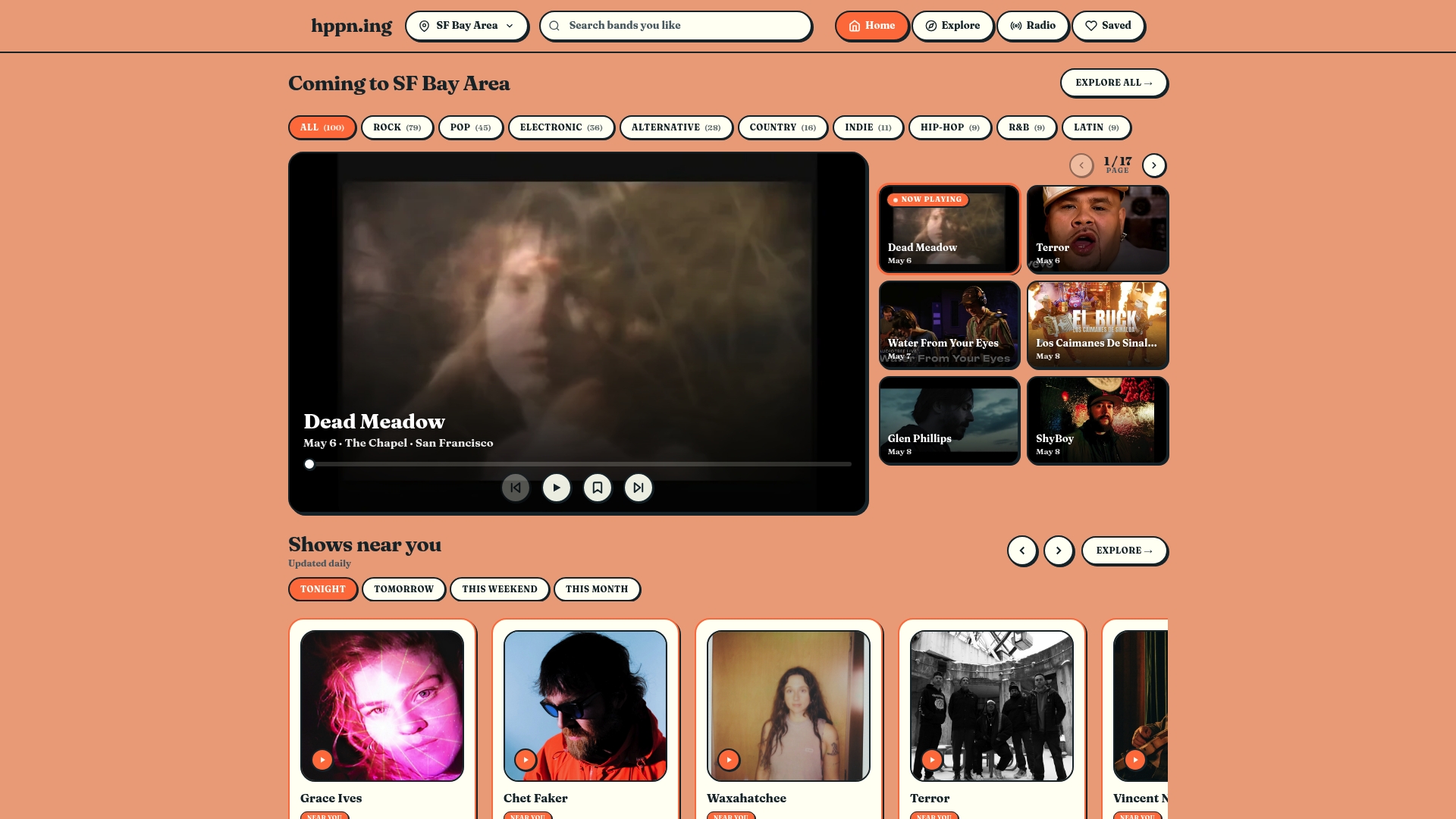
Hppn is a live music discovery platform built for exactly this gap. City officials and community advocates can use Hppn to see which local artists are gaining traction, which venues are active, and where live music is happening right now. The platform lets you preview artists and find shows near you, browse concerts by location, and engage with the music community in real time. For planners building a music strategy, Hppn provides a ground-level view of the scene that no city report captures. Supporting local artists starts with knowing who they are.
FAQ
Why do cities invest in local music scenes?
Cities invest in local music scenes because music generates direct economic returns through tourism, job creation, and local spending, while also building community identity and social cohesion. Newcastle's music investment produced £364 million in economic activity and 1,300 new jobs in a single year.
What is the economic impact of music tourism?
Music tourism produces a strong multiplier effect. In 2024, UK music tourism generated £10 billion from 23.5 million attendees, and every $100 spent on concert tickets by out-of-town visitors generates $335 in broader local economic activity.
How do cities avoid displacing artists when investing in music?
Cities avoid displacement by pairing music district investment with affordable workspace protections and multi-year funding commitments. Leipzig preserved affordable venues during an economic downturn and retained its music talent as a direct result.
What is the role of intermediary organizations in music city strategy?
Intermediary organizations like Generator Newcastle connect grassroots artists with city administration, funders, and industry partners. Without that connection, music policy stays siloed and never reaches the artists who need support most.
Should cities copy successful music hubs like Austin or Nashville?
Copying established music hub models consistently fails. Cities that build on their own authentic musical identity, history, and community culture produce more sustainable scenes than those that import a model wholesale.