

Music events are a proven catalyst for local tourism, generating visitor spending, extending stays, and transforming communities into recognized cultural destinations. Understanding how music events attract local tourism gives tourism officials and local businesses a direct path to measurable economic growth. U.S. music festivals generated over $8.2 billion in direct economic activity in 2024. That number reflects not just ticket sales but a full chain of spending on lodging, food, transport, and local attractions.
How music events attract local tourism through economic impact
Music events generate economic activity across multiple channels, and the full picture is larger than most officials initially expect. The industry term for this analysis is music tourism, defined as travel motivated wholly or partly by live music experiences. Understanding both direct and indirect effects is the foundation of any serious music tourism strategy.
Direct spending flows immediately into the local economy:
- Ticket and venue revenue
- Hotel and short-term rental bookings
- Restaurant, bar, and food vendor sales
- Ground transportation and parking
- Retail and merchandise purchases
Indirect impacts compound that initial spending. Communities retained approximately 60% of festival benefits through jobs and sustained business revenue. That retention rate means a well-run recurring festival does not just spike revenue once. It builds a durable economic base.
The multiplier effect makes the math even more compelling. Major UK and European festivals carry an economic multiplier of 1.4 to 1.8, meaning every $10 million in direct revenue can generate up to $18 million in regional activity. That amplification happens because local vendors, suppliers, and employees recirculate their earnings within the community.

The Outside Lands festival in San Francisco is one of the clearest U.S. examples. Another Planet Entertainment's 2025 concerts generated $245.1 million in economic benefit across 440,000 attendees. Lodging accounted for 29% of that spending, onsite venue costs 24%, and food and drink 19%. Those proportions give tourism planners a reliable template for projecting where visitor dollars will land.
Pro Tip: When presenting economic projections to city councils or business associations, use the multiplier range of 1.4 to 1.8 to show the realistic floor and ceiling of community benefit, not just the headline gross figure.
How do music events influence visitor behavior and spending?
Music event attendees behave differently from standard leisure tourists. They plan further in advance, spend more per day, and actively seek out local experiences beyond the venue itself. This behavioral profile makes them among the highest-value visitor segments a destination can attract.
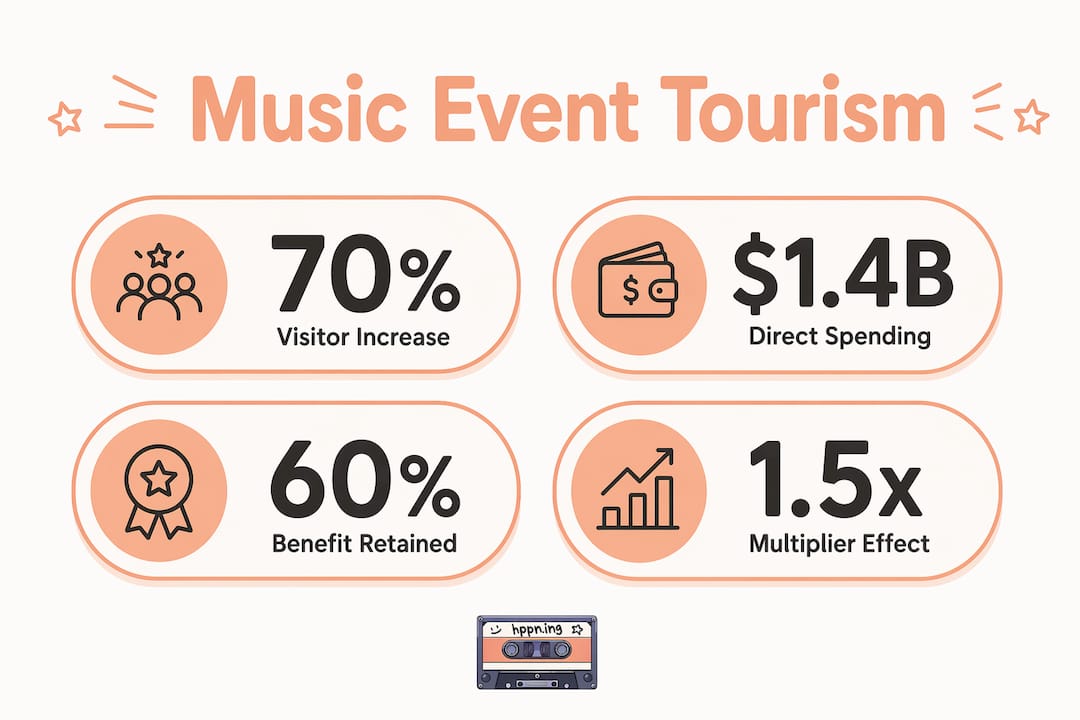
The BTS concert data from South Korea illustrates this with unusual precision. Foreign fans stayed 2.6 days longer than typical tourists and spent $2,600 per person. Local card spending rose from 8.9 million won to 337.8 million won over three days. That is a 38-fold increase driven entirely by a single recurring artist event. The implication for tourism officials is direct: the right music event does not just fill hotels. It changes the entire spending profile of a destination for its duration.
Visitor behavior follows a predictable pattern once music draws them in:
- Pre-trip planning includes booking local restaurants, researching neighborhoods, and identifying cultural sites near the venue.
- Day-of exploration extends beyond the event, with attendees visiting markets, galleries, and historic districts.
- Post-event stays are common when the destination offers compelling reasons to remain an extra night.
- Repeat visitation builds when the event becomes annual and the destination becomes personally meaningful.
The Singapore Tourism Board recognized this pattern and acted on it deliberately. Singapore partnered with Universal Music on a three-year initiative using destination storytelling and exclusive fan experiences like pop-up exhibitions to convert concert attendees into long-stay tourists. The strategy treats the concert as an entry point, not the entire product.
Pro Tip: Work with venue operators to distribute neighborhood maps and curated local experience guides at entry points. Attendees who discover a great restaurant near the venue on night one are far more likely to extend their stay.
Large festivals vs. smaller music events: which drives more tourism?
The scale of a music event shapes the type and sustainability of its tourism impact. Large festivals and smaller events each offer distinct advantages, and the most effective local music tourism strategies use both in combination.
| Factor | Large Festivals | Smaller Music Events |
|---|---|---|
| Visitor volume | High, often 10,000+ attendees | Moderate, 500–5,000 attendees |
| Media and PR reach | National and international coverage | Local and regional coverage |
| Community disruption | Higher, requires significant logistics | Lower, easier to integrate |
| Economic concentration | Concentrated over 2–4 days | Spread across more dates |
| Repeat visitation | Strong when brand is established | High, builds loyal local following |
| Infrastructure demand | Requires significant investment | Works within existing venues |
Large festivals like Outside Lands or Coachella generate high visitor volumes and national media attention that reframes a destination's identity. Large festivals serve as cultural identity builders, enhancing destination reputation and supporting year-round tourism growth beyond the event weekend. That reputational lift is difficult to quantify but shows up in hotel occupancy data and repeat booking trends in the months that follow.
Smaller events offer a different kind of value. The Big Ears Festival in Knoxville, Tennessee, is a strong model. Big Ears collaborates with nonprofits to provide job training in hospitality and audio production, embedding economic benefits into workforce development. The festival does not just bring visitors for a weekend. It builds local capacity that serves the community year-round.
Concert-driven demand also reshapes smaller markets significantly. Hotel occupancy spikes 60–80% in Tier II cities during major concert weekends. For a mid-size city with limited hotel inventory, that kind of demand surge justifies infrastructure investment and signals to developers that the market can support expansion.
Strategies for tourism officials to maximize music event impact
The benefits of music events for tourism do not arrive automatically. They require deliberate planning, cross-sector collaboration, and a clear measurement framework. The following practices reflect what works in markets from Knoxville to Singapore.
Build stakeholder coalitions before the event is announced. Tourism boards, hotel associations, restaurant groups, and transportation providers all need to coordinate. When each sector knows what to expect, they can staff up, extend hours, and create packages that capture visitor spending more completely. Community and government roles in sustaining live music are well-documented, and early alignment prevents the coordination failures that leave money on the table.
Integrate music events with broader cultural tourism offerings. Visitors who come for a concert and discover a compelling food scene, a walkable historic district, or a unique local art gallery are far more likely to return. The Singapore model proves this works at scale. Creating unique fan experiences beyond concerts transforms tourists into engaged visitors who increase local stays and spending.
Invest in workforce development alongside event infrastructure. The Big Ears Festival model in Knoxville shows that music events can be vehicles for skills training, not just revenue generation. Hospitality training programs tied to event cycles produce workers who serve visitors better and stay in the local labor market longer.
Use targeted storytelling in pre-event marketing. Tourism boards that publish neighborhood guides, artist profiles, and local experience itineraries in the weeks before a major event see measurably higher visitor engagement. Collaborate with music publishers to curate local track playlists with proper metadata and rights, enabling audio guides and city soundtracks that extend the music experience into the destination itself.
Measure net economic impact, not gross spending. Accurate impact measurement requires isolating net new visits by controlling for locals' displacement and substitution tourists who would have visited regardless. Gross spending figures consistently overstate true benefit. Tourism officials who present net figures build more credibility with elected officials and are better positioned to secure ongoing public investment.
Test before scaling. Implement a 48–72 hour music experience pilot incorporating local soundwalks and intimate concerts to test demand, logistics, and economic flows before committing to a large-scale event. This approach reduces financial risk and generates real data to support future investment decisions.
Key takeaways
Music events drive local tourism most effectively when communities combine economic planning, stakeholder coordination, and authentic cultural integration from the start.
| Point | Details |
|---|---|
| Economic multiplier effect | Every $10M in direct festival revenue can generate up to $18M in regional economic activity. |
| Visitor behavior advantage | Music event attendees stay longer and spend more than typical tourists, as BTS concert data confirms. |
| Scale matters differently | Large festivals build destination identity; smaller events like Big Ears build workforce and community depth. |
| Measure net impact | Isolate net new visitor spending to avoid overestimating event ROI and to secure credible public investment. |
| Integrate the destination | Pair music events with cultural tourism offerings to convert one-time attendees into repeat visitors. |
Why most cities leave music tourism money behind
I have watched tourism boards announce a major festival partnership and then do almost nothing to capture the economic benefit beyond the venue perimeter. The concert fills the arena. The surrounding restaurants are understaffed. The hotels have not coordinated packages. The visitor leaves having spent money at the venue and nowhere else. That is a planning failure, not a music failure.
The cities that get this right treat the music event as the opening act for the destination, not the headline. Knoxville does not just host Big Ears. It trains workers, activates downtown businesses, and builds a hospitality culture that serves visitors better each year. Singapore does not just book artists. It builds three-year partnerships that turn concert attendance into cultural immersion.
The uncomfortable truth is that most economic impact studies for music events are inflated. Gross spending figures include locals who would have spent that money in the community anyway and tourists who were already planning to visit. Net economic impact analysis is harder to produce but far more useful for making real investment decisions. If you are a tourism official presenting a case for public funding, net figures will survive scrutiny in ways that gross figures will not.
Start small, measure carefully, and build the case with real data. A well-documented 48-hour pilot event with honest attribution analysis is worth more than a splashy festival announcement built on projections nobody can verify.
— Ari
Discover local music events that drive real tourism
Tourism officials and local businesses need visibility into what is actually happening in their live music scene before they can plan around it. Hppn makes that possible.
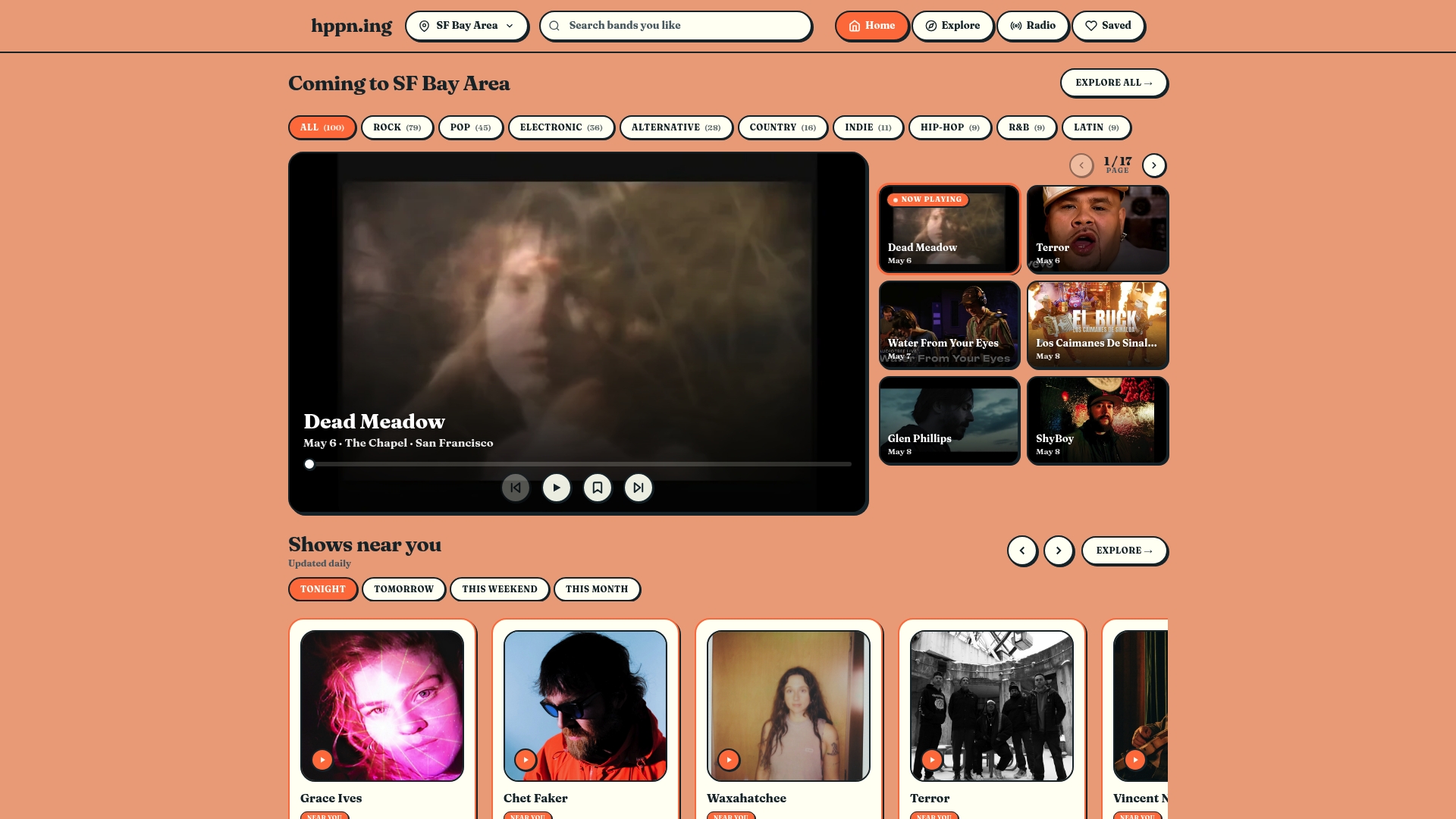
Hppn is a live music discovery platform that surfaces emerging artists, local concerts, and underground events by location. For tourism planners, it offers a real-time view of the local music ecosystem, including which artists are gaining traction, which venues are active, and where fan communities are forming. You can preview artists and find shows near you, browse the local artist catalog, and follow community discussions around live music in your city. Hppn gives you the ground-level intelligence to identify events worth building a tourism strategy around before they sell out.
FAQ
What is music tourism and why does it matter?
Music tourism is travel motivated wholly or partly by attending live music events. It matters because music event attendees consistently spend more and stay longer than average leisure tourists, generating outsized economic returns for host communities.
How do music festivals boost the local economy?
Music festivals generate direct spending on lodging, food, transport, and retail, then amplify that through an economic multiplier of 1.4 to 1.8. U.S. festivals produced over $8.2 billion in direct economic activity in 2024, with communities retaining roughly 60% through jobs and business revenue.
Do smaller music events attract tourists too?
Smaller events attract loyal, repeat visitors and generate 60–80% hotel occupancy spikes in Tier II cities. Events like Big Ears Festival in Knoxville show that smaller formats also build workforce capacity and community engagement that outlasts the event weekend.
How should tourism officials measure music event impact?
Officials should measure net economic impact by isolating spending from visitors who traveled specifically for the event. Gross spending figures overstate benefit by including locals and substitution tourists, so attribution analysis is required for accurate ROI.
How can local businesses prepare for music event visitors?
Local businesses should coordinate with tourism boards before the event, extend operating hours, create event-specific packages, and distribute neighborhood guides at venues. Pre-event marketing that highlights local dining, culture, and attractions converts single-night attendees into multi-day visitors.