

A micro-genre in music is a hyper-specific subcategory of sound defined by a narrow set of sonic traits, a distinct visual or cultural aesthetic, and usually a tight-knit online or local community that names and spreads it. Think of Vaporwave's slowed-down mall-music nostalgia, Chillwave's sun-bleached synthesizer haze, or the thousands of tags that Every Noise at Once (Glenn McDonald's genre-mapping project) has cataloged across streaming platforms. These are not just subgenres. They are micro-communities organized around a very specific sound, and they are multiplying faster than any radio era could have produced them.
Most music micro-genres share a recognizable cluster of traits:
- A sonic fingerprint — a narrow combination of tempo, texture, production style, or instrumentation that distinguishes the tag from its parent genre
- A visual or cultural aesthetic — cover art, fashion, meme language, or a mood that travels with the music
- A community origin — a blog, a message board, a SoundCloud scene, or a local venue that first named and circulated the sound
- A provisional quality — the label may be ironic, short-lived, or later absorbed into a broader genre
Table of Contents
- What is a micro-genre in music, and where did the term come from?
- How do micro-genres actually form and spread?
- Seven micro-genre examples worth knowing
- Why micro-genres matter for discovery, artists, and the industry
- The real criticisms of micro-genre labeling
- How micro-genres evolve, stabilize, or disappear
- How to find and follow micro-genre music
- How local live scenes surface micro-genres
- Key Takeaways
- The part most explainers get wrong about micro-genres
- Hppn connects you to micro-genre music happening near you
- Useful sources and further reading
What is a micro-genre in music, and where did the term come from?
The word "microgenre" has been in use since at least the 1970s, particularly in music contexts, where it described stylistic offshoots of larger genres like heavy metal and electronic music. Record collectors and vinyl dealers applied these narrow labels retroactively, partly to categorize rare pressings and partly to signal insider knowledge. A crate-digger calling something "Northern Soul" or "Cosmic Disco" was doing the same work a Spotify algorithm does today: sorting music into the smallest useful bucket.
Wikipedia defines microgenre as a highly specific subcategory used across media, including music, film, and literature, with the term gaining broader cultural traction in the late 20th century. Academic definitions go further: one scholarly source describes a microgenre as "a flexible, provisional, and temporary category used to establish micro-connections among cultural artifacts." That provisional quality is the key distinction from a full genre. A genre has institutions, labels, and decades of history behind it. A micro-genre might have a Tumblr page and three hundred SoundCloud followers.
The real acceleration happened in two waves. The first was the blog era of the mid-2000s, when music writers at sites like Gorilla vs. Bear and Altered Zones coined and spread tags faster than print journalism ever could. The second was the streaming era, when platforms began encoding those tags into algorithmic recommendation systems, giving micro-genre labels commercial weight they had never carried before. Chillwave, credited to writer Emilie Friedlander as a 2009 blog-era coinage, became a canonical example of this pipeline: a meme-ish label that major outlets including the New York Times eventually treated as a legitimate descriptor.
How do micro-genres actually form and spread?
The path from "a few weird tracks" to "a named micro-genre with a Spotify playlist" follows a surprisingly consistent pattern. It rarely starts with a label. It starts with a sound or an aesthetic that a small group of people recognize as distinct, even before they have words for it.
The common formation routes look like this:
- Scene or venue origin — a cluster of artists in one city or on one platform develops a shared sound through proximity and mutual influence
- Blog or collector label — a writer or tastemaker coins a name, often tongue-in-cheek, that sticks because it captures something real
- Social media meme — the label spreads as a meme, sometimes ironically, which paradoxically accelerates its adoption
- Playlist and algorithmic tagging — Spotify, Apple Music, or a third-party curator creates a playlist under the tag, and the algorithm begins recommending it to listeners with matching taste profiles
- Press legitimization — a major outlet covers the micro-genre as a cultural moment, cementing the label even if the music has already moved on
SoundCloud and Bandcamp were the first platforms to let artists self-tag in ways that bypassed traditional genre gatekeepers. TikTok accelerated this further by letting a fifteen-second clip define an entire aesthetic before anyone had agreed on a name for it. Spotify's editorial and algorithmic playlist infrastructure then codifies whatever survives the social-media phase, giving the tag real discovery weight. Aligning with a specific micro-genre helps artists reach smaller, highly engaged communities rather than competing in broad markets, which is why producers increasingly treat micro-genre positioning as a deliberate branding move rather than an accident of style.
Pro Tip: If you are an artist trying to seed a micro-genre label, name the sound before someone else does. Post a short video describing the aesthetic in your own words, tag it consistently across Bandcamp, SoundCloud, and TikTok, and reach out to two or three niche playlist curators simultaneously. Coordinated early tagging is how Witch house and Bedroom pop both built critical mass before mainstream press noticed them.

Seven micro-genre examples worth knowing
The table below covers the micro-genres most frequently cited in contemporary music writing, providing enough context to understand what each one actually sounds like.
| Micro-genre | Sound in one line | Notable artists / tracks | Origin and notes |
|---|---|---|---|
| Vaporwave | Slowed, pitch-shifted mall music and elevator jazz layered with digital glitch | Macintosh Plus, Blank Banshee | Emerged on Tumblr; started as an ironic critique of consumer capitalism, became a genuine aesthetic |
| Chillwave | Hazy, reverb-drenched synth-pop with lo-fi vocals and a nostalgic summer feel | Washed Out, Toro y Moi, Neon Indian | Coined in 2009 as a blog-era meme; one of the first internet micro-genres to receive serious critical coverage |
| Witch house | Slow, distorted hip-hop beats with occult imagery, pitch-shifted vocals, and gothic electronics | †‡†, oOoOO, Salem | Originated on MySpace and early blogs; the name itself was partly a joke that stuck |
| Bedroom pop | Intimate, lo-fi indie pop recorded at home with minimal production and confessional lyrics | Clairo, Rex Orange County, Snail Mail | Grew from the DIY recording culture; now a recognized commercial category |
| Dubstep-derived micro-genres | Ranges from the original UK wobble bass to post-dubstep's atmospheric minimalism and brostep's aggressive drops | Burial (post-dubstep), Skrillex (brostep), Mala (UK dubstep) | UK dubstep; splintered into multiple micro-genres as it crossed the Atlantic and entered festival culture |
| Hyperpop | Maximalist, pitch-shifted pop with distorted drums, hyper-compressed production, and internet-native aesthetics | Gecs, Charli XCX, SOPHIE | Developed on SoundCloud and PC Music label; initially a critical descriptor, later adopted by artists themselves |
| Lo-fi (lo-fi hip hop / lo-fi house) | Warm, sample-based beats with tape hiss, jazz chords, and a deliberately unpolished texture | Nujabes, Knxwledge, DJ Boring (lo-fi house) | Lo-fi hip hop grew through YouTube study-music streams; lo-fi house emerged from the UK club scene |
Pitchfork's survey of 25 micro-genres notes the recent explosion of niche labels and points to Glenn McDonald's Every Noise at Once as the most thorough index of this proliferation. McDonald's project has cataloged thousands of named genres across streaming platforms, making it the closest thing to a complete map of where micro-genres live. If you want to hear any of the tags above in context, Every Noise at Once is the fastest starting point.
Why micro-genres matter for discovery, artists, and the industry
Micro-genres changed the economics of music discovery in a concrete way. Before streaming, a listener who loved Burial's post-dubstep atmospherics had no reliable path to similar artists beyond word of mouth and specialist blogs. Algorithmic tagging changed that. Playlists and algorithmic tags allow platforms to create and nurture niche listening contexts that radio once filtered out entirely, routing listeners directly to the specific sonic pocket they want rather than the nearest mainstream approximation.
Streaming platforms and curated playlists help codify micro-genres by tagging hyper-specific listener vibes and surfacing them via algorithmic recommendations, materially changing how niche music reaches its audience.
For artists, the calculus is equally clear. A producer releasing music tagged as "lo-fi hip hop" is not competing with Drake. They are competing within a defined niche where a few thousand dedicated listeners can sustain a career, build a Patreon, and fill a 200-capacity venue. Underground artists who build audiences through niche labels tend to retain those audiences longer than artists who chase broad genre positioning, because the community forms around a shared taste identity, not just a single song.
The industry side is less romantic but just as real. Catalog managers at major labels now use micro-genre tags to organize licensing pitches, sync placements, and playlist submissions. A track tagged "dark ambient" or "hyperpop" lands in the right editorial queue faster than one tagged simply "electronic." The tag is infrastructure.
The real criticisms of micro-genre labeling
Not everyone finds micro-genres useful. The critiques are worth taking seriously, because some of them are correct.
- Ephemerality — many micro-genre labels peak within a single news cycle and disappear before the music they describe has time to develop
- Meme-ification — a label that starts as a joke (Witch house, Seapunk) can trap artists inside an ironic frame they never intended
- Marketing capture — labels and platforms sometimes manufacture micro-genre tags to create the appearance of a scene where none exists, using the language of community to sell a product
- Reductiveness — collapsing a diverse set of artists into a single narrow tag can erase meaningful differences in their work and limit how critics and listeners engage with them
- Gatekeeping — micro-genre communities can be exclusionary, policing authenticity in ways that mirror the mainstream gatekeeping they claim to reject
Cultural critics at Pitchfork have argued that some micro-genres function more like memes than musical movements: they reflect a cultural moment with precision but lack the staying power of genuine genre formation. The irony is that this ephemerality is also part of their appeal. A micro-genre that burns bright for a relatively short time before disappearing still served its purpose for the artists and listeners who found each other through it.
The honest position is that both things are true simultaneously. Some micro-genre labels are lazy marketing. Others are the first accurate name for something genuinely new.
How micro-genres evolve, stabilize, or disappear
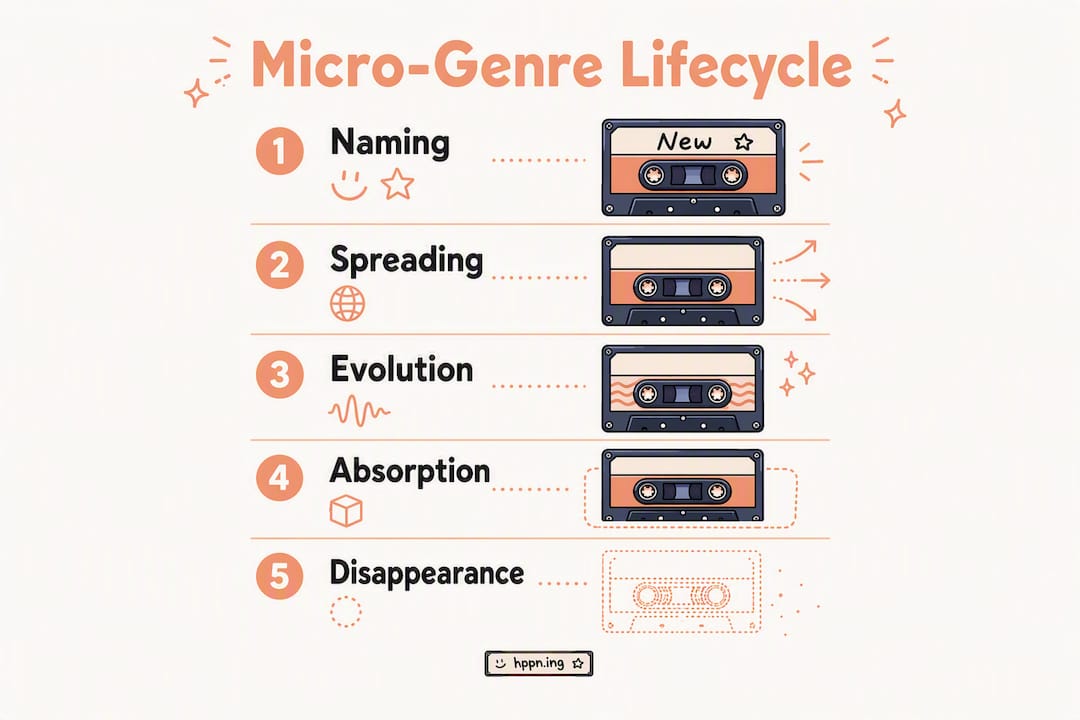
A micro-genre's lifecycle tends to follow a recognizable arc, even if the timeline varies wildly.
Coinage is usually informal: a blog post, a Reddit thread, or a tweet that names something listeners already recognize. At this stage the label is contested and often ironic. Peak visibility comes when press coverage and playlist placement align, usually within one to three years of coinage. This is when the tag appears in mainstream outlets and streaming platforms begin using it as an editorial category. After that, three things can happen.
The first is absorption: the micro-genre gets folded into a larger parent genre or spawns its own subgenres. Post-dubstep is now a recognized subgenre with its own critical history. Chillwave's sonic DNA is audible in mainstream indie pop a decade after the tag peaked. The second is stabilization: the micro-genre retains a dedicated community and continues generating new music without ever crossing into mainstream recognition. Lo-fi hip hop is a good example — it never became a pop genre, but it sustains a large, loyal audience and a functional economy of artists and curators. The third is fade-out: the label loses coherence as the artists associated with it move on, and the tag becomes a historical marker rather than an active scene. Seapunk, a brief 2012 internet aesthetic mixing aquatic imagery with club music, followed this path almost exactly.
Spotting which path a micro-genre is on requires watching two signals: whether new artists are actively self-identifying with the tag (stabilization or growth) and whether the tag is appearing in editorial playlists on major platforms (institutional adoption). When both are happening, the micro-genre is likely to persist. When neither is, the label is probably in its final phase.
How to find and follow micro-genre music
The practical steps are straightforward once you know where to look.
- Start with a sound, not a name. Find one track or artist you love and use Spotify's "Related Artists" or "Fans Also Like" feature to map the surrounding territory before you worry about what the tag is called.
- Read the tags on Bandcamp. Artists self-tag on Bandcamp more honestly than anywhere else, because there is no algorithmic incentive to misrepresent your sound. A tag like "dungeon synth" or "outsider house" on Bandcamp is usually accurate.
- Follow niche subreddits and Discord servers. Communities like r/WeirdHiphop, r/vaporwave, or genre-specific Discord servers are where micro-genre naming actually happens in real time. Lurking for a week tells you more than a month of Spotify listening.
- Use Every Noise at Once. Glenn McDonald's project lets you click any genre name and hear a representative sample immediately. It is the fastest way to orient yourself in unfamiliar territory.
- Watch TikTok hashtags. Micro-genre aesthetics often surface on TikTok before they have a name. A hashtag like #darkacademia or #cottagecoremusic is a micro-genre in formation.
- Check Spotify's editorial playlists by mood and activity. Playlists like "Late Night Vibes" or "Bedroom Beats" are often micro-genre playlists in disguise, curated around a specific sonic pocket even when the title does not say so.
- Attend local shows. A venue that books three acts with a shared aesthetic on the same bill is often incubating a local micro-genre before anyone has named it.
For discovering niche music genres locally, the live show is still the most reliable signal. Online tags can be gamed; a room full of people who showed up for the same sound cannot.
A few quick ways to evaluate whether a tag is meaningful or just noise:
- Does more than one artist actively use the tag to describe themselves?
- Does the tag describe something you cannot already capture with an existing genre name?
- Is there a community (subreddit, Discord, local scene) that predates the press coverage?
If the answer to all three is yes, the tag is probably pointing at something real.
How local live scenes surface micro-genres
Some of the most durable micro-genres did not start on the internet. They started in a specific room on a specific night. The UK dubstep scene grew out of South London club nights like Plastic People, where producers like Skream and Benga played to a few hundred people before any blog had named what they were doing. The sound was coherent enough that when writers eventually applied a label, it stuck immediately because the community already existed.
The same pattern plays out at a smaller scale in American cities constantly. A DIY venue in a mid-sized city books a run of shows with a shared aesthetic — maybe slow, heavily reverbed guitar music with electronic elements — and over six months a local scene forms. Artists start referencing each other's work. A local promoter coins a name for the night. A regional blog picks it up. By the time a Spotify playlist editor notices, the micro-genre has real roots.
For listeners who want to find genre-specific live shows before they become trends, the practical steps are: read venue booking calendars rather than just ticketing sites, pay attention to which promoters consistently book a certain aesthetic, and show up to the smaller shows where the sound is still forming. A lineup of three acts you have never heard of, booked by a promoter you trust, is almost always more interesting than a headliner whose micro-genre peaked two years ago.
Hppn is built for exactly this kind of discovery. The platform lets you browse upcoming shows by location, preview artists through audio and video before you commit to a ticket, and follow trending local performers who are building scenes rather than chasing mainstream placement. For readers who want to put the theory in this article into practice, searching artists and previewing their music on Hppn is a direct path from reading about a micro-genre to hearing it live.
Key Takeaways
Micro-genres are provisional, community-driven sound categories that form online and in local scenes, spread through algorithmic tagging and social platforms, and either stabilize into lasting subgenres or fade out within a few years.
| Point | Details |
|---|---|
| Core definition | A micro-genre is a hyper-specific sound category defined by sonic traits, a visual aesthetic, and a community origin. |
| Formation path | Most micro-genres move from scene or blog coinage through social-media spread to algorithmic playlist adoption. |
| Key examples | Vaporwave, Chillwave, Witch house, Bedroom pop, Hyperpop, and Lo-fi hip hop are the most cited contemporary examples. |
| Limits of labeling | Some tags are ephemeral memes or marketing constructs; a meaningful tag has active artists, a distinct sound, and a real community behind it. |
| Discovery with Hppn | Hppn lets you browse local shows, preview artists by sound, and track trending underground acts to find micro-genre music live. |
The part most explainers get wrong about micro-genres
The standard take on micro-genres frames them as a streaming-era invention, a product of Spotify's recommendation engine and TikTok's algorithm. That framing is half right and half convenient. The internet accelerated micro-genre formation dramatically, but the underlying impulse, naming a specific sound to find the people who love it, is as old as record collecting. What changed is the speed and the scale.
What most explainers miss is the directionality. The conventional story runs: artists make music, platforms tag it, listeners find it. The reality often runs the other way. A community names a sound, artists hear the name and start making music that fits it, and platforms eventually catch up. Hyperpop is a clean example. The tag existed as a critical descriptor before most of the artists now associated with it had released a record. The label shaped the music as much as the music shaped the label.
The practical implication for listeners is that the most interesting micro-genres are usually the ones that have not reached Spotify's editorial team yet. By the time a micro-genre has a curated playlist and a Pitchfork feature, the artists who defined it have often already moved on. The real action is always one step earlier: the local show, the Bandcamp tag with forty followers, the Discord server where people are still arguing about what to call the sound. That is where micro-genres are actually alive.
Hppn connects you to micro-genre music happening near you
Most discovery tools tell you what was popular last month. Hppn shows you what is happening in your city this week, with enough artist context to know whether it is worth your time.
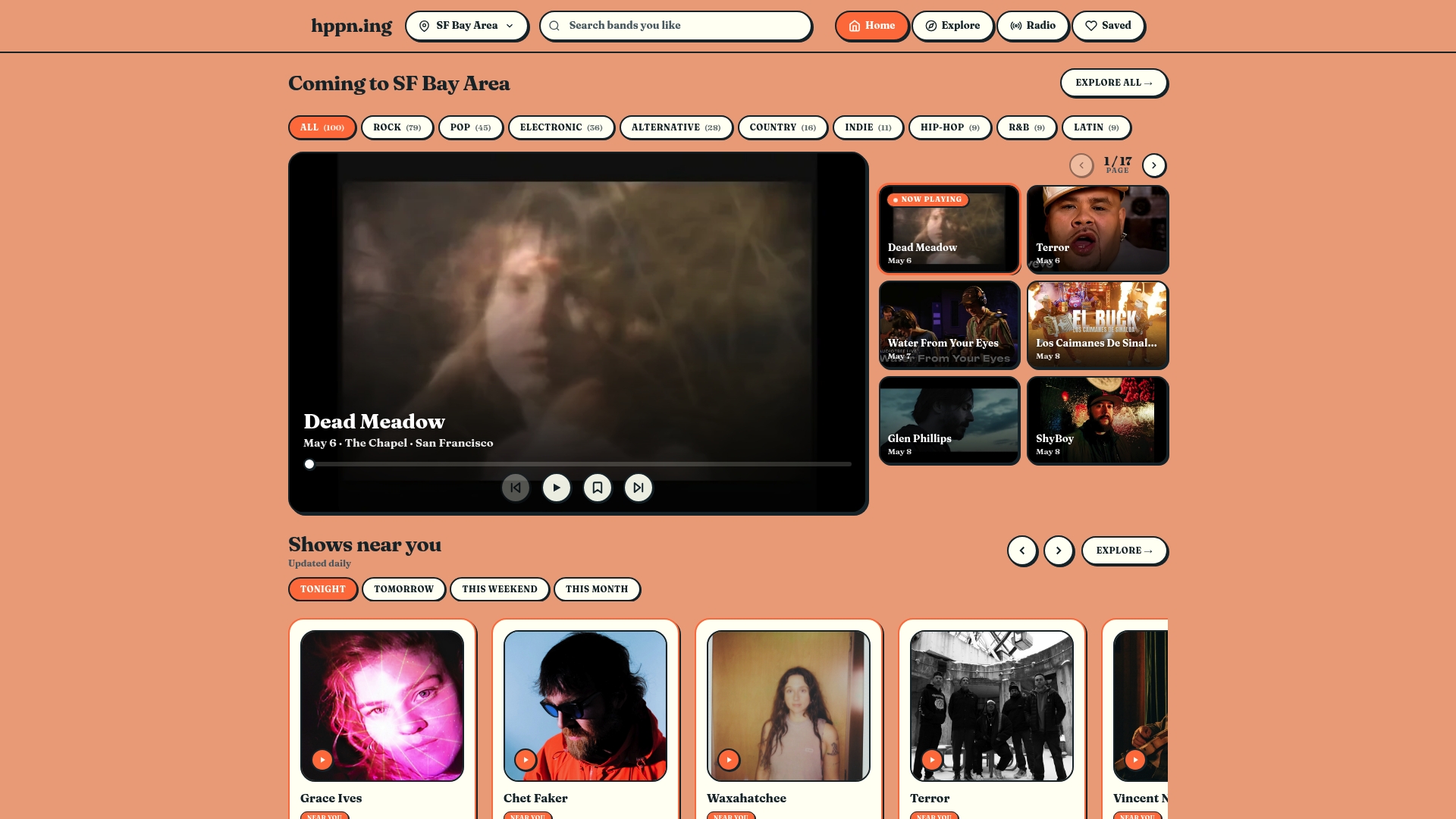
The platform is built around three things that matter for micro-genre discovery: you can search upcoming shows by location and browse artist previews through audio and video before you buy a ticket; you can track trending local and underground performers who are building scenes rather than chasing radio play; and you can engage with a music-focused community that surfaces niche acts through shared tips and local notes. For readers who just learned what Witch house or Bedroom pop actually sounds like, the next step is hearing it live. Find shows and preview artists near you on Hppn, and check the local trending charts to see which micro-genre acts are gaining ground in your area right now.
Useful sources and further reading
The sources below were used in this article and are worth bookmarking if you want to go deeper on any section.
- Microgenre — Wikipedia (Internet microgenre) — The most thorough encyclopedic overview of the term's history, from 1970s music contexts through the blog era; includes a useful timeline of when specific tags emerged.
- List of music microgenres — Wikipedia — A browsable catalog of named music micro-genres; useful as a reference when you encounter an unfamiliar tag.
- Microgenres in music — Audio Network blog — Covers the blog and streaming era acceleration of micro-genre formation, with Chillwave as the central case study.
- 25 Microgenres That (Briefly) Defined the Last 25 Years — Pitchfork — Pitchfork's annotated list of significant micro-genres, with cultural context for each; also the source for the reference to Glenn McDonald's Every Noise at Once index.
- The Rise of Micro Genres and Their Role in Music Production — Soundtrap Blog — Artist-facing perspective on using micro-genre positioning as a branding strategy; practical for producers and curators.
- The Rise of the Microgenre — University of Melbourne (Pursuit) — Academic perspective on micro-genre proliferation across media, with useful framing for understanding why the category expanded in the digital era.
- How to Discover Niche Music Genres Locally — Hppn Blog — Practical local discovery tactics that extend the playbook in this article into real-world steps.
- How to Find Genre-Specific Live Shows — Hppn Blog — Step-by-step guidance for finding live shows tied to specific sounds, directly relevant to the live discovery section above.