

A local music grant is financial support for music projects that build audiences, increase community participation, and promote local artists within a defined geographic area. These grants come from local governments, arts councils, private foundations, and cultural organizations. Programs like the NSW Local Audience Development Grants, the Mississauga Live Music Grant, and the Levitt Music Series Grants each fund different project types, but share one core requirement: the work must benefit a specific local community. If you are a musician, promoter, venue operator, or nonprofit working in live music, understanding how these grants work is the fastest way to unlock funding you may not know exists.
What is a local music grant and who can apply?
A local music grant is not a general arts subsidy. It is a targeted funding mechanism designed to achieve specific community outcomes through music, such as growing live audiences, programming all-ages events, or spotlighting emerging local performers. The industry term most commonly used by grant administrators is "project grant," meaning the funding supports a defined activity with a start date, end date, and measurable results.

Eligibility varies significantly by program, but most grants accept a wider range of applicants than musicians expect. Grant applicants can include individual artists, music businesses, for-profit concert presenters, venues, promoters, and nonprofit organizations. The Mississauga Live Music Grant, for example, explicitly welcomes for-profit concert presenters, while the Levitt Music Series Grants require applicants to hold 501(c)(3) nonprofit status. Knowing which category you fall into before you read a single guideline saves hours of wasted effort.
Common project types that qualify for local music funding include:
- Live events and concerts programmed for public audiences, especially free or low-cost shows
- Music festivals with a community development component, not just ticket sales
- All-ages programming designed to bring younger audiences into live music spaces
- Professional development activities for local artists, such as workshops or mentorship programs
- Recording projects tied to community storytelling or local cultural identity
Geographic eligibility is just as important as organizational eligibility. Many programs require that both the applicant and the event be located within the same jurisdiction. The Mississauga Live Music Grant, for instance, funds events that take place within city limits. Some programs go further and restrict by radius to prevent overlap with existing funded series in nearby communities.
Pro Tip: Read the geographic eligibility rules before anything else. A project that is physically one mile outside a grant's coverage area is still ineligible, regardless of how strong the application is.
How local music grants work: funding amounts and funder expectations
Local music grants operate as project grants with defined funding caps, application windows, and outcome requirements. They are not open-ended subsidies. NSW's Local Audience Development Grants offer up to A$100,000 for one stream and up to A$200,000 for another, with specific open and close dates each cycle. That range reflects the reality of local music funding: amounts vary widely depending on the program's scope and the funder's budget.
Matching funds are a common requirement. Ireland's Night-Time Economy Grassroots Venue Support Scheme 2026 uses a €1 million fund split into streams capped at €20,000 and €8,000, with the larger stream requiring 10% self-funding from the applicant. This means you need to demonstrate financial commitment to your own project, not just ask for full coverage. Funders treat matching requirements as a signal that the applicant has skin in the game.
The table below shows how funding structures differ across three well-known programs:
| Program | Funding cap | Applicant type | Key requirement |
|---|---|---|---|
| NSW Local Audience Development Grants | Up to A$200,000 | Music businesses, nonprofits, venues | Community audience development outcomes |
| Mississauga Live Music Grant | Varies by stream | For-profit and nonprofit presenters | Events held within Mississauga city limits |
| Levitt Music Series Grants | Varies by series size | 501(c)(3) nonprofits only | Free public concerts, radius exclusion rules |
Funders do not just want events. They want measurable community outcomes like audience growth, youth engagement, and artist development. The Toronto Arts Council, for example, funds one-time music projects specifically tied to community development results. Your application needs to show how you will measure success, not just describe what you plan to do.
Pro Tip: Frame your project around what the funder is trying to achieve, not around what you want to create. If the grant targets youth participation, your proposal should lead with how many young people will attend and why that matters to the community.
What are the main steps to apply for a music grant?
Applying for a local music grant is a planning exercise as much as a writing exercise. MusicNSW recommends allocating at least two weeks for application preparation, with clear budget line items and confirmed or projected costs for every expense. Rushing an application almost always produces a weaker result.
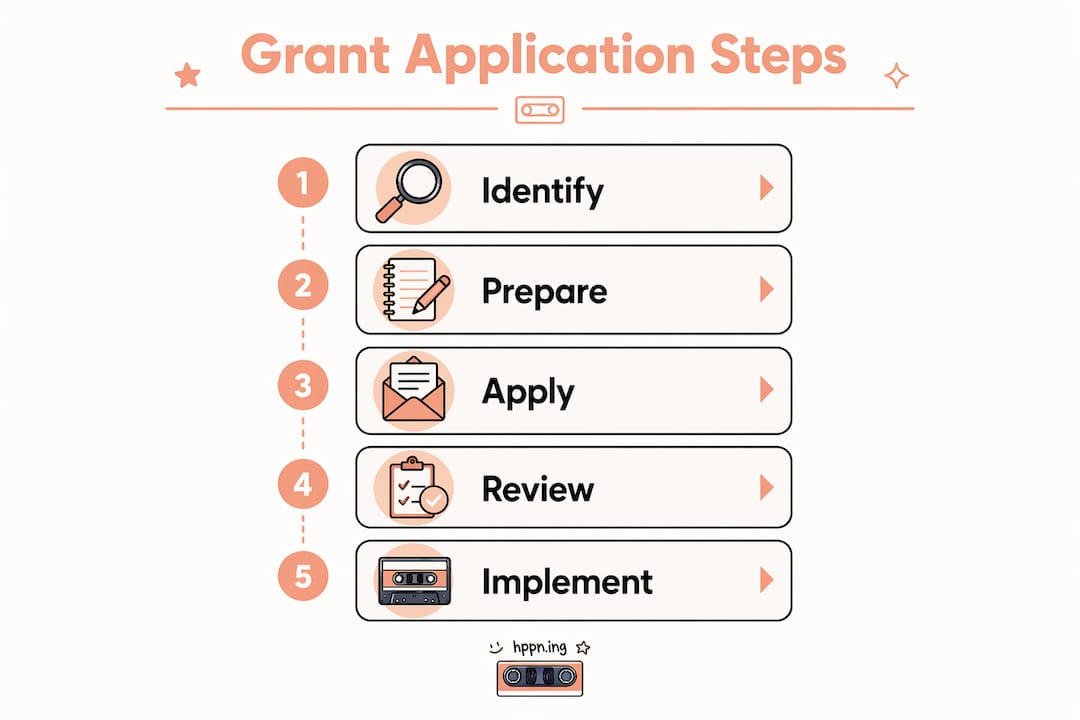
Here is a practical sequence to follow:
-
Identify programs that match your project. Search your city, state, or regional arts council website for active grant cycles. Look for programs that align with your project type, your organizational status, and your geographic location. Hppn's guide on bringing live music to your area is a useful starting point for understanding what kinds of projects attract community funding.
-
Read the full guidelines before writing a single word. Every program has specific eligibility rules, ineligible expenses, and documentation requirements. Missing one criterion disqualifies an otherwise strong application.
-
Build a detailed project budget. List every cost with a justification. Budget line specificity is one of the top factors in grant evaluation credibility. Vague estimates like "marketing: $2,000" are weaker than "social media advertising on Meta and Google: $1,200; printed flyers and posters: $800."
-
Write a project description that connects to funder goals. Describe the activity, the audience, the timeline, and the outcomes. Use the funder's own language from their guidelines. If they prioritize "all-ages programming," use that phrase and explain how your project delivers it.
-
Gather supporting documentation early. Letters of support from community partners, venue confirmations, and artist agreements all take time to collect. Starting this process in week one, not week two, prevents last-minute delays.
-
Avoid ineligible expenses. Grants rarely cover equipment purchases, capital costs, or general operating expenses. Including these in your budget signals that you have not read the guidelines carefully, which damages your credibility on every other line item.
The most common reason strong projects get rejected is not a weak idea. It is a budget that does not match the project description, or a project description that does not match the funder's stated priorities.
How local music grants differ across regions and programs
Local music grants are not a single category with uniform rules. They reflect the priorities, politics, and budgets of the organizations that fund them. Understanding regional variation helps you tailor applications and avoid applying to programs that are structurally misaligned with your work.
The most significant differences fall into four areas. First, nonprofit versus for-profit eligibility: some grants require nonprofit status while others explicitly welcome for-profit presenters. Levitt requires 501(c)(3) status; Mississauga does not. This single factor eliminates or opens entire programs depending on your organizational structure.
Second, free versus ticketed events: many community-focused grants prioritize free public concerts because they maximize access. The Levitt Music Series Grants are built entirely around free outdoor concerts. Ticketed festival grants exist, but they typically require stronger evidence of community benefit beyond revenue generation.
Third, geographic radius rules: radius exclusions can disqualify projects in communities that appear eligible on a map but fall too close to an existing funded series. This is one of the least-understood eligibility rules and one of the most common sources of rejected applications.
Fourth, integration with broader economic or cultural strategies: some grants are tied to city-wide economic development goals, such as Ireland's Night-Time Economy scheme, which targets grassroots venues as part of a national strategy to support nightlife infrastructure. Understanding the policy context behind a grant helps you frame your project in terms that resonate with decision-makers.
Key differences to check before applying to any program:
- Whether the program funds recurring series or one-time events only
- Whether international touring artists are eligible or only local performers
- Whether the grant covers production costs, artist fees, or both
- Whether a final report with attendance data is required for future eligibility
Key takeaways
Local music grants fund community-focused projects with defined outcomes, and the strongest applications align project goals directly with funder priorities rather than treating the grant as general event support.
| Point | Details |
|---|---|
| Definition and purpose | Local music grants fund specific projects that build audiences, engage youth, and promote local artists within a defined area. |
| Eligibility varies widely | Programs like Mississauga accept for-profit presenters; Levitt requires 501(c)(3) nonprofits. Check status before applying. |
| Funding caps and matching funds | Grants range from a few thousand to A$200,000, and some require 10% or more in self-funded contributions. |
| Application preparation | MusicNSW recommends at least two weeks for preparation, with specific budget line items and confirmed costs. |
| Avoid ineligible expenses | Equipment purchases and capital costs are almost never covered. Budget only for activities the funder explicitly supports. |
Why most musicians leave grant money on the table
I have reviewed a lot of grant applications over the years, and the pattern is consistent. Musicians write about their music. Funders want to read about their community. That gap is where most applications fail, and it is entirely fixable.
The biggest misconception I see is that "local" means easy. Artists assume that because a grant is local, the competition is thin and the bar is low. The opposite is often true. Local funders know their communities well. They can tell immediately when a proposal is generic, when the budget has been inflated to hit a cap, or when the "community outcomes" section was written in ten minutes as an afterthought.
What actually works is treating the application as a planning document, not a pitch. When you build your project around what the funder is trying to achieve, the writing becomes specific and credible almost automatically. If the grant targets youth engagement, your proposal should include a realistic plan for reaching young audiences, not just a line that says "this event will attract all ages."
I also strongly recommend contacting the grant administrator before you apply. Most programs have a staff contact for eligibility questions. A five-minute phone call can confirm whether your project qualifies and often reveals what the reviewers actually care about. That information is worth more than any grant-writing template. Understanding how community boards support live music in your city is also worth the time. It gives you context for who is making funding decisions and why.
— Ari
Discover local music opportunities with Hppn
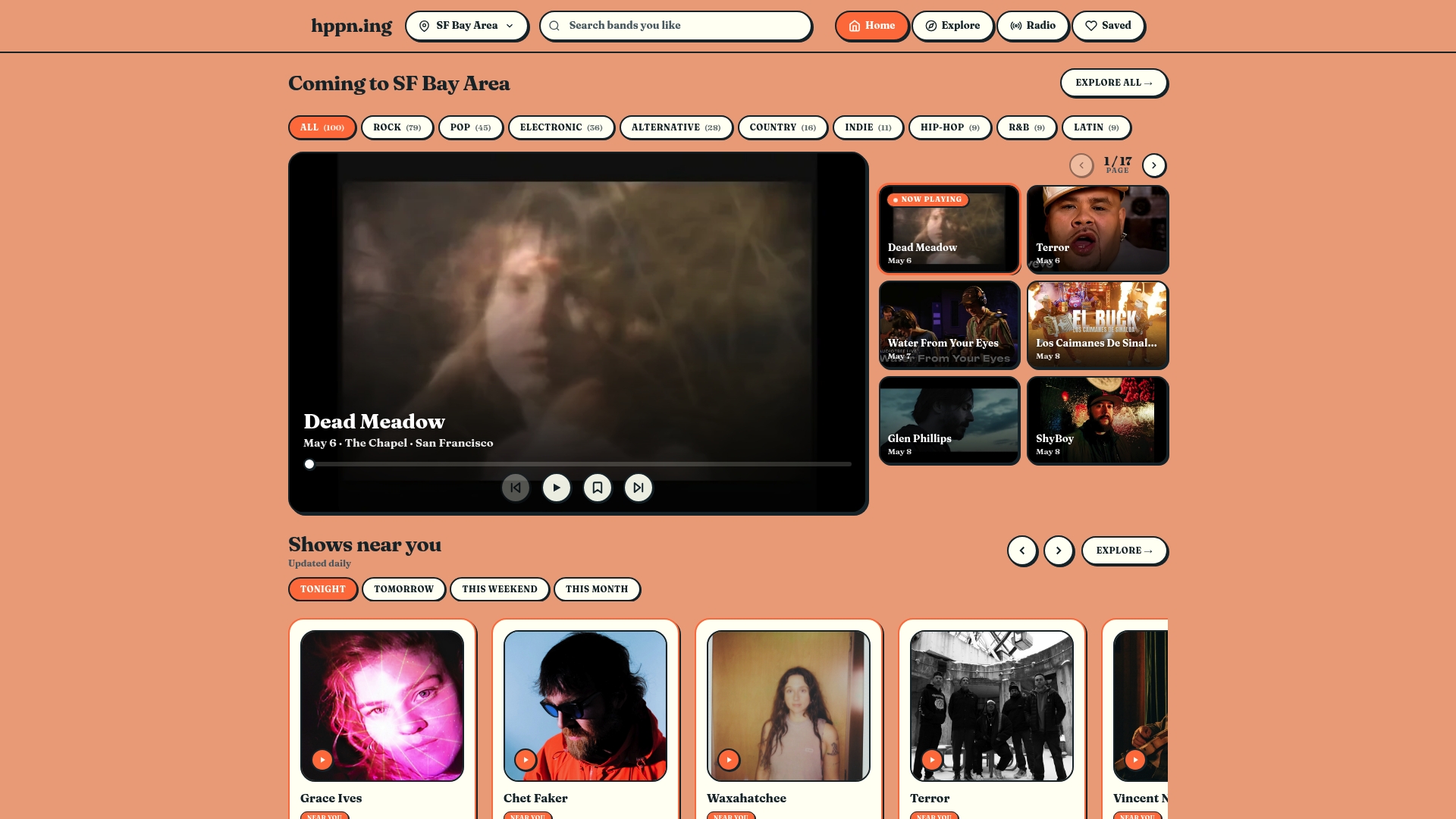
Hppn is built for exactly the kind of music ecosystem that local grants are designed to support. The platform lets you discover live music nearby, preview artists through video and audio, and find shows featuring emerging and underground performers in your city. For musicians pursuing community music funding, Hppn offers a direct way to demonstrate audience demand and community engagement, two things every grant reviewer wants to see. Browse local concert listings, connect with other music fans, and use the platform to build the kind of documented local presence that strengthens any grant application. The live music scene you are trying to fund already exists on Hppn.
FAQ
What is a local music grant?
A local music grant is funding provided by a local government, arts council, or foundation to support music projects that benefit a specific community. Projects typically focus on audience development, youth engagement, or promoting local artists.
Who is eligible to apply for music grants?
Eligibility depends on the program. Some grants, like the Mississauga Live Music Grant, accept for-profit concert presenters. Others, like the Levitt Music Series Grants, require 501(c)(3) nonprofit status. Individual artists, venues, and music businesses are eligible for many programs.
How much funding can a local music grant provide?
Funding amounts vary widely. NSW Local Audience Development Grants offer up to A$200,000, while Ireland's Night-Time Economy Grassroots Venue Support Scheme caps streams at €20,000 and €8,000. Most programs also have defined application windows and project timelines.
What expenses do local music grants typically not cover?
Most local music grants do not cover equipment purchases, capital costs, or general operating expenses. MusicNSW specifically warns applicants to exclude equipment from grant budgets and focus spending on activities that directly support audience development and community outcomes.
How long does it take to apply for a music grant?
MusicNSW recommends allocating at least two weeks for application preparation. This includes writing the project description, building a detailed budget with confirmed costs, and gathering supporting documentation such as venue confirmations and letters of support.