

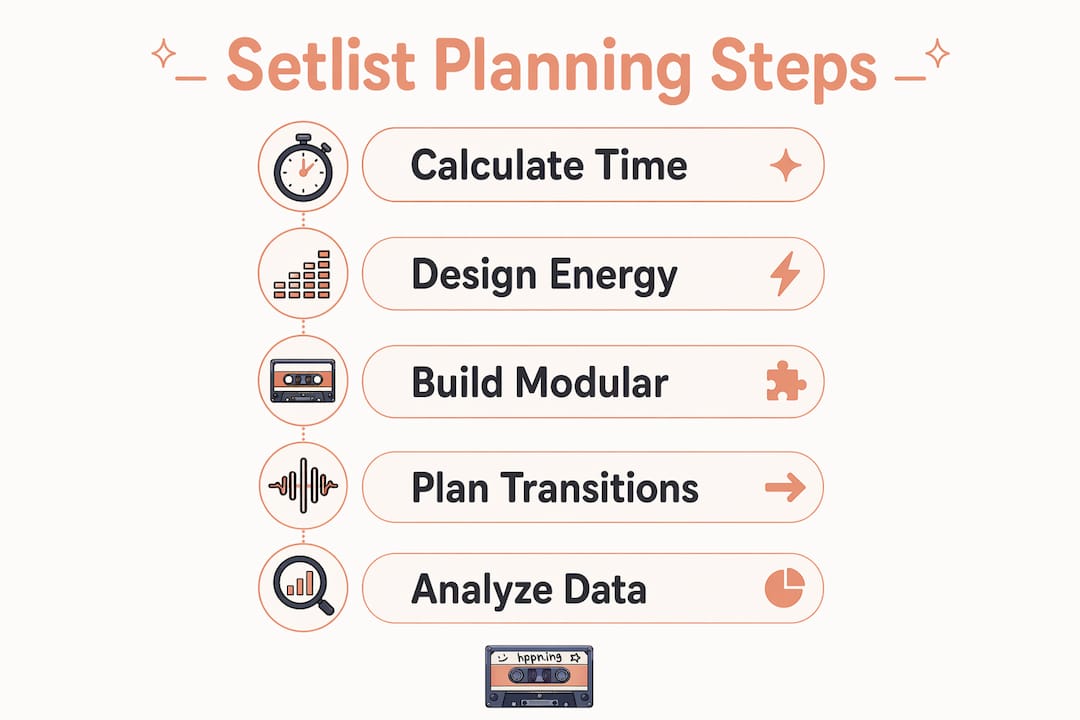
Setlist planning for live shows is the deliberate process of organizing song order and pacing to maximize audience engagement within a fixed performance time. Every professional act treats this as a structured creative exercise, not a casual playlist shuffle. The best shows feel effortless because the setlist was built with intention: timing math, an energy curve, modular flexibility, and planned transitions all working together. This guide breaks down how setlists are planned for live shows from the first calculation to the final encore, so musicians, event planners, and fans can understand what actually goes into a great night.
How to calculate song count and time constraints
The first step in live show setlist planning is pure math. You need to know exactly how many songs fit inside your stage time before you can make any creative decisions.
Calculating song count starts with your total slot length and average song duration including transitions. For a 60-minute set, assuming roughly 4 minutes per song plus 30 seconds of transition time, you land at approximately 13 songs. That number is your ceiling, not your target.
Here is a practical breakdown for common slot lengths:
- 15–20 minute opening slot: Fits 4–5 songs. No room for slow builds. Open strong, close strong, and cut anything that does not serve those two goals.
- 30-minute support slot: Fits 7–8 songs. You can include one mid-set breath moment, but every other song needs to earn its place.
- 60-minute headlining set: Fits 12–14 songs. This is where an energy curve becomes possible and necessary.
- 90-minute headline set: Fits 18–22 songs. Multiple peaks, valleys, and a full encore structure are all viable here.
Overbuilding setlists is one of the most common mistakes working musicians make. Writing 18 songs for a 60-minute slot feels safe until you are standing on stage at minute 55 with 6 songs left and no clean way out. The fix is to build a primary setlist at your realistic song count, then prepare a shortened version in advance. That shortened version becomes your backup when soundcheck runs long, the previous act overruns, or the venue enforces a hard curfew.
Pro Tip: Always prepare a "cut version" of your setlist that removes 2–3 songs without breaking the energy arc. Know exactly which songs to drop before you walk onstage.
How does the energy curve shape audience engagement?
The energy curve is the single most important structural concept in setlist arrangement strategies. Controlling energy flow throughout the show, rather than stacking your best songs at the front, is what keeps a room locked in from start to finish.
A well-built energy curve follows a recognizable shape regardless of set length:
- Opening hook: Your first song sets the contract with the audience. It should be immediately recognizable, high energy, and signal exactly what kind of show this is. Artists like Beyoncé and Bruce Springsteen famously open with crowd favorites, not album deep cuts.
- Early climb: Songs 2 and 3 maintain or build on that opening energy. This is not the moment to introduce unfamiliar material.
- First breath: Around the one-third mark, a tempo drop or a slower song gives the audience a moment to absorb what they have heard. This contrast makes the next climb feel bigger.
- Mid-set peak: The emotional and sonic high point of the show. This is where your most powerful song or fan favorite lives.
- Valley: A deliberate low-energy section, often used for acoustic moments, storytelling, or a new song introduction. The valley creates anticipation.
- Final climb and closer: The last three songs should build relentlessly toward a definitive ending. The closer is your signature statement.
- Encore payoff: If your format includes an encore, it should feel like a genuine reward. One or two songs that the audience has been waiting for all night.
For 15–20 minute sets, the curve compresses: open strong, one breath moment, close strong. Longer sets allow multiple peaks and valleys, which is what separates a 90-minute show from feeling like a marathon.
The emotional arc matters as much as the sonic one. A show that moves from defiance to vulnerability to celebration tells a story. That story is what audiences remember and talk about after they leave.
Fixed anchors vs. flexible zones: what goes into a modular setlist?
Modular setlists use fixed anchors and flexible middle zones to balance consistency with adaptability. This structure is standard practice for touring acts playing multiple cities with different audience demographics.
| Section | Type | Purpose |
|---|---|---|
| Opener | Fixed anchor | Sets tone; never swapped mid-tour |
| Songs 2–4 | Flexible zone | Adjusted by venue size and crowd energy |
| Signature midpoint | Fixed anchor | Fan-favorite moment; consistent across dates |
| Middle block | Flexible zone | Regional favorites, new material, rarities |
| Pre-closer build | Semi-fixed | Adjusted based on crowd response |
| Closer | Fixed anchor | Definitive statement; never changed |
| Encore | Fixed or flexible | One fixed song; one optional swap |
Fixed anchors give the band confidence and the audience a reliable experience. Flexible zones are where adaptability without rebuilding the entire setlist becomes possible. A band playing Nashville might swap in a country-influenced deep cut that would not land in Seattle. A festival crowd gets a different middle block than a theater crowd.
Iterative refinement drives this process over the course of a tour. Acts test multiple candidate setlists in early dates, gather feedback from meet-and-greets and social media, and adjust the flexible zones accordingly. The opener and closer stay locked. Everything in between is subject to revision.
Experienced setlist planners treat the setlist as a living document rather than a fixed script. That mindset is what separates acts that grow stronger across a tour from those that feel stale by week three.
How do transitions and technical details affect live flow?
Transitions are the connective tissue of a live show. Most audiences never consciously notice them. Every musician and event planner should.
Transitional moments are explicitly planned in professional setlists, covering everything from seamless key changes to drum fills, crowd interaction, and gear swap breaks. Planning these in advance prevents the awkward silences that kill momentum. Here is how transitions break down by type:
- Seamless transitions: The band moves directly from one song to the next with no gap. Works best when songs share a key or tempo. Radiohead and Arcade Fire use this technique to create unbroken sonic environments.
- Drum fill or instrumental bridge: A short musical moment that signals a shift without stopping the energy. Gives other band members time to retune or change instruments.
- Spoken moment: A story, joke, or crowd call-and-response. Used strategically to lower energy before a big moment or to buy time for a technical reset.
- Planned break: An explicit pause for water, tuning, or equipment changes. Scheduling these prevents unplanned stops mid-set.
The show advance document is the production backbone behind all of this. It covers load-in time, soundcheck timing, set length, curfew, number of performers, and technical needs. Every venue interaction starts with this document, and it directly shapes what the setlist can realistically include.
Soundcheck is not just volume testing. It is the verification stage where the band confirms that all inputs and stage monitors work, that the room sounds right, and that the planned dynamics will translate. Soundcheck results regularly cause real-time edits to pacing and song choices. A song that sounded great in rehearsal may reveal a monitor problem during soundcheck that makes it unworkable for that night.

Pro Tip: Write your transitions directly onto your printed setlist. Label each gap as "seamless," "story," or "break" so every band member knows what is expected without a mid-show conversation.
If you are tracking your own open mic or smaller venue performances, resources like open mic performance tracking offer practical frameworks for logging what worked and what did not between sets.
How does post-show data improve future setlists?
A data-driven approach to setlist refinement uses local feedback, streaming data, and direct audience input to develop and optimize multiple candidate setlists across a tour. This is not just for arena acts. Any working musician can apply these methods at their scale.
The iterative process runs through three stages:
- Opening run: Test two or three candidate setlists across the first few dates. Keep the fixed anchors constant and vary the flexible zones. Track applause intensity, crowd movement, and merch sales by set section to identify which songs generate the strongest response.
- Optimization phase: Use meet-and-greet conversations, social media comments, and local polls to understand what resonated. Streaming spikes after a show often reveal which songs the audience searched for immediately after hearing them live. Those songs deserve more prominent placement.
- Payoff run: Lock in the refined setlist for the final stretch of the tour. The flexible zones are now informed by real data, not guesswork. The show feels tighter because it is.
Segmenting your audience by market also matters. A college-town crowd in Austin responds differently than a seated theater audience in Chicago. Developing candidate setlists with those differences in mind, rather than running one identical show everywhere, is what separates good tours from great ones.
For fans who want to find new music through live shows, understanding this refinement process explains why the same artist can feel completely different from one tour to the next.
Key takeaways
Effective live show setlist planning combines timing math, energy curve design, modular structure, and technical preparation into a single repeatable process.
| Point | Details |
|---|---|
| Start with duration math | Calculate song count from slot length before making any creative decisions. |
| Build an energy curve | Sequence songs to create peaks, valleys, and a strong closer rather than stacking highlights. |
| Use fixed anchors and flexible zones | Lock your opener and closer; swap middle songs based on venue and audience. |
| Plan every transition explicitly | Label each gap on the printed setlist to prevent mid-show pauses. |
| Refine with post-show data | Track applause, streaming spikes, and audience feedback to improve future setlists. |
The part of setlist planning nobody talks about enough
Most setlist advice focuses on song selection. The part that actually separates a good show from a great one is rehearsing the transitions and staging alongside the songs themselves.
I have watched bands nail every individual song in rehearsal and then fall apart live because nobody practiced the 15 seconds between songs. That gap is where the audience decides whether they are still with you or checking their phone. When you rehearse the transition as seriously as the song, the whole show tightens up in a way that no amount of song selection can fix.
The other thing I keep coming back to is the instinct to overbuild. Writing 20 songs for a 60-minute set feels like preparation. It is actually anxiety dressed up as preparation. The discipline of cutting down to exactly what the slot requires, and knowing in advance which songs to drop if time runs short, is a skill that takes real practice to develop.
The best setlists I have seen treat the show as a single piece of work, not a collection of songs. Every decision, from the opener to the encore, serves the arc. That requires treating the setlist as a living document right up until showtime, and being genuinely willing to adapt based on what the room is telling you. A crowd that is cold in the first three songs is giving you information. The bands that respond to that information in real time are the ones people remember.
— Ari
Discover live shows and artists before you go
Understanding how setlists work makes the live experience richer. Knowing what an artist typically opens with, how they build their energy curve, and what their closer usually is turns a concert into something you can anticipate and feel more deeply.
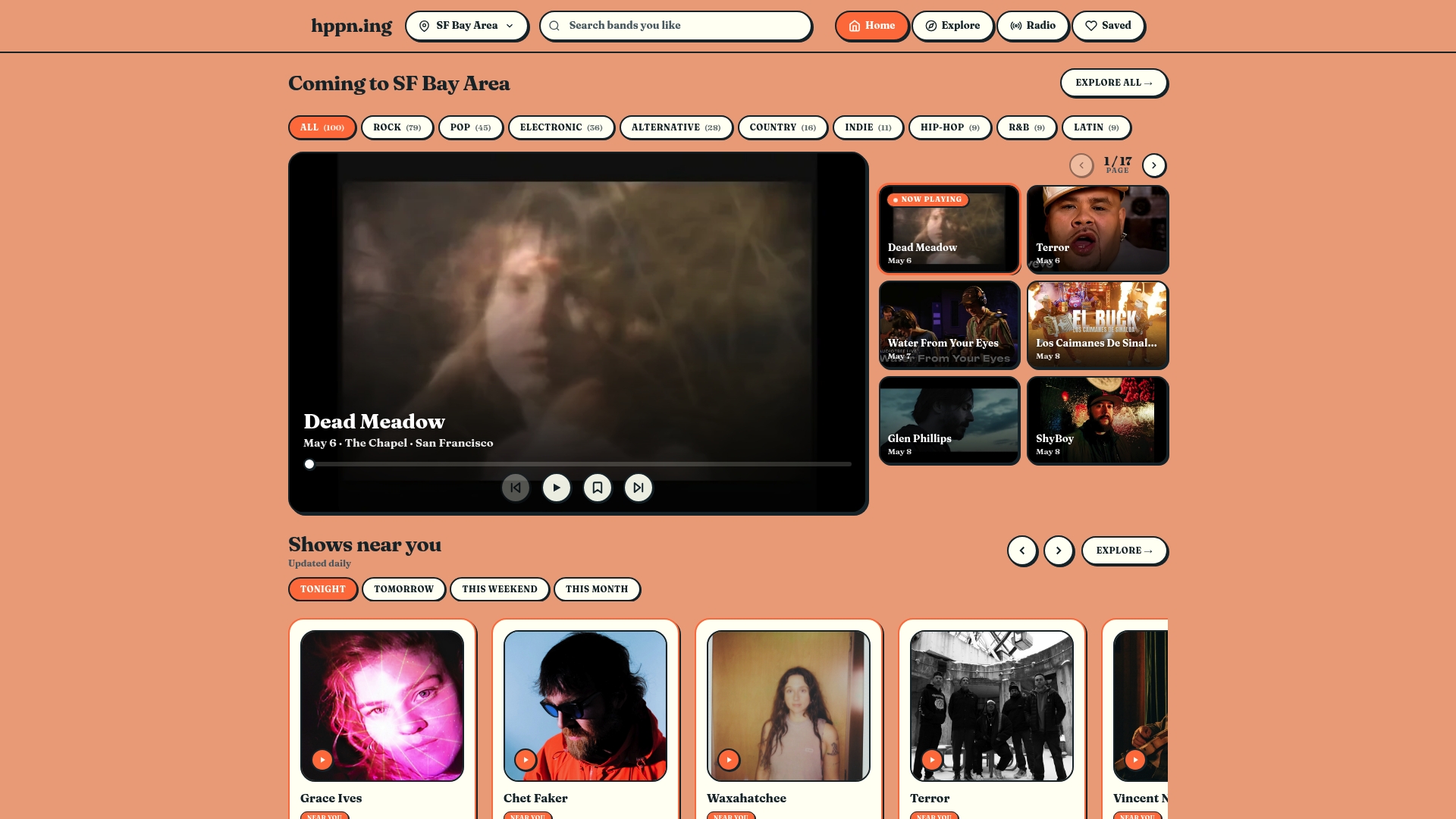
Hppn is built for exactly that kind of engaged music fan. The platform lets you preview artists and shows before you commit to a ticket, browse concerts by location, and discover emerging performers who are building their live sets right now. Whether you are an event planner researching acts or a fan looking for your next great night out, Hppn surfaces the live music that matters in your city. Explore trending local artists and find shows worth attending at hppn.ing.
FAQ
How are setlists planned for live shows?
Setlists are planned by calculating available stage time, sequencing songs along an energy curve, and building in planned transitions and modular flexibility. The process combines timing math with creative and technical decisions made before and during soundcheck.
How many songs fit in a 60-minute set?
A 60-minute set fits approximately 13 songs, assuming an average of 4 minutes per song plus 30 seconds of transition time per gap. Most acts build a primary list of 13 and a shortened backup of 10–11 in case of time cuts.
What is the energy curve in setlist planning?
The energy curve is the intentional rise and fall of intensity across a show, moving from a strong opener through peaks, valleys, and a definitive closer. Controlling this arc, rather than stacking highlights at the front, sustains audience engagement throughout the performance.
What are fixed anchors in a setlist?
Fixed anchors are the songs that stay constant across every show on a tour, typically the opener, a signature midpoint, and the closer. They provide consistency while the flexible middle zones allow the setlist to adapt to different venues and audiences.
How does soundcheck affect the final setlist?
Soundcheck verifies that all technical elements work as planned and can trigger real-time edits to song order or pacing. A monitor problem or room acoustic issue discovered during soundcheck may cause a band to swap or drop a song before the show begins.