

What is a ticketed versus free event?
A ticketed event requires attendees to secure admission, usually by purchasing a ticket before they arrive. A free event lets people register or RSVP without paying anything. Both formats use similar registration systems; the core difference is that ticketed events integrate payment processing while free events skip that step entirely.
The practical split looks like this:
- Ticketed events: concerts, festivals, conferences, galas, workshops with paid admission, VIP experiences
- Free events: community gatherings, brand activations, free webinars, gallery openings, networking mixers, soft launches
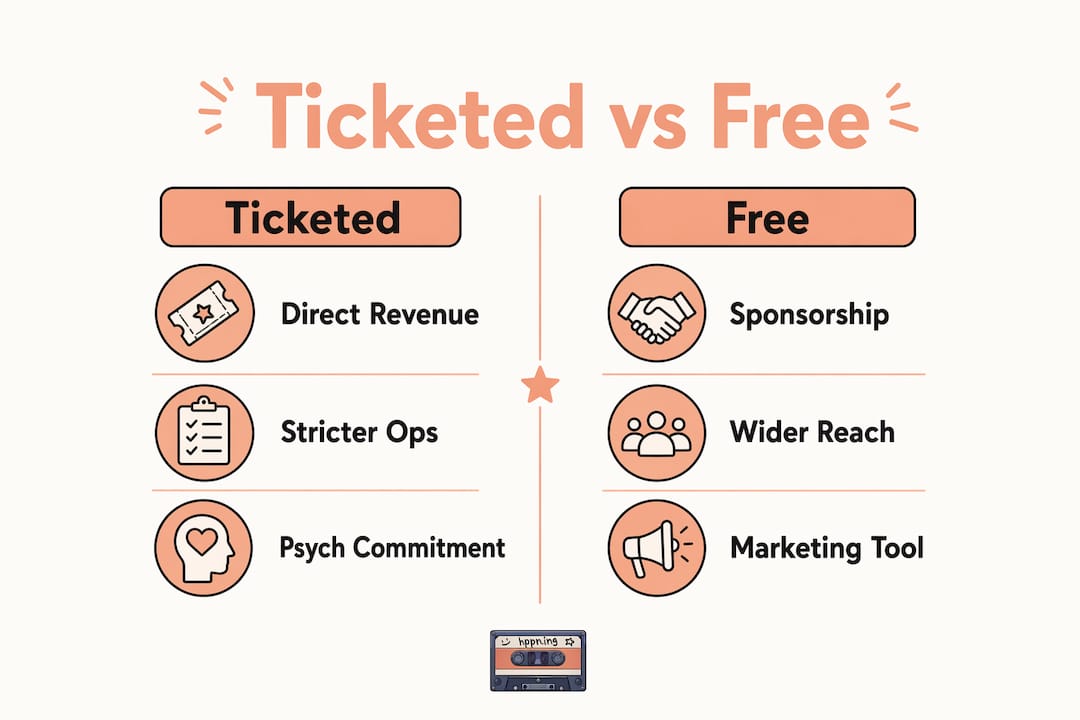
Ticketed events generate direct revenue to cover production costs. Free events typically rely on sponsorships, grants, or downstream sales, and they prioritize volume and community reach over admission income.
Why free ticketing is a tool, not just an absence of payment
Free ticketing, meaning issuing zero-cost tickets that still require registration, is a growing crowd-control strategy that planners increasingly use to manage headcount without charging admission. The distinction matters: a truly open-door event collects no data and gives you no visibility into who is coming. A free-ticketed event gives you both.
Key benefits of free ticketing for planners:
- Capacity control: You cap registrations at a set number, preventing overcrowding without turning anyone away at the door.
- Attendee data: Names, emails, and demographic info flow into your system automatically, building a list you can market to later.
- Resource planning: Knowing your expected headcount lets you right-size staff, parking, catering, and A/V before the day arrives.
- Wider reach: Removing the payment barrier lowers the decision threshold for potential attendees, especially for first-time audiences.
- Community goodwill: Free events signal accessibility and build the kind of trust that converts casual attendees into loyal fans or customers.
Free events also work as top-of-funnel marketing, pulling audiences in without charging admission and then monetizing through merchandise, food, follow-up paid events, or sponsorships. AREA15's Mega Block Party in Las Vegas is a textbook example: free admission to a 200-foot drop ride debut, with all real revenue flowing from return visits to paid attractions.
Pro Tip: Even if your event costs nothing to attend, use a registration platform to issue free tickets. You get a confirmed headcount, an attendee email list, and a paper trail for capacity compliance, all without adding friction for your audience.
How operations differ when money is on the line
The gap between running a free event and a ticketed one is wider than most planners expect before their first paid show.
Operational differences by format:
- Entry protocols: Ticketed events require ticket scanning, fraud prevention, and secure gate management. Free events can use simpler check-in lists or QR-code confirmation.
- Financial reconciliation: Paid events involve payment processing, refund policies, chargebacks, and revenue reporting. Free events have none of that administrative load.
- Attendee commitment: People who pay show up. RSVP events often see higher no-show rates depending on event type and timing, while ticketed events see far lower dropout because attendees have a financial stake.
- Fraud risk: Ticketed events attract ticket scalpers, counterfeit passes, and payment fraud. Free events face different risks, mainly over-registration and ghost attendees.
- Capacity management: Paid events tend to sell to a firm cap, making planning predictable. Free events can spike unpredictably, especially when registration is open-ended.
A nominal ticket fee creates a psychological commitment that dramatically improves show-up rates compared to a fully free registration. Even $5 changes the calculus for an attendee deciding whether to bother on a rainy Tuesday.
For the technology side, platforms like Cvent handle enterprise-level ticketed event management, covering payment processing, access control, and reporting in one system. AttendStar focuses on ticket sales and marketing for live events, with tools built specifically for driving registrations and managing gate operations. Planners running free events with large expected crowds often use the same platforms but activate only the registration and check-in modules, skipping payment entirely. For live music specifically, understanding how concert ticket access works in 2026 helps planners choose the right tools before they commit to a format.

What industry experts say about the structural divide
The difference between free and ticketed events is not just financial. It is structural, and practitioners in live music and entertainment have learned this the hard way.
Ty McBride, general manager of Mason Lane Entertainment, has been direct about what changes when a venue moves from free community shows to ticketed admission. Ticketed events demand a complete overhaul of entry and exit protocols, secure ticketing software to prevent fraud, and a sharper focus on capacity management. When people pay, their expectations for sound engineering, production quality, and crowd safety rise sharply. A free show allows for some logistical looseness. A ticketed event does not.
Key expert perspectives on the free-versus-paid divide:
- Liability shifts with the ticket price. Free events carry lower legal exposure when something goes wrong. Paid events create a contractual obligation to deliver a specific experience, and failures become PR and legal risks, not just inconveniences.
- Free events function as loss leaders. Organizers who understand this structure their free events to drive downstream revenue, not to break even at the door. The free admission is the cost of customer acquisition.
- Nominal fees change psychology. A small charge, even a token one, signals that the event has value and filters out attendees who were never genuinely interested. That filtering improves engagement quality for everyone who does show up.
- Free ticketing bridges both worlds. Issuing zero-cost tickets captures the registration and commitment benefits of a paid model without the revenue complexity. It is the format that free admission shows increasingly use to manage crowds at scale.
The live music industry's broader shift toward experience-based ticketing, tiered access, VIP packages, and bundled hospitality, reflects a deeper truth: the format you choose shapes every downstream decision, from talent booking to sponsor conversations to how you handle a no-show spike at the door.
Hppn makes it easier to find and preview live music events before committing, whether the show is free or ticketed. Browse concerts near you, preview artists through audio and video, and discover emerging local acts worth showing up for.
Key Takeaways
Ticketed events generate direct revenue and demand stricter operations, while free events prioritize reach and rely on downstream monetization, and free ticketing bridges both by capturing registration data without charging admission.
| Point | Details |
|---|---|
| Core operational difference | Ticketed events integrate payment processing; free events use the same registration framework without it. |
| No-show risk | RSVP events see no-show rates of 20–40%, while ticketed events see significantly lower dropout due to financial commitment. |
| Free ticketing as a tool | Zero-cost tickets still capture headcount, attendee data, and capacity control without a payment barrier. |
| Revenue model contrast | Ticketed events cover costs through admission; free events rely on sponsorships, grants, or downstream sales. |
| Liability and expectations | Paying attendees expect higher production quality, creating greater legal and operational responsibility for organizers. |