
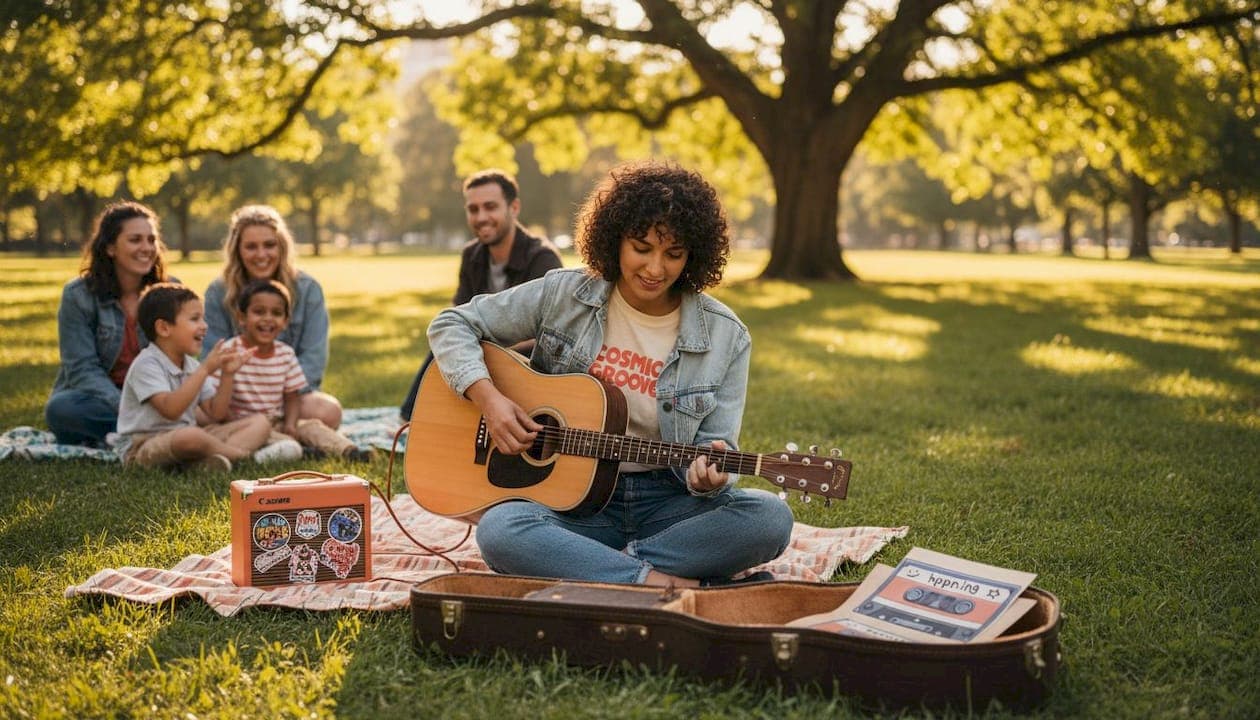
You've probably heard someone say they caught a surprise show in a bookstore, a rooftop, or the back of a bar with no warning. That's a pop-up live music event. These shows flip the standard concert model on its head: no arena, no pre-sale tickets six months out, no merch table waiting for you at the door. They are short-lived, often unannounced, and built on the thrill of being in the right place at exactly the right moment. If you want to understand what separates them from every other live experience, you're in the right place.
Table of Contents
- Key takeaways
- What is a pop-up live music event?
- Why artists and fans keep showing up
- What to expect when you actually go
- How to organize a pop-up music show
- Pop-ups vs. other live music formats
- My honest take on pop-up culture
- Find your next pop-up show with Hppn
- FAQ
Key takeaways
| Point | Details |
|---|---|
| Pop-ups are defined by surprise | The unexpected nature creates scarcity-driven loyalty that standard concerts simply cannot replicate. |
| Two core formats exist | Surprise pop-ups and scheduled series both qualify, but they deliver very different fan experiences. |
| Location shapes everything | Intimate, unconventional venues are central to what makes these events feel raw and memorable. |
| Discovery requires preparation | Fans must follow social alerts and fan communities closely to have any real chance of attending. |
| Artists gain real benefits | Pop-ups let musicians test material, build genuine connection, and generate organic buzz without big budgets. |
What is a pop-up live music event?
A pop-up live music event is a performance that appears with little or no advance notice, in a non-traditional venue, for a limited audience. The word "pop-up" is borrowed from retail, where temporary stores would appear overnight and vanish days later. Applied to music, it carries the same logic: these shows exist briefly, often by design, and the fleeting nature is the whole point.
What separates a pop-up from a standard small concert is intent. A local band playing a bar every Friday night is a recurring show. A pop-up is when that same band, or a touring artist, announces a set 48 hours out in an art gallery, a parking lot, or someone's backyard. Pop-up events create scarcity and intense fan loyalty despite the inconvenience of short notice and limited capacity.
There are two distinct formats worth knowing:
- Surprise pop-ups: Zero or near-zero advance notice. These lean hardest into the unexpected. Think an artist showing up to perform at a record store or a neighborhood park with no pre-announcement beyond a same-day social post.
- Scheduled pop-up series: Recurring but temporary. For example, the North Hills pop-up series runs Fridays and Sundays with acoustic performances in public spaces, free and accessible to anyone nearby.
- Micro-popups: Ultra-small shows for 20 to 200 people, often tied to a brand moment, album cycle, or fan club access.
"Pop-up concerts make little money but create cultural touchstones and real fan connection that no arena show can manufacture." — Music industry agents quoted by Billboard
Compared to a traditional concert, pop-ups strip away the production barrier between artist and crowd. No LED screens, no VIP sections, no opening act you half-listen to. Just music in a space that was probably never designed for it.
Why artists and fans keep showing up
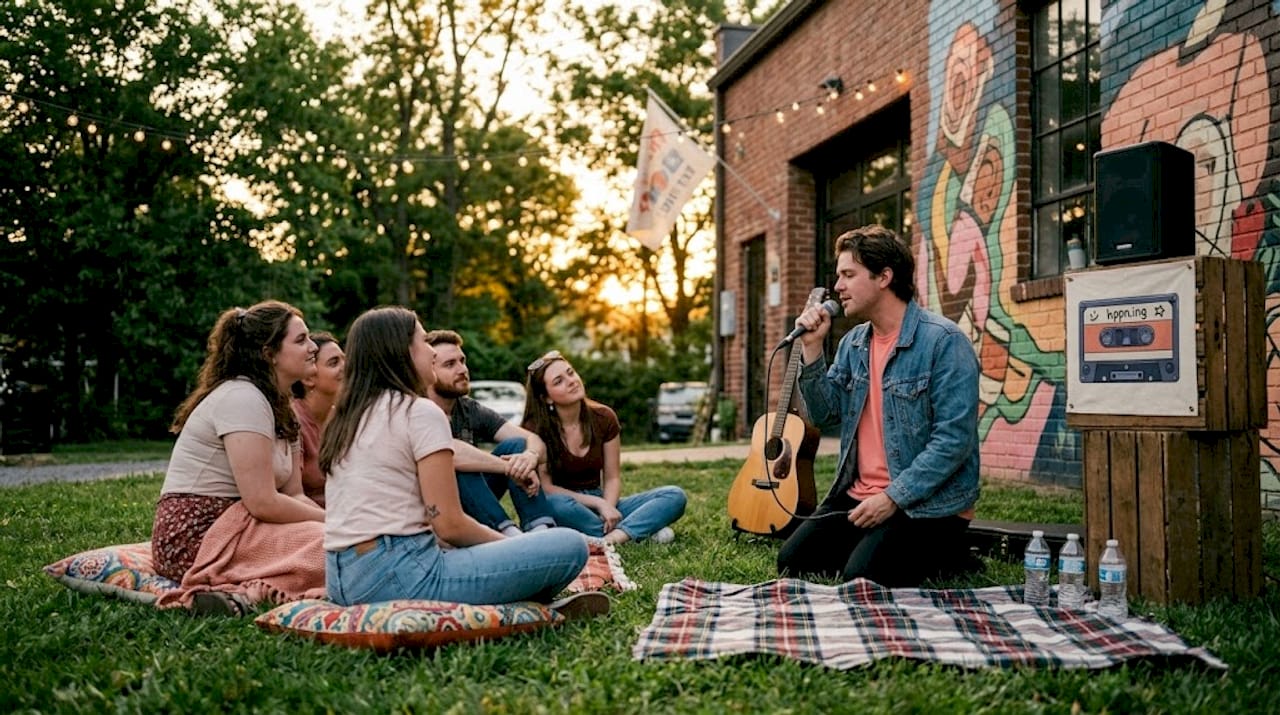
For artists, pop-up shows solve a problem that streaming has made worse: reaching people who actually care. Pop-ups cut through streaming algorithms and build real fan connections rather than racking up passive playlist plays. They also function as a low-stakes laboratory. An artist can play three new songs to 150 people and watch the reaction in real time, something that no focus group or comment section can replicate.
Artists also use pop-ups to reclaim control of the story around them. Artists use pop-ups as subversive acts to generate viral social media content and create hyper-local moments that spread far beyond the room. A set that only 300 people witnessed can reach millions online within hours precisely because of its rarity.
For fans, the benefits are just as real:
- Intimacy: You're close enough to see the artist sweat. That physical proximity changes how you hear music.
- Exclusivity: Being one of a few hundred people at a show an artist played once makes that memory stick for life.
- Surprise and adrenaline: The surprise element converts inconvenience into loyalty. The story you tell later always starts with "I had no idea this was happening."
- Community: The crowd at a pop-up tends to be made up of people who actively sought it out. The energy in the room reflects that.
Pop-up events generate strong word-of-mouth and media buzz that outlasts the show itself, which is why artists from emerging bedroom producers to established stadium acts have leaned into the format. Fans who discover artists on platforms like Hppn's charts often find those same artists booking pop-ups as a first major local appearance.
What to expect when you actually go
Attending a pop-up for the first time can feel disorienting if you walk in with standard concert expectations. Here is a realistic picture of what the experience looks like from announcement to last chord.
- The announcement drops without warning. Most pop-ups are announced via an artist's social media, a fan group text thread, or a local music newsletter. Fans must be connected to local fan communities and social alerts to have a real shot at attending.
- You move fast or you miss it. Venue capacity is almost always under 400 people. Fans more than an hour away when announcements drop have very low odds of getting in due to the combination of limited space and short notice.
- Lining up happens early. For higher-profile pop-ups, fans begin lining up midday with tickets often priced around $50 and distributed at the door.
- No-recording policies are common. Many artists enforce a strict no-phones rule to protect the intimacy of the space and prevent early leaks of unreleased material.
- The atmosphere is different. Crowds at pop-ups are alert, engaged, and slightly electric with disbelief. That shared energy is hard to describe until you feel it.
Pro Tip: Set push notifications for every artist you follow on social media and join their fan group chats or Discord servers. Pop-up announcements often live and die within a 30-minute window on those channels.
How to organize a pop-up music show
Planning a pop-up is genuinely different from booking a normal show. The surprise element adds a layer of complexity that most first-time organizers underestimate.
| Element | Traditional Concert | Pop-Up Show |
|---|---|---|
| Announcement timeline | Weeks to months ahead | Hours to 48 hours ahead |
| Venue type | Licensed music venue | Gallery, rooftop, park, pop-up space |
| Ticketing | Pre-sale via platforms | Door only, limited, sometimes free |
| Permits required | Standard venue coverage | Organizer must handle independently |
| Social media role | Promotional | Central to discovery and attendance |
Permits, noise ordinances, and performance rights are the most common traps for organizers new to unconventional venues. A rooftop set that gets shut down 20 minutes in damages the artist's reputation and wastes everyone's effort. Check local noise ordinances before you book any outdoor or semi-outdoor space.
Venue selection is where pop-ups succeed or fail artistically. Success hinges on authenticity. A folk singer in a converted greenhouse works. The same folk singer in a corporate lobby does not, no matter how many people it holds. The venue should feel like a natural extension of the artist's world.
Pop-up shows can be complex to organize, requiring promoters to face red tape and safety requirements when transforming nontraditional spaces. Build those logistics into your timeline. Talk to the venue owner about sound containment, entry flow, and emergency exits before the day of the show.
Pro Tip: For your first pop-up, keep capacity under 100 people. A packed room of 80 feels far more electric than a half-filled space of 300, and the intimacy is the whole point.
Resources like Hppn's guide on bringing live music to your area are practical for anyone thinking about organizing a first show from scratch.
Pop-ups vs. other live music formats
Understanding where pop-ups sit in the broader live music world helps you choose the right experience and set the right expectations.
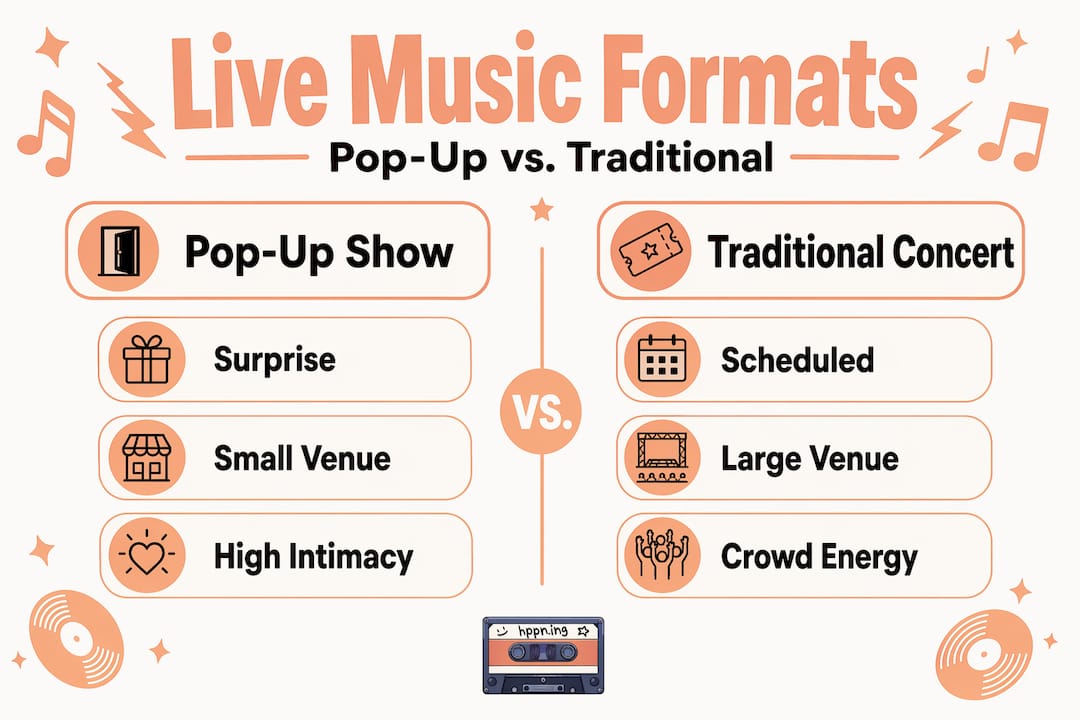
| Format | Scale | Advance Notice | Cost to Attend | Intimacy Level |
|---|---|---|---|---|
| Surprise pop-up | 50 to 400 people | Hours or none | Free to low | Very high |
| Scheduled pop-up series | 100 to 500 people | Days | Free to low | High |
| Traditional concert | Hundreds to thousands | Weeks to months | Medium to high | Low |
| Music festival | Thousands | Months | High | Very low |
| Digital livestream | Unlimited | Varies | Free to low | None |
Pop-ups occupy a space that no other format can fill. Festivals offer range but sacrifice depth. Traditional concerts offer polish but sacrifice proximity. Livestreams offer access but eliminate the physical energy that makes live music actually live. The pop-up format thrives on authenticity and intimacy that traditional tours cannot replicate at scale.
A few trends shaping where pop-ups are heading:
- More artists are using micro-popup formats of 20 to 200 attendees specifically as brand-building tools during album cycles.
- Fan-operated discovery platforms are making it easier to track these shows in real time through tools like live music aggregators.
- Urban pop-up music festivals are emerging, where multiple artists perform across different locations in a neighborhood on the same day, creating a scavenger-hunt-style experience.
My honest take on pop-up culture
I've seen what happens when a pop-up lands right, and I've seen what happens when it doesn't. The difference almost always comes down to one thing: whether the artist actually wants to be there or is just checking a marketing box.
The best pop-ups I've encountered have an undeniable energy that no ticketed arena show can manufacture. You walk into a room where no one fully expected to be standing an hour ago, and you watch someone play music like the only thing that matters is the next note. That experience does something to you. It makes the music feel urgent again in a way that three-year stadium tour cycles rarely do.
What I've learned after spending time deep in local music scenes is that fans underestimate how much work goes into a successful pop-up. Organizers absorb real risk, from the permit gray zones to the possibility of zero attendance if the announcement doesn't spread fast enough. The artists who do this well treat it as a gift to their most dedicated listeners, not a publicity stunt. The ones who treat it as a stunt get found out immediately.
My advice for anyone who wants to experience their first pop-up: follow your city's local music community pages, not just the artists you already know. The most memorable pop-ups I've attended weren't from artists I was already tracking. They were from people I'd never heard of, playing 40 minutes in a space that holds 80, making me feel like I'd stumbled into something I had no right to witness.
That feeling is worth chasing.
— Ari
Find your next pop-up show with Hppn
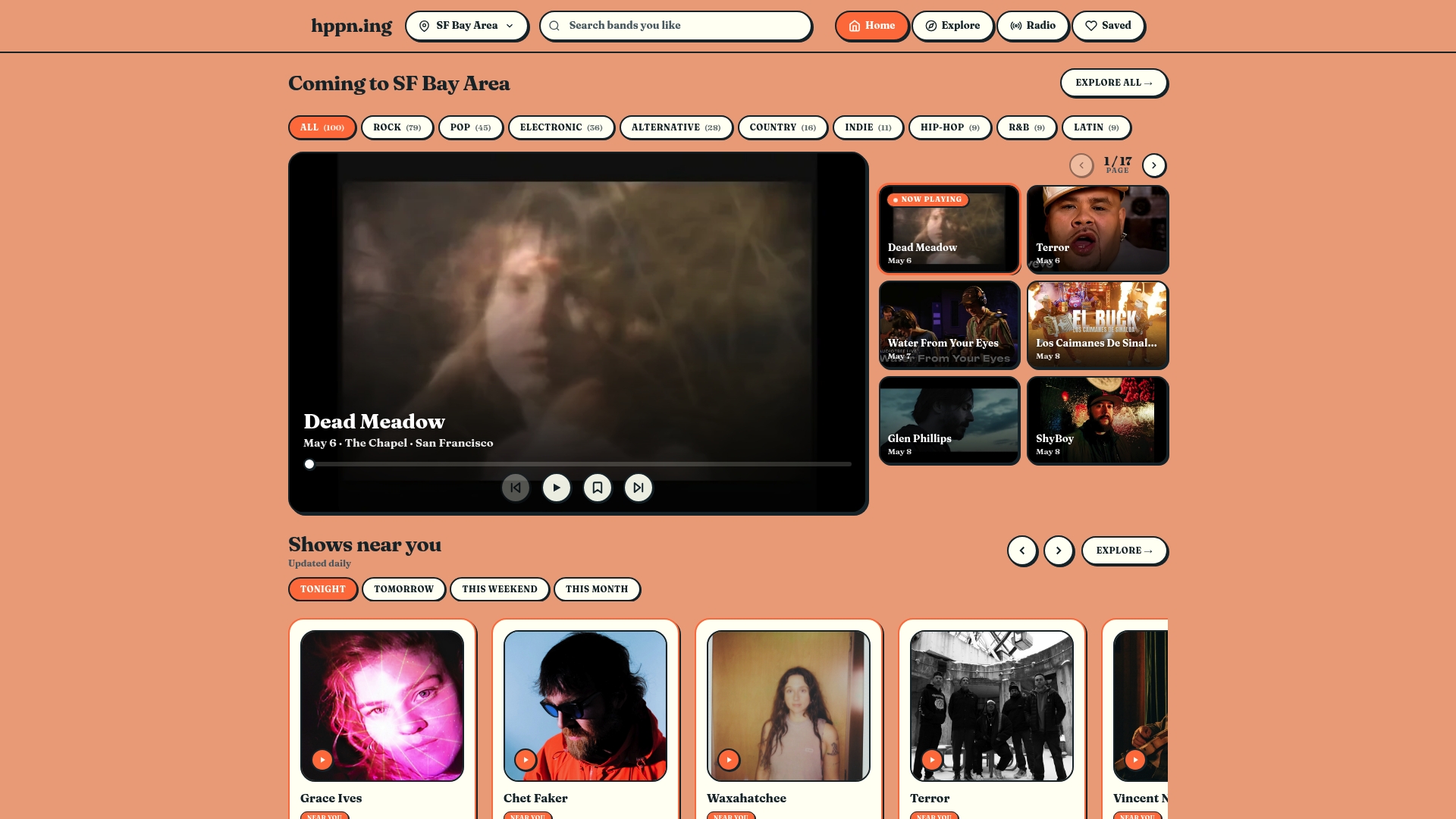
Hppn is built exactly for this kind of discovery. The platform lets you find live music nearby, preview artists through video and audio before you commit to showing up, and stay connected to the local scenes where pop-ups actually happen. You're not sorting through stadium tours and festival lineups to find what's real and close to you. Hppn surfaces the emerging artists, the underground shows, and the local performances that don't get algorithmic push anywhere else. Whether you're trying to catch a surprise set or plan ahead for a scheduled series, staying plugged into live music conversations through the platform keeps you a step ahead of the crowd.
FAQ
What is a pop-up live music event?
A pop-up live music event is a short-notice or surprise performance in a non-traditional venue, designed around intimacy, scarcity, and an element of surprise that standard concerts don't offer.
How do pop-up concerts differ from regular shows?
Pop-up concerts use unconventional venues, offer little advance notice, and cap attendance tightly, creating a raw, close-up experience that large-venue tours cannot replicate.
How do I find out about pop-up shows near me?
Following artists on social media, joining fan group chats, and using live music discovery platforms like Hppn are the most reliable ways to catch pop-up announcements before they fill up.
Are pop-up concerts free to attend?
Some are free, especially scheduled public series, while others charge a small door fee. Pricing varies widely, and many sell out within minutes of announcement due to limited capacity.
Can anyone organize a pop-up music show?
Yes, but organizers need to address permits, noise ordinances, and performance rights before the event date, particularly when using outdoor or non-licensed venues.