
Streaming live concerts from home gives music fans real-time access to world-class performances without buying a ticket, booking travel, or standing in a crowd. Platforms like Amazon Music, Twitch, Prime Video, Beyond LIVE, and Carnegie Hall+ now cover everything from massive outdoor festivals to intimate classical recitals. Whether you want to watch live concerts online during a festival weekend or catch a single artist's set on a Tuesday night, the options in 2026 are broader, better quality, and more interactive than ever before.
What platforms are best for streaming live concerts from home?
The strongest free option for festival fans right now is the Amazon Music and Twitch combination. Stagecoach 2026 streamed 118 performances across Amazon Music, Prime Video, and Twitch at no cost, with two simultaneous channels letting viewers toggle between stages across three days. That dual-feed format is a genuine upgrade over traditional broadcasts. You are no longer locked into a single camera angle or a programmer's playlist. You choose what you watch, when you watch it.
Primavera Sound 2026 took the same approach, streaming nearly 40 performances live and free on Twitch and Prime Video, with sets from The Cure, Gorillaz, and Doja Cat. Austin City Limits offers free studio tapings via YouTube, including S.G. Goodman's 2026 performance, available live at 9 p.m. ET with no subscription required. These public media streams are among the most reliable and highest-quality free options available.
For classical and opera fans, Carnegie Hall+ charges $7.99 per month for on-demand and live access to its full catalog. The Berlin Philharmonic and Gothenburg Symphony both offer free monthly streams, with Gothenburg streaming 7 to 8 concerts each month at no cost. These are not low-budget productions. They are full-orchestra performances with professional broadcast crews.
| Platform | Cost | Concert types | Key feature |
|---|---|---|---|
| Amazon Music / Twitch | Free | Festivals, pop, country | Dual-channel stage toggle |
| Prime Video | Free with Prime | Festivals, special events | Multi-feed viewing |
| Beyond LIVE | Paid per event | K-pop, pop, global artists | Fan cams, live chat |
| Carnegie Hall+ | $7.99/month | Classical, chamber music | On-demand archive |
| YouTube / ACL TV | Free | Americana, indie, PBS | No account required |
| Gothenburg Symphony | Free | Classical, orchestral | 7 to 8 streams monthly |
Pro Tip: Open two browser tabs or devices when a festival offers dual-channel streaming. You can monitor both stages simultaneously and switch the main screen to whichever set is most compelling at any moment.
How to set up your home for the best concert streaming experience
Your hardware matters more than most guides admit. A 4K smart TV with a native app installed delivers a noticeably sharper and more stable picture than casting from a phone or laptop. Using native apps rather than screen mirroring reduces dropout risk significantly, because mirroring adds a wireless relay step that introduces lag and disconnection points. If your TV supports the platform's app directly, always use it.
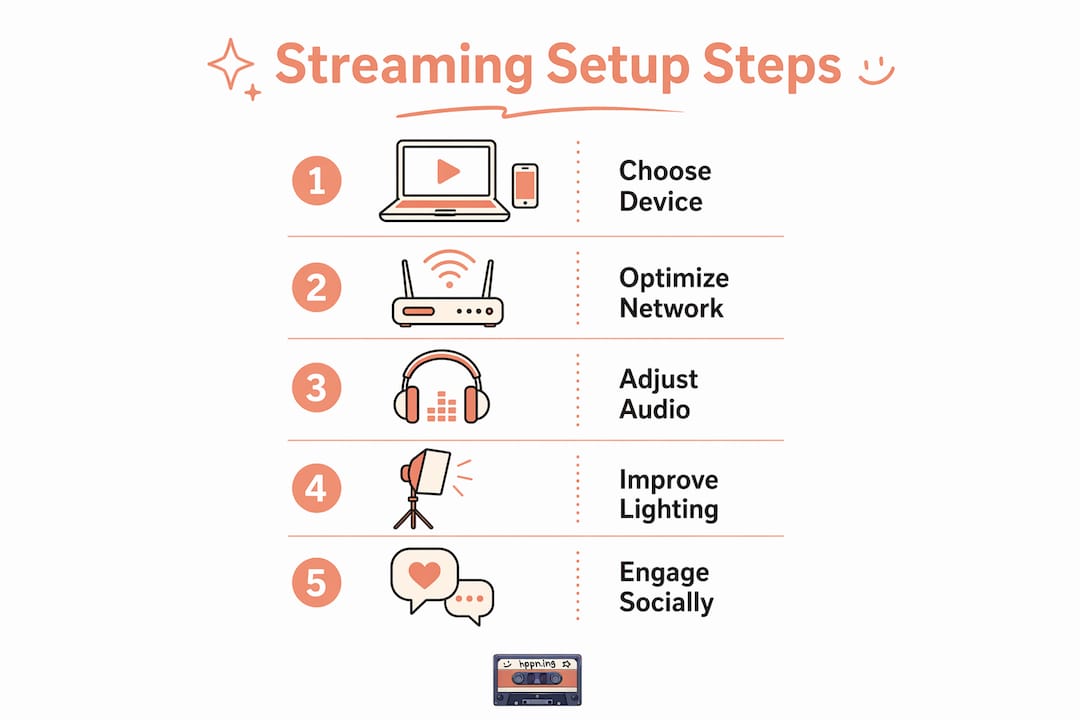
Internet speed is the other variable most people underestimate. A stable 25 Mbps connection handles HD streaming comfortably. For 4K with multi-feed options, 50 Mbps or higher is the practical floor. A wired Ethernet connection to your TV or streaming stick eliminates the interference that kills Wi-Fi streams at the worst moments, like a guitar solo or a key vocal.
For audio, even a basic soundbar transforms the experience compared to built-in TV speakers. Bluetooth headphones work well for late-night listening without disturbing others. If you have a stereo receiver and bookshelf speakers, connecting your TV via optical or HDMI ARC gives you the closest approximation to a real venue sound.
- Use the platform's native app on your smart TV, not a cast or mirror from your phone
- Connect via Ethernet when possible, especially for high-stakes streams like festival headliners
- Close background apps on shared Wi-Fi networks before the stream starts
- Set your TV's picture mode to "Cinema" or "Movie" rather than "Vivid" for more accurate color
- Test your setup 15 minutes before the stream begins, not during the opening song
Pro Tip: Many smart TVs have a "Game Mode" that reduces input lag. For live streams where you want to interact with real-time chat features, enabling Game Mode can make the experience feel more synchronized.
Where to find upcoming live concerts and virtual events to stream
The most reliable source for any major festival stream is the official artist or festival channel on YouTube, Twitch, or Amazon Music. Stagecoach, Primavera Sound, Coachella, and Glastonbury all announce their livestream schedules weeks in advance through official social media and email newsletters. Subscribing to those channels directly is the most dependable way to avoid missing announcements.
Beyond the big festivals, several discovery methods work well for finding smaller or niche streams:
- Follow your favorite artists on Twitch and YouTube. Many independent musicians stream live sets directly from their home studios with no intermediary platform.
- Check Reddit communities like r/listentothis and r/indieheads, where members regularly post upcoming free streams and virtual events.
- Use Hppn to browse local and virtual concerts by location and genre, including previews of artists you have not heard before.
- Monitor the official pages of venues like the Kennedy Center, the Hollywood Bowl, and the Sydney Opera House, all of which stream select performances free.
- Sign up for newsletters from platforms like Carnegie Hall+ and Beyond LIVE, which send advance notice of ticketed virtual events.
For classical and opera specifically, Playbill maintains a regularly updated guide to free and subscription streams across platforms. The public spaces in live music model, where institutions broadcast performances as a public good, is expanding. More orchestras and opera companies added free digital access in 2025 and 2026 than in any prior period.
Community watch parties add another layer to home concert streaming. Discord servers, Reddit live threads, and group video calls through platforms like Teleparty let fans react together in real time. The shared experience closes some of the gap between watching alone at home and standing in a crowd.
What makes virtual concert experiences worth the watch?
The best live music streaming services have moved well past passive viewing. Beyond LIVE offers real-time fan-to-artist chat, virtual stickers, and multi-angle fan cam views that let you choose your own perspective during a performance. That is a capability that does not exist at a physical concert. You cannot stand at the front and the side simultaneously. Online, you can.
Multi-angle viewing is the feature that most changes the experience for serious fans. Festival dual-channel broadcasts let viewers switch stages instantly, unlike traditional fixed-angle streams. Some platforms add exclusive backstage content, merchandise links timed to specific songs, and fan polls that influence setlist choices. These are not gimmicks. They represent a genuinely different relationship between artist and audience.
At the other end of the spectrum, intimate formats offer something the big platforms cannot replicate. Independent curators and artists run house concerts and private listening rooms as alternative live experiences with more personal connection than large digital streams. Rio Rancho House Concerts in New Mexico is one documented example of this model, where a small community gathers physically or virtually around a single performer. The scale is tiny. The connection is not.
"The most memorable virtual concerts I have attended were not the ones with the biggest production budgets. They were the ones where the artist acknowledged the chat, changed a song because someone asked, or simply talked between tracks like they were in your living room."
Explore the full range of unique live music formats available in 2026, from festival streams to subscription listening rooms, to find what fits your taste.
Common problems when streaming concerts and how to fix them
Buffering and dropout are the two complaints that appear most often in streaming communities. Both are almost always connectivity problems, not platform problems. A wired connection solves the majority of dropout issues. When wired is not possible, positioning your router closer to your viewing device and switching to a 5 GHz Wi-Fi band reduces interference from neighboring networks.
Regional restrictions block certain streams in specific countries. The legal workaround is a reputable VPN service like NordVPN or ExpressVPN, which routes your connection through a server in an eligible country. This is especially relevant for BBC Proms streams, which are geo-restricted to UK viewers, and for certain K-pop events on Beyond LIVE that limit access by region.
Unlicensed streams are a real problem. Low-quality re-streams on obscure sites often carry malware risks alongside poor video quality. The rule is simple: if the stream is not on an official artist, venue, or platform channel, it is not worth the risk. Official festival streams frequently offer replays and extended access windows after the live event, so missing the live window does not mean missing the performance entirely.
Pro Tip: Before any major stream, check the official festival or artist social accounts for the confirmed stream link. Fake streams with identical thumbnails appear on YouTube within minutes of a major event going live. The real one will always be on the verified channel.
Key takeaways
The most effective way to stream live concerts from home in 2026 combines free festival platforms like Amazon Music and Twitch with niche subscription services like Carnegie Hall+ and Beyond LIVE, matched to your specific music interests.
| Point | Details |
|---|---|
| Free festival streams are high quality | Amazon Music, Twitch, and Prime Video broadcast major festivals like Stagecoach and Primavera Sound at no cost. |
| Native apps outperform casting | Using a platform's native TV app reduces buffering and dropout compared to screen mirroring. |
| Niche platforms serve classical fans | Carnegie Hall+ at $7.99/month and Gothenburg Symphony's free monthly streams cover orchestral and opera content. |
| Interactive features change the experience | Beyond LIVE's fan cams and live chat turn passive viewing into active participation. |
| Discovery requires multiple sources | Combine official artist channels, Hppn, and community forums to track upcoming virtual events. |
Why streaming concerts changed how I listen to live music
I used to think streaming a concert was a consolation prize. You watch because you could not be there. That framing is wrong, and I changed my mind after the Stagecoach dual-feed broadcast. Toggling between two stages, catching an artist I had never heard of on the secondary channel, then switching back for a headliner I already knew, that is not a lesser version of attending. It is a different experience with its own advantages.
The global access argument matters too. Primavera Sound in Barcelona is not accessible to most people on the planet, for financial or geographic reasons. Streaming it free on Twitch does not replace being there, but it does mean the music reaches people it would never otherwise reach. That is worth something real.
Where I draw the line is on replacing intimate formats with digital ones. House concerts and private listening rooms exist in a category that streaming cannot touch. The physical presence of a performer in a small room, the eye contact, the silence between songs, those are irreplaceable. The free local music events model and the digital stream model are not competitors. They serve different needs, and the smartest music fans use both.
My recommendation: start with one free festival stream this year. Pick an artist you already love, set up your TV properly, and treat it like an event rather than background noise. The experience will shift your expectations for what home concert streaming can actually be.
— Ari
Discover live music and concerts with Hppn
Hppn is built for music fans who want more than an algorithm-generated playlist. The platform lets you browse upcoming concerts by location, preview artists through video and audio before committing to a show, and track both local and virtual live music events in one place.
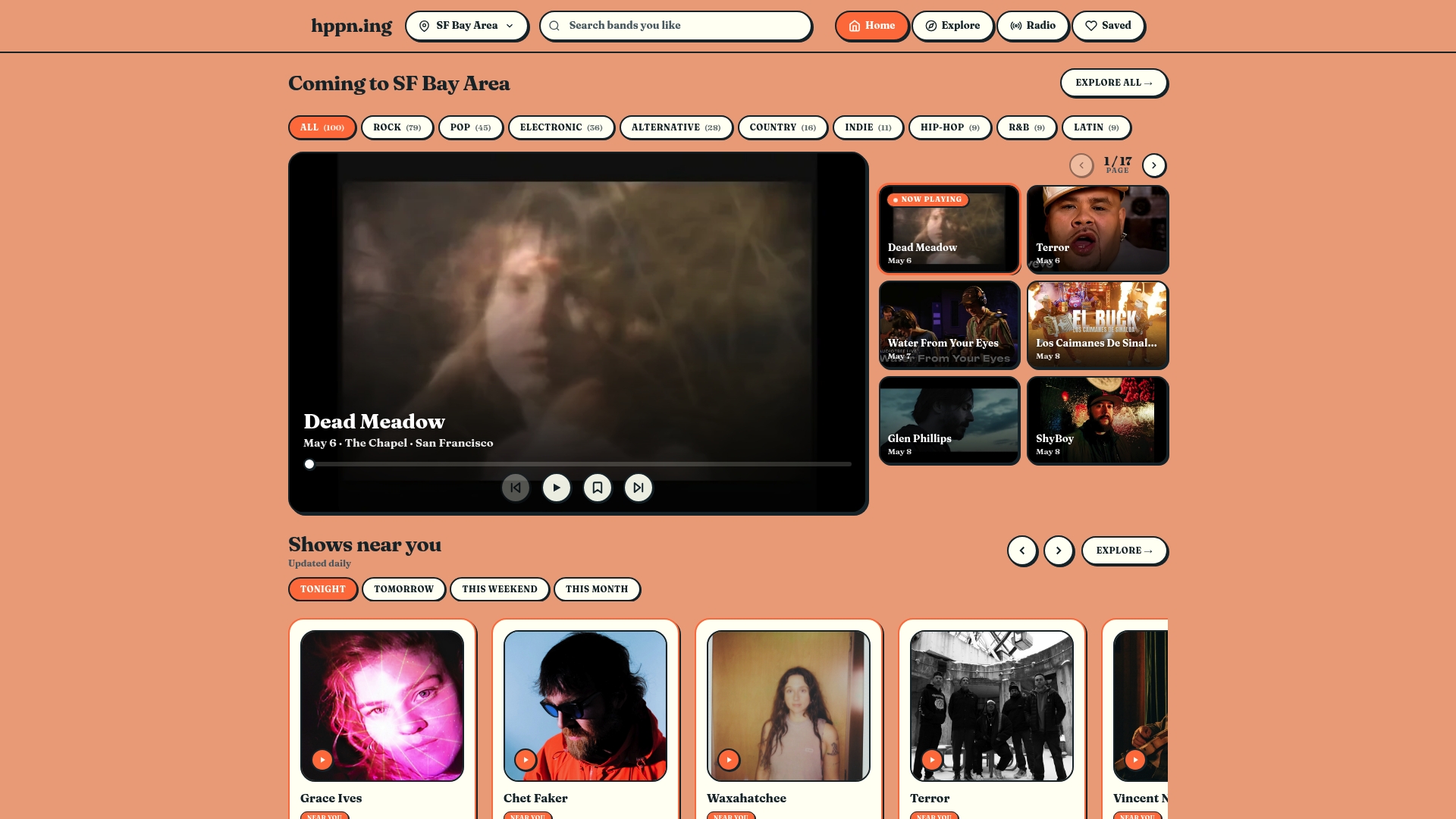
Whether you are looking for a major festival stream, a local underground show, or an emerging artist worth following, Hppn surfaces the kind of live music that mainstream platforms miss. The community features let you connect with other fans around specific events, making the discovery process social rather than solitary. Start exploring live music near you and find your next concert to stream or attend in person.
FAQ
What is the best free platform to watch live concerts online?
Amazon Music, Twitch, and Prime Video are the strongest free options in 2026, broadcasting major festivals like Stagecoach and Primavera Sound at no cost with multi-channel viewing.
How much does home concert streaming cost on subscription platforms?
Carnegie Hall+ costs $7.99 per month for classical and chamber music. Beyond LIVE charges per event for pop and K-pop concerts. Gothenburg Symphony and Austin City Limits offer free streams with no subscription required.
How do I avoid buffering when streaming live concerts?
Connect your device via Ethernet rather than Wi-Fi, use the platform's native app instead of screen mirroring, and close background apps on your network before the stream begins.
Can I watch concerts I missed after the live window closes?
Many platforms including Beyond LIVE offer replays after live events, though availability varies by artist agreement. Official festival channels on YouTube often archive full sets within 24 to 48 hours.
Where can I find upcoming virtual concerts to stream from home?
Follow official artist and festival channels on Twitch and YouTube, use Hppn to browse events by location and genre, and monitor platforms like Carnegie Hall+ and Beyond LIVE for ticketed virtual event announcements.